Solving roots of quadratics (factorising, CTS, quadratic formula) + discriminant: notes and practice questions
- Factorising: Write as .
- Completing the square (CTS): Rewrite as .
- Quadratic formula: .
- Discriminant ():
- : Two distinct roots.
- : One repeated root.
- : No real roots.
How it is examined
The discriminant question with a parameter is the standard version, and it ends in an inequality that has to be solved and stated correctly. At SL "no real roots" means exactly that, not "two complex roots", because complex numbers are HL. `Find`, `Show that`, `Determine`. 5 to 7 marks.
Both the quadratic formula and the discriminant are given.
- Solution of quadratic equations and inequalities.
- The quadratic formula.
- The discriminant and the nature of the roots, that is, two distinct real roots, two equal real roots, no real roots.
Complex roots arrive at AHL 1.14; inequalities are generalised at AHL 2.15.
Linking questions
- Links to other subjects: projectile motion and energy changes in simple harmonic motion (physics); equilibrium equations (chemistry).
Practice questions
94 questions · 2 easy · 69 medium · 23 hardQuestion 1
EasyPaper 1 · no calculator5 marksConsider the functions and , where is a non-zero real constant.
(a) Write down an expression for .
(b) Given that , find the possible values of .
To find the composite function , you need to substitute the expression for into the function wherever you see .
Substitute into your expression for from part (a). Set this equal to 5 and solve the resulting equation for .
Question 2
MediumPaper 1 · no calculator5 marksIf the equation is said to have exactly one real solution, find the value of .
If an equation looks like a quadratic one, it can be recognized sometimes by a variable different than just .
Question 3
HardPaper 1 · no calculator15 marksConsider the series , where and .
Consider the case where the series is geometric.
(a) (i) Show that .
(a) (ii) Given that and the sum to infinity is , find the value of .
Now consider the case where the series is arithmetic with common difference .
(b) (i) Show that .
(b) (ii) Write down in the form , where .
(b) (iii) The sum of the first terms of the series is .
Find the value of .
For a sequence to be geometric, the ratio of any term to its preceding term must be constant. Set up an equation by equating the ratio of the second term to the first term, and the third term to the second term.
Use the formula for the sum to infinity of a geometric series, . You can determine and from the question.
For a sequence to be arithmetic, the difference between consecutive terms is constant. Set up an equation by equating the difference between the second and first terms, and the third and second terms.
The common difference 'd' is the second term minus the first term. Use the value of k you just found.
Use the formula for the sum of an arithmetic series, . Substitute the given sum and the values for and . This will lead to a quadratic equation in terms of .
Question 4
EasyPaper 2 · calculator4 marksConsider a function which has a first derivative given by , where .
Find the range of values of for which is increasing.
A function is increasing when its first derivative is positive. Try setting and solving for .
Question 5
MediumPaper 1 · no calculator8 marksConsider the function .
The graph of passes through the point and has an oblique asymptote with equation .
(a) Write down the equation of the vertical asymptote.
(b) Find the value of:
(i)
(ii)
(c) Hence, find the exact coordinates of any points where the graph of intersects the x-axis.
A vertical asymptote occurs where the function is undefined. This happens when the denominator of the rational function is equal to zero.
The equation of the oblique asymptote is the quotient when the numerator is divided by the denominator. Perform polynomial long division or consider the limit of as approaches infinity.
You know that the point (1, -2) lies on the graph of the function. Substitute these x and y values, along with the value of 'a' you just found, into the equation for g(x).
The x-intercepts occur when y=0. Set the function g(x) equal to zero and solve for x. Remember that a fraction is zero only when its numerator is zero.
Question 6
HardPaper 1 · no calculator19 marksLet for .
(a) Show that .
(b) Use mathematical induction to prove that for .
Let , where is a real constant.
Consider the function defined by for .
It is given that the coefficient of the term in the Maclaurin series for is .
(c) Find the possible values of .
Rewrite the function as and apply the chain rule twice.
Start by showing the formula holds for the base case, n=2, using your result from part (a). Then, assume the formula is true for n=k, and differentiate this expression to find the (k+1)th derivative. Finally, manipulate your result to show it matches the given formula for n=k+1.
You can solve this in two ways. Either find the first few terms of the Maclaurin series for f(x) and g(x) and then multiply them to find the x^2 term of h(x). Or, you can use the formula for the Maclaurin series coefficient, which involves finding the second derivative of h(x) at x=0.
Question 7
MediumPaper 2 · calculator6 marksEvents S and C are independent. The probability that a student passes a Statistics exam, P(S), is twice the probability that the student passes a Calculus exam, P(C).
Given that the probability a student passes at least one of these exams is 0.625, find the probability that the student passes the Calculus exam, P(C).
Recall the formula for the probability of the union of two events, , and the specific condition for independent events. Remember that probability values must be between 0 and 1.
Question 8
HardPaper 1 · no calculator19 marksTwo spacecraft, S1 and S2, travel along straight paths, represented by the lines and respectively. The paths of the spacecraft intersect at a docking station D. A probe is located at a point P on the path of . This is shown in the following diagram.
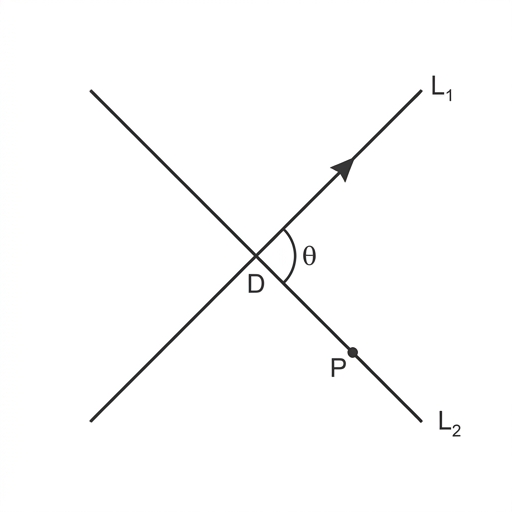
The direction vector of is . The vector is given by , where .
The acute angle between the paths and is , where .
(a) Show that .
(b) Find the value of .
(c) Hence, find the shortest distance from the probe at P to the path .
The paths and lie on a plane, .
(d) Find a vector normal to the plane .
A satellite dish is modelled as a right circular cone with its vertex at V. The base of the cone lies in the plane and is centred at P. The path is tangent to the circular base of the cone. The volume of the cone is cubic units. The position vector of P is .
(e) Find the two possible position vectors for V.
Use the scalar product formula for the angle between two vectors, .
Square both sides of the equation from part (a) to eliminate the square root, then solve the resulting quadratic equation.
The shortest distance from a point P to a line L1 can be found using trigonometry. Consider the right-angled triangle formed by P, D, and the point on L1 closest to P. The distance is given by . Alternatively, use the vector product formula for the distance.
A normal vector to a plane containing two lines can be found by taking the vector product of their direction vectors.
The radius of the cone's base is the shortest distance from P to L1. Use the volume formula to find the cone's height, . The vertex V is located at a distance from the centre P, along the direction of the normal vector to the plane. Remember there are two possible directions along the normal.
Question 9
MediumPaper 1 · no calculator7 marks(a) Show that , for .
(b) Hence or otherwise, solve the equation for , .
To show that the two expressions are equal, you can either start with the left-hand side and combine the terms into a single fraction, or start with the right-hand side and perform algebraic long division.
Notice the structure of the equation in this part is the same as the expression in part (a). Let and use the result from part (a) to form a simpler equation. This will lead to a quadratic equation in terms of .
Question 10
HardPaper 1 · no calculator6 marksFind the set of values for the constant such that the equation has at least one real solution for .
Let . What is the possible range of values for ? The equation becomes a quadratic in . For the original equation to have a solution, this quadratic equation must have at least one root within the valid range for .
Question 11
MediumPaper 1 · no calculator7 marksThe graphs of the functions and intersect at two distinct points.
(a) Find the set of possible values for .
(b) Consider the case when . The x-coordinates of the intersection points can be written in the form , where . Find the values of and .
The number of intersection points between two graphs is related to the number of solutions to the equation . What does 'two distinct points' tell you about the discriminant of the resulting quadratic equation? Don't forget to consider any special cases for the parameter .
Substitute the given value of into the equation you found in part (a). Then, use the quadratic formula to find the roots and compare them to the given form.
Question 12
HardPaper 1 · no calculator14 marksA rectangle is inscribed in an ellipse with equation . The sides of the rectangle are parallel to the coordinate axes. The vertices of the rectangle are located at , where and .
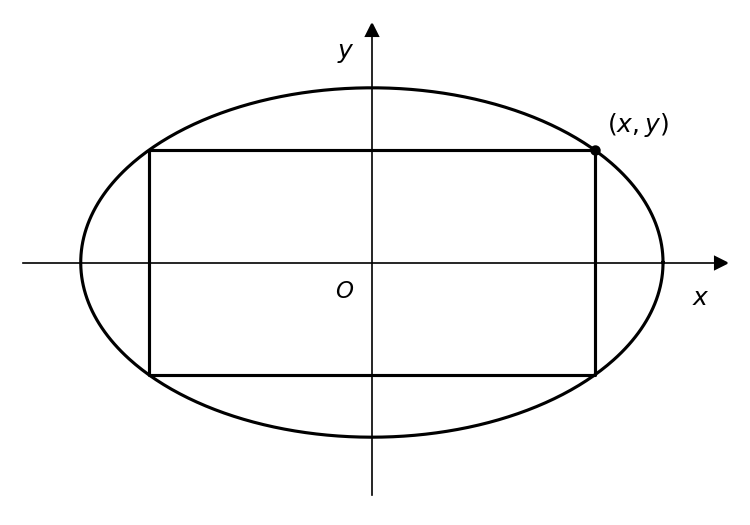
(a) Show that the area of the rectangle, , can be expressed as .
(b) Show that .
(c) Hence, find the exact dimensions of the rectangle with the maximum possible area.
The area of the rectangle is given by its width times its height. Express the width and height in terms of and . Then, use the equation of the ellipse to express in terms of and substitute this into your area formula.
You will need to use the product rule, , and the chain rule to differentiate the expression for the area with respect to .
To find the maximum area, you need to find the value of for which the derivative of the area is zero. Set the expression for from part (b) equal to zero and solve for . Then use this value of to find the corresponding value of and the dimensions of the rectangle.
Question 13
MediumPaper 1 · no calculator7 marksA solid is formed by rotating the curve with equation for by about the -axis. This forms a solid paraboloid.
A cylindrical hole of radius is drilled through the center of the paraboloid, along the -axis. The resulting solid is a ring of height .
This information is shown in the following diagrams.
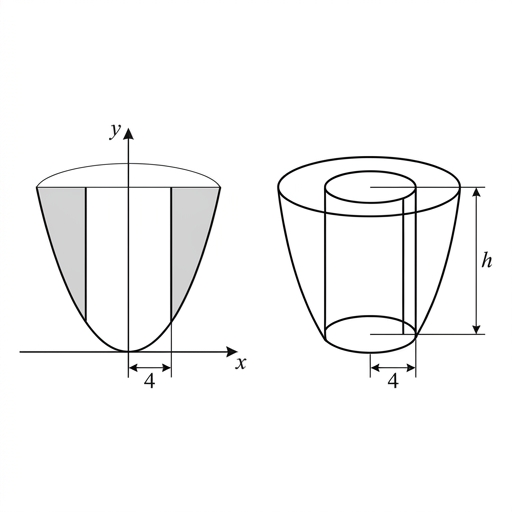
The volume of the ring is .
Find the value of .
The volume of the ring can be found by integrating the difference in the areas of two circles (a 'washer') along the height of the ring. First, determine the limits of integration by considering where the inner wall of the ring (the cylinder) intersects the outer wall (the paraboloid).
Question 14
HardPaper 1 · no calculator17 marksFind the binomial expansion of . Give your answer in the form where and are expressed in terms of and .
By using De Moivre's theorem and your answer to part (a), show that .
Hence, show that and are solutions of the equation .
Hence, find the exact value of .
Recall the binomial theorem . Remember to simplify the powers of : .
Use De Moivre's theorem to find another expression for . Then, equate the real parts of this expression and your answer from part (a). You will need to use the identity .
Consider the equation . What are the principal values of that satisfy this? How does this relate to the identity you proved in part (b)?
The equation from part (b) is a polynomial in terms of . Can you make a substitution, like , to turn it into a quadratic equation? Then you can find the roots of this quadratic and relate them to the specific values of from part (c)(i).
Question 15
MediumPaper 1 · no calculator13 marksThe functions and are defined by
, where
, where .
The graphs of and intersect at two distinct points.
(a) State the equation of the vertical asymptote to the graph of .
(b) (i) Show that, at the points of intersection, .
(b) (ii) Hence show that .
(b) (iii) Find the range of possible values of .
The graphs intersect at and , where .
(c) In the case where , find the value of . Express your answer in the form , where .
The vertical asymptote of a logarithmic function occurs where the argument is equal to zero.
Set and use the properties of logarithms to simplify the equation. Remember the power rule: .
The condition 'two distinct points of intersection' means the quadratic equation from part (b.i) must have two distinct real roots. What does this imply about the discriminant?
Solve the quadratic inequality found in part (b.ii). Remember to consider the given domain for .
Substitute into the quadratic equation from part (b.i). Solve this equation to find the values of and . Then calculate their difference.
Question 16
HardPaper 1 · no calculator15 marksA drone takes off from a platform. Its height, metres, above the platform after seconds is given by , for . This is shown in the following diagram.
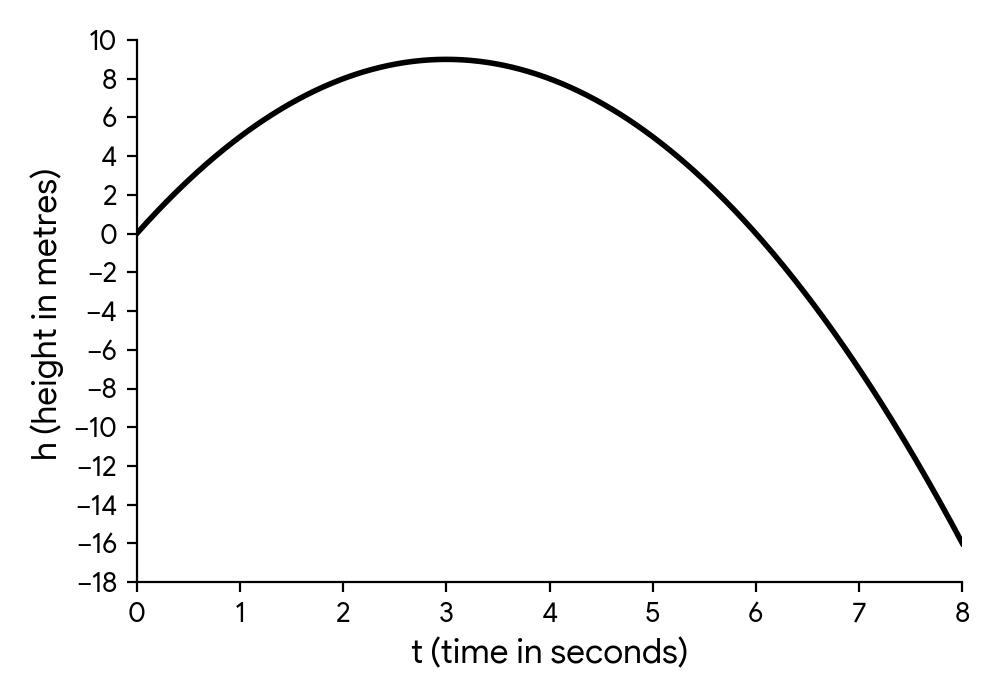
The drone lands back on the platform when .
Find the value of .
The drone reaches its maximum height when .
Find the value of .
Find the drone's maximum height above the platform.
Find the drone's vertical distance from the platform when .
The total vertical distance travelled by the drone in the first 8 seconds is given by .
Find the value of .
A second drone, Drone B, takes off from the same platform. Its velocity is given by , for .
When , the total vertical distance travelled by Drone B is equal to .
Find the value of .
The drone is on the platform when its height is zero. Set the height function equal to zero and solve for time .
The maximum height is reached when the drone's vertical velocity is zero. Find the derivative of the height function, which represents velocity, and set it to zero.
You found the time to reach maximum height in the previous part. Substitute this time back into the original height function.
Substitute into the height function. Remember that distance must be a positive value.
Total distance is not the same as displacement. The drone goes up and then comes down. You need to calculate the distance travelled on the way up and the distance travelled on the way down separately and add them together. The turning point you found in part (b) is crucial here.
First, find the total distance travelled by Drone B as a function of time . This will involve an integral of the absolute value of its velocity. You'll need to find when Drone B changes direction. Then, set this total distance equal to the value of you found in part (d) and solve for .
Question 17
MediumPaper 1 · no calculator15 marksConsider the function defined by .
Find the -intercepts of the graph of .
The graph of for is shown below. The graph encloses two regions with the -axis, shaded in the diagram.
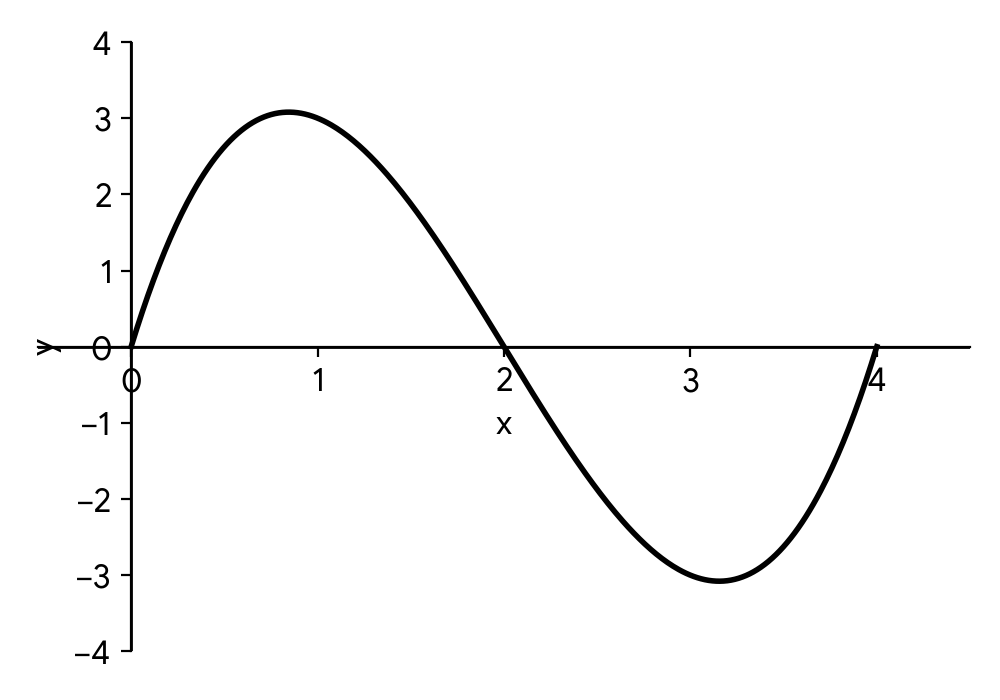
Find the total area of the shaded regions.
The total surface area of a closed right cylinder is 8, equal to the total shaded area found in part (b). The cylinder has a height of .
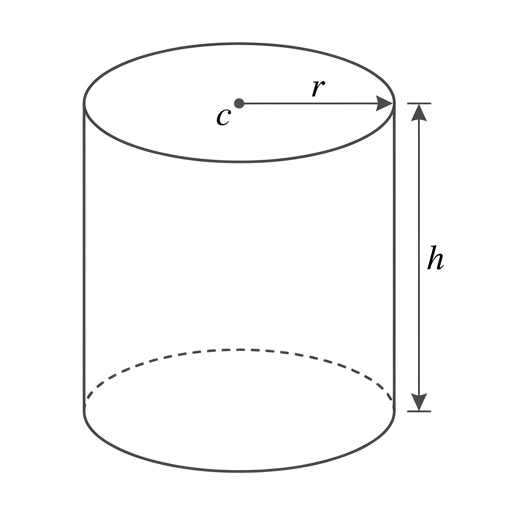
Find the radius, , of the cylinder.
Hence, find the volume of the cylinder.
To find the x-intercepts, you need to solve the equation . Look for a common factor first, then factorize the remaining quadratic.
The total area is the sum of two separate definite integrals. Remember that area must be positive, so you may need to take the absolute value of one of the integrals.
The formula for the total surface area of a closed cylinder is . Set this equal to the area you found, substitute the given height, and solve the resulting quadratic equation for .
The formula for the volume of a cylinder is . Use the values of and you now have.
Question 18
HardPaper 1 · no calculator9 marksA function is defined by , where .
The graph of is shown below.
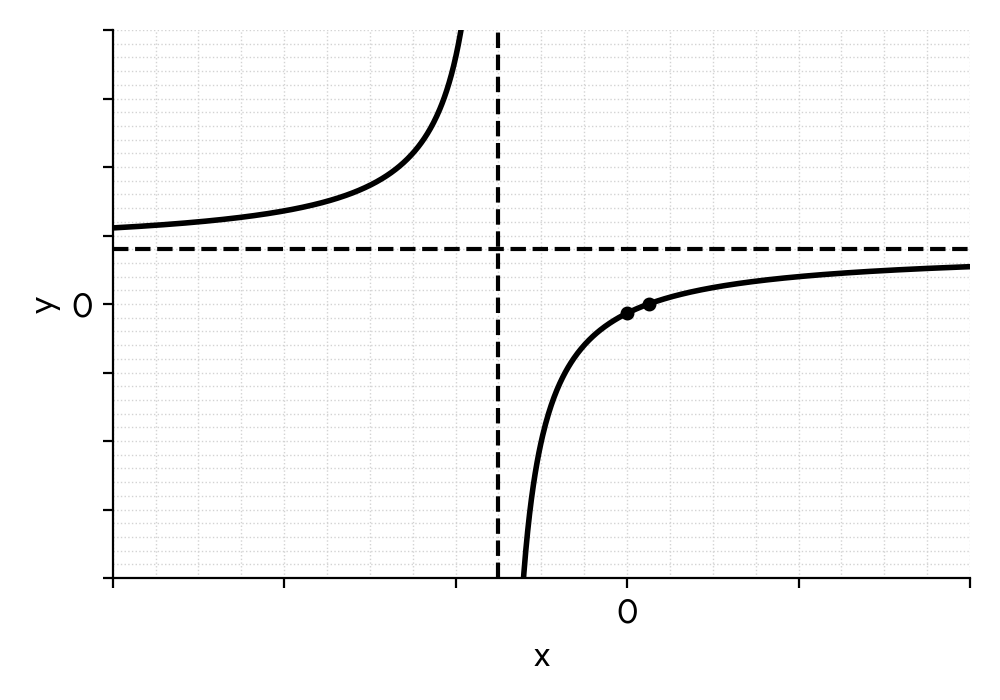
(a) Write down the equation of the horizontal asymptote.
Consider the function , where .
(i) Write down the number of solutions to for .
(ii) Determine the value of such that has only one solution for .
(iii) Determine the range of values for for which has two distinct solutions for .
The horizontal asymptote is determined by the behavior of the function as approaches . For a rational function where the degree of the numerator and denominator are the same, the asymptote is the ratio of the leading coefficients.
The line passes through the y-intercept of . Sketch a line with a negative slope passing through this point on the given graph. How many times does it intersect the curve ?
A single solution occurs when the line is tangent to the curve . Since the line always passes through the y-intercept of the curve, the point of tangency must be the y-intercept. Therefore, the slope of the line, , must be equal to the gradient of the curve at that point. Alternatively, you can set up the equation , rearrange it into a quadratic, and use the discriminant or analyze the roots.
From the previous part, you found the two solutions for in terms of . One solution is always . For there to be two distinct solutions for , what condition must the other solution satisfy?
Question 19
MediumPaper 1 · no calculator8 marksThe functions and are defined by and , for .
The curves and intersect at a point P whose x-coordinate is .
Show that .
Hence, show that the tangent to the curve at P and the tangent to the curve at P are perpendicular.
Find the value of . Give your answer in the form , where and .
At the point of intersection, the y-values of the two functions are equal. Use a trigonometric identity for .
Find the derivatives of both functions. To show that two lines are perpendicular, what must be true about the product of their gradients?
Use the result from part (a) and the Pythagorean identity to form a quadratic equation in terms of .
Question 20
HardPaper 1 · no calculator7 marksA project manager has employees available for a new project. The employees are to be divided into two teams, Team Alpha and Team Beta. For the project to be successful, Team Alpha must have exactly four members and Team Beta must have at least four members.
The manager will randomly assign four employees to Team Alpha, with the rest forming Team Beta.
Write down an expression for the number of ways that the teams could be formed.
Two of the employees, Chloe and David, have a history of conflict and cannot be in the same team. The manager agrees to this condition, and finds that this restriction reduces the number of possible team formations to two-fifths of the original number.
Determine the value of .
How many ways can you choose a group of a specific size from a larger group, where the order of selection does not matter?
First, find an expression for the number of ways to form the teams such that Chloe and David are in different teams. Then, set this expression equal to the new total number of formations and solve for n.
No question on this page matches those filters. Try another difficulty or paper.
74 more Solving roots of quadratics (factorising, CTS, quadratic formula) + discriminant questions in the app
Every answer is marked mark by mark, IB-style, and the AI tutor helps when you are stuck.
Where marks are lost
- Using your own wrong value after failing a "show that".