Derivatives & integrals of special HL functions (inv / reciprocal trig, log and power): notes and practice questions
- Derivatives: Includes standard forms for exponential functions (), logarithmic functions (), reciprocal trigonometric functions (), and inverse trigonometric functions (). Chain rule applications are essential for composite functions.
- Integrals: Covers integrals of exponential and logarithmic forms, including those with linear arguments. A key pattern is recognizing when the numerator is the derivative of the denominator for logarithmic results.
- Trigonometric Integrals: Includes standard trigonometric integrals and forms that result in inverse trigonometric functions, particularly for arcsin and arctan when denominators involve square roots or sums of squares.
- Integration by Parts: A technique for integrating products of functions, using the formula , with a strategy for choosing u and dv/dx.
How it is examined
Recognising which standard form an integral matches is the skill, and completing the square to get there () is the standard step. Paper 1. 4 to 7 marks.
The full HL derivative and integral tables are given, including the and integral forms and .
- Derivatives of , , , , , , , , .
- Indefinite integrals of the derivatives of any of the above functions.
- The composites of any of these with a linear function.
- Use of partial fractions to rearrange the integrand.
Linking questions
- The partial fractions limit from AHL 1.11 applies here too: two distinct linear factors in the denominator, nothing else.
Practice questions
9 questions · 6 medium · 3 hardQuestion 1
MediumPaper 1 · no calculator8 marksThe continuous random variable has probability density function
(a) Find the value of .
(b) Find .
The total probability for any probability density function must be 1. This means the integral of the function over its domain must equal 1. You'll need to recognize the integral form for arctan.
The expected value is found by calculating the integral of over the domain of the function. You will need to use the value of k you found in part (a).
Question 2
HardPaper 1 · no calculator7 marksFind the exact value of , where , such that .
Recall the standard integral form that leads to an inverse tangent function. You will need to manipulate the integrand to match this form. After integrating and applying the limits, you will need to solve a trigonometric equation using your knowledge of exact values.
Question 3
MediumPaper 1 · no calculator6 marksThe function is defined as , where .
Consider the shaded region R enclosed by the graph of , the -axis and the line , as shown in the following diagram.
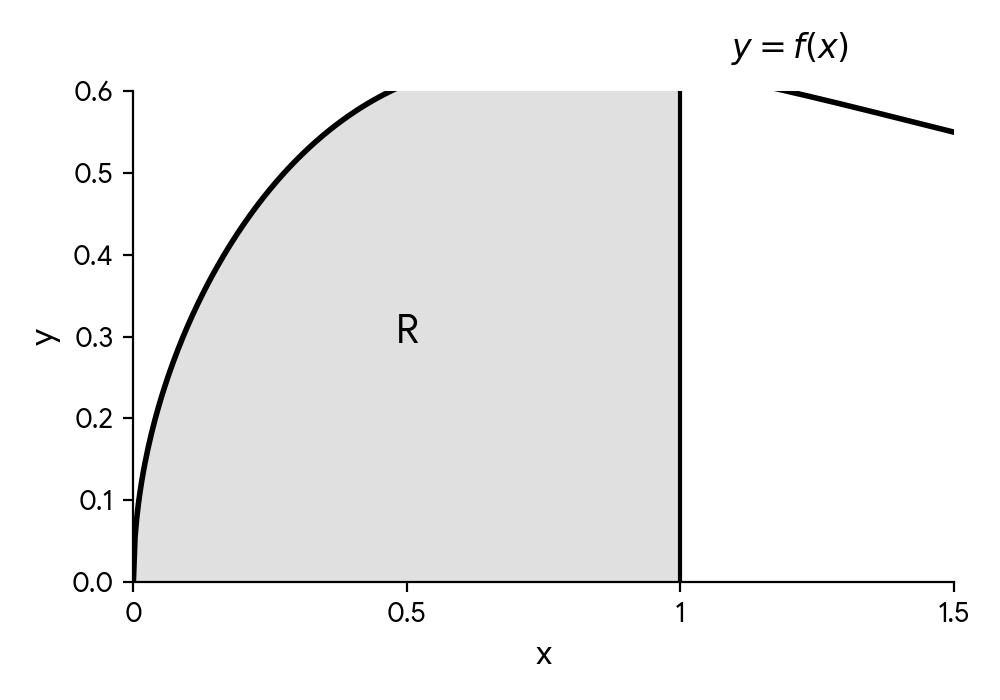
The shaded region R is rotated by radians about the -axis to form a solid.
Show that the volume of the solid is .
Start by setting up the integral for the volume of revolution. Look at the resulting integrand. Does it have a structure that suggests a particular integration technique, like substitution or integration by parts? Consider the relationship between the different parts of the integrand.
Question 4
HardPaper 1 · no calculator11 marksFind .
The region is enclosed by the curve , the -axis, and the lines and . Show that the area of is .
This integral is a product of two different types of functions. Which integration technique is suitable for this? Consider letting .
The area under a curve from to is given by the definite integral . Use your result from part (a) and evaluate it at the given limits. Remember the exact values for trigonometric functions of and properties of logarithms.
Question 5
MediumPaper 1 · no calculator7 marksFind for the following functions:
(a)
(b)
You will need to use the chain rule. Let and find the derivative of with respect to , and the derivative of with respect to .
This requires the product rule. Let and . Remember that the derivative of will also require the chain rule.
Question 6
HardPaper 3 · calculator25 marksThis question asks you to investigate the motion of a buoy bobbing up and down in the water.
A buoy bobs up and down in the water.
A fixed origin is the equilibrium position of the buoy (the water level).
The buoy's displacement, metres, from at time seconds is given by
Determine
the amplitude of the buoy's motion;
the buoy's initial displacement from ;
the value of when the buoy first passes through .
Now consider the general case of a buoy bobbing up and down.
The buoy's acceleration is always directed towards a fixed origin at its equilibrium position.
The buoy's acceleration, , at a displacement, , from satisfies the differential equation
The buoy's displacement, , from at time is given by
By finding expressions for and , verify that satisfies the differential equation .
Use the chain rule to show that , where is velocity.
By solving the differential equation, , show that .
Hence, or otherwise, find the buoy's maximum speed.
The continuous random variable denotes the buoy's displacement, , from at time .
The probability density function of is defined by
Show that .
For , the function can be expressed in the form , where and is the buoy's velocity at a displacement, , from .
Find the value of .
Determine , justifying your answer.
Interpret the result found in part (f)(i) in the context of the buoy's motion.
The amplitude is the maximum displacement from the equilibrium position, which corresponds to the coefficient of the sine function.
Initial displacement occurs when time . Substitute this into the displacement equation.
Passing through means the displacement . Solve the equation for the smallest positive value of .
Differentiate the displacement function with respect to twice to find the acceleration, then show it equals .
Start with the definition of acceleration and apply the chain rule by introducing .
Separate the variables and , then integrate both sides. Use the initial conditions or the properties of the motion (like when ) to find the constant of integration.
Consider the expression for . What value of will make as large as possible?
Set up a definite integral of the probability density function between the given limits. Use the standard integral result for .
Use the expression for found in part (c)(ii) to write in terms of , then substitute this into the given form for .
Consider the symmetry of the probability density function or the properties of the integral of an odd function.
What does the expected value of the displacement represent physically for the oscillating buoy?
Question 7
MediumPaper 1 · no calculator6 marksFind the value of .
Consider using a substitution. Look for a function and its derivative in the integrand. Note that .
Question 8
MediumPaper 2 · calculator7 marksBy using the substitution , show that .
Start by differentiating the given substitution, , with respect to . Remember to use the chain rule or implicit differentiation. Then, rearrange to find an expression for or to substitute into the integral. You will also need to substitute for . After substituting, use a Pythagorean identity to simplify the expression under the square root.
Question 9
MediumPaper 1 · no calculator5 marksFind
Consider using integration by parts. What would be a good choice for 'u' and 'dv/dx'? Remember the derivative of arctan(x).
No question on this page matches those filters. Try another difficulty or paper.
Every Derivatives & integrals of special HL functions (inv / reciprocal trig, log and power) question, marked for you
Every answer is marked mark by mark, IB-style, and the AI tutor helps when you are stuck.
Where marks are lost
- Using your own wrong value after failing a "show that".