Systems of linear equations (by hand and with GDC): notes and practice questions
- Systems of linear equations can be classified as consistent (at least one solution) or inconsistent (no solution).
- They can be underspecified () or overspecified ().
- 2x2 systems can be solved using substitution, elimination, or geometrically (line intersection).
- Larger systems are solved using row reduction on augmented matrices to reach Row Echelon Form or Reduced Row Echelon Form.
- Interpreting the final matrix rows determines if there's a unique solution, no solution (contradiction like ), or infinite solutions (identity like ).
- Infinite solutions are expressed parametrically, representing lines or planes of intersection.
- GDCs offer solvers and RREF functions for efficient solving.
How it is examined
Three by three, never larger. The interesting questions carry a parameter, so the answer is "for which value of does the system have no solution / infinitely many", and the general solution has to be written in parametric form. Paper 1 wants row reduction shown. 5 to 8 marks.
Solutions of systems of linear equations (a maximum of three equations in three unknowns), including cases where there is a unique solution, an infinite number of solutions or no solution.
Linking questions
- This is the algebraic half of AHL 3.18. The same three-plane picture is examined from both directions.
Practice questions
20 questions · 15 medium · 5 hardQuestion 1
MediumPaper 1 · no calculator7 marksA biologist is studying a species of fish. The length, cm, and weight, g, of each fish in a sample are recorded.
The lengths of the fish are summarized in the following box and whisker diagram.
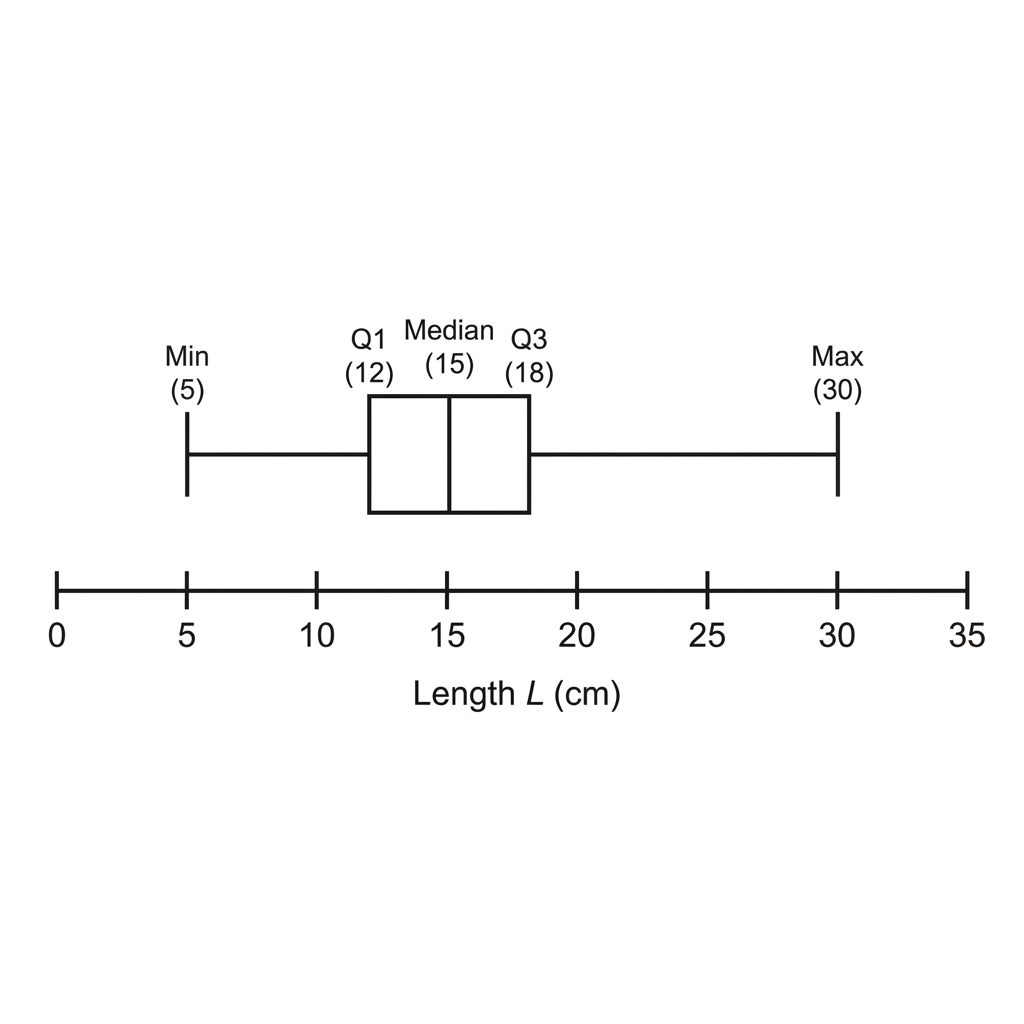
Find the largest value of that would not be considered an outlier.
The regression line of on is . The regression line of on is .
One of the fish in the sample weighs 200 g. Estimate the length of this fish.
Find the mean weight of the fish in the sample.
An outlier is defined as a data point that is more than 1.5 times the interquartile range (IQR) above the upper quartile or below the lower quartile. First, calculate the IQR.
You are given the weight () and asked to estimate the length (). You should use the regression line that predicts from .
The point , representing the mean length and mean weight, is the intersection point of the two regression lines.
Question 2
HardPaper 1 · no calculator6 marksA system of linear equations is given by
Find the value of and the value of , where , for which the system has an infinite number of solutions.
For a system of three linear equations to have an infinite number of solutions, the three planes they represent must intersect along a common line. Consider what this implies algebraically. You could use methods like Gaussian elimination (augmented matrix), substitution, or vector analysis of the planes.
Question 3
MediumPaper 1 · no calculator7 marksA biologist records the number of eggs in the nests of a certain species of bird. The results for 25 nests are shown in the following frequency table.
| Number of eggs (x) | 1 | 2 | 3 | 4 | 5 |
|---|---|---|---|---|---|
| Frequency (f) | p | 6 | q | 4 | 2 |
It is given that the mean number of eggs per nest is 2.6.
(a) Find the value of p and the value of q.
The biologist enters the data into a competition. The competition score is calculated using the formula , where is the number of eggs in a nest.
(b) Find the mean competition score.
You are given two key pieces of information: the total number of nests and the mean number of eggs. Use these to set up two separate equations involving p and q. Then, solve these equations simultaneously.
Recall the effect of a linear transformation on the mean of a dataset. If each data point is transformed to , how does the mean change?
Question 4
HardPaper 2 · calculator20 marksTwo drones, Drone X and Drone Y, have position vectors with respect to an origin O given respectively by
where represents the time in minutes and .
Entries in each column vector give the displacement east of O, the displacement north of O and the distance above sea level, all measured in kilometres.
(a) Find the three-figure bearing on which Drone Y is travelling.
(b) Show that Drone X travels at a greater speed than Drone Y.
(c) Find the acute angle between the two drones' lines of flight. Give your answer in degrees.
The two drones' lines of flight cross at point P.
(d) (i) Find the coordinates of P.
(ii) Determine the length of time between the first drone arriving at P and the second drone arriving at P.
(e) Let represent the distance between Drone X and Drone Y for .
Find the minimum value of .
The bearing is determined by the horizontal components (East and North) of the direction vector. Remember bearings are measured clockwise from North.
The speed of a drone is the magnitude of its direction vector.
Use the dot product formula for the angle between two vectors: . Remember to find the acute angle.
Set the two vector equations equal to each other, using different time parameters for each drone (e.g., and ). Solve the resulting system of equations.
The time values you found in part (d)(i) represent when each drone arrives at P. Find the difference between these times.
First, find the vector representing the displacement between the two drones, . Then, find the magnitude of this vector, . To minimize , it's often easier to minimize . Use calculus (derivative) to find the minimum.
Question 5
MediumPaper 1 · no calculator8 marksThe following diagram shows the graph of , where , for , and .
The graph has a y-intercept at and an x-intercept at .
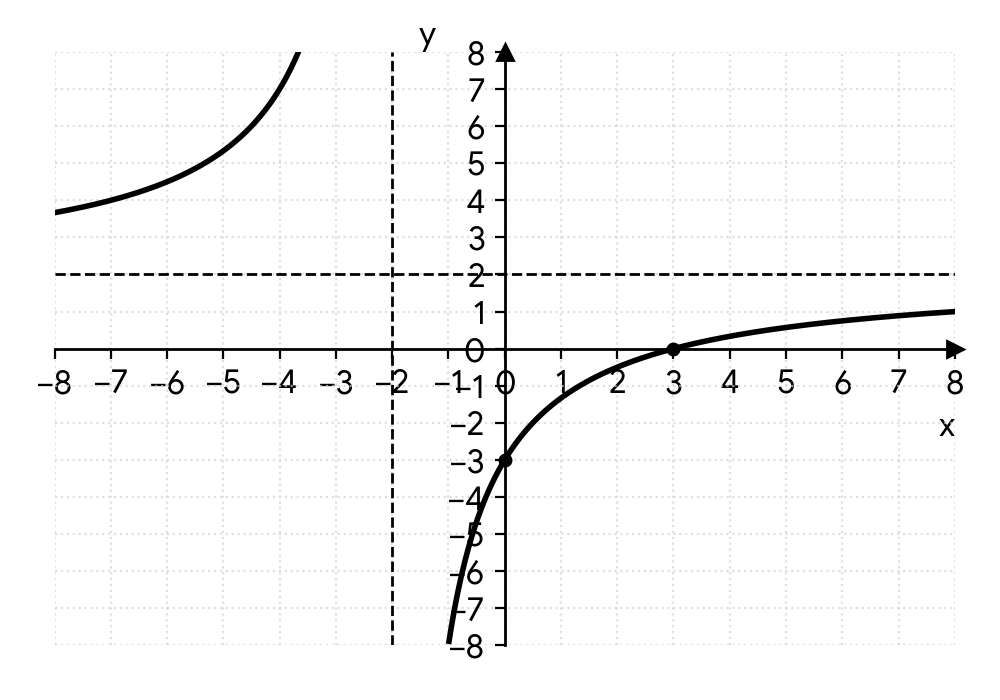
(a) Find the value of and the value of .
(b) Describe a sequence of transformations that maps the graph of onto the graph of .
Substitute the coordinates of the x-intercept and y-intercept into the function's equation to create a system of two linear equations with two variables, C and D.
First, rewrite the function in the form using algebraic long division or by manipulating the numerator. Then, identify the transformations (translation, stretch, reflection) and their parameters based on the values of P, Q, and R.
Question 6
HardPaper 1 · no calculator10 marksConsider the system of equations
where .
(a) Find the values of for which the system has a unique solution and find this solution in terms of .
(b) For the system of equations, find the value of for which there is:
(i) no solution;
(ii) infinitely many solutions. For this case, write down the general solution.
A unique solution exists when the determinant of the coefficient matrix is non-zero. After finding the values of k for which this is true, use an algebraic method like elimination or substitution to solve for x and y.
No solution occurs when the lines are parallel but distinct. This happens for one of the values of that makes the determinant zero.
Infinitely many solutions occur when the two equations represent the same line. This happens for one of the values of that makes the determinant zero.
Question 7
MediumPaper 2 · calculator6 marksA team of architects is designing a new building and needs to define a support beam's orientation. The beam must be perpendicular to two existing structural walls, Wall A and Wall B. The equations of the planes representing these walls are given by:
Wall A ():
Wall B ():
Find a Cartesian equation of the plane () that represents the orientation of the support beam, given that it passes through the origin (0, 0, 0).
Find the coordinates of the point where Wall A, Wall B, and the support beam's plane () intersect.
The normal vector of a plane is perpendicular to the plane. If a new plane is perpendicular to two other planes, its normal vector must be parallel to the cross product of the normal vectors of the two other planes. Remember that the equation of a plane is of the form , where is the normal vector.
You need to solve a system of three linear equations in three variables. You can use substitution, elimination, or a matrix method (e.g., with your GDC).
Question 8
HardPaper 2 · calculator21 marksConsider the non-zero vectors and . Let be the angle between and .
Using the definitions of and in terms of , and , show that .
A triangle PQR has vertices P(1, 0, 1), Q(, 2) and R(4, 1, 1), where .
The vectors and are defined as and .
It is given that and the area of triangle PQR is square units.
Find the value of .
Hence, or otherwise, find the value of .
Hence, or otherwise, find the possible values of and the corresponding values of .
Consider a new point S, the vector is defined as .
It is given that and , and the area of triangle PRS is 10 square units.
Assuming that , find the possible vectors for .
Recall the definitions of the dot product and the magnitude of the cross product in terms of the magnitudes of the vectors and the angle between them. Use the Pythagorean identity for trigonometric functions.
The area of a triangle formed by two vectors is half the magnitude of their cross product.
Use the identity from part (a) and the values you've found for the dot product and the magnitude of the cross product. Remember to calculate the magnitude of first.
Express in terms of and . Set up two equations using the given dot product and the magnitude of found in the previous part. Solve the system of equations.
If is perpendicular to both and , it must be parallel to their cross product. The area of triangle PRS can be found using the magnitude of and and the angle between them.
Question 9
MediumPaper 2 · calculator7 marks(a) The altitude, metres, of a drone above the ground is modelled by a quadratic function , where is the time in seconds after launch. The drone's altitude is recorded at three different times:
At second, the altitude is metres.
At seconds, the altitude is metres.
At seconds, the altitude is metres.
Find the equation of the quadratic function .
Substitute each given point into the general quadratic equation to form a system of three linear equations. Then, solve this system for the coefficients , , and .
Question 10
HardPaper 1 · no calculator5 marksThe equations of three planes are given by:
where .
Find the set of values of and for which the system of equations has no solution.
To find when a system of linear equations has no solution, you need to find the conditions that make the system inconsistent. This can be achieved using Gaussian elimination on the augmented matrix to reach a row where you have an equation of the form `0 = non-zero`. Alternatively, you can use determinants. If the determinant of the coefficient matrix is zero, there is no unique solution. You must then check further to distinguish between no solution and infinitely many solutions.
Question 11
MediumPaper 2 · calculator7 marksThe concentration of a certain nutrient in a plant's root system, , after hours, is modelled by the function for , where are constants.
(a) Given that the model predicts a singularity (vertical asymptote) at , determine the value of .
(b) Given that the concentration is units after hour and units after hours, determine the values of and .
A vertical asymptote occurs when the denominator of a rational function is equal to zero. Set the denominator to zero at the given asymptote value.
Substitute the given points into the function using the value of found in part (a). This will create a system of two linear equations with and as unknowns. Solve this system.
Question 12
MediumPaper 1 · no calculator6 marksSolve the following system of simultaneous equations for and .
First, rearrange each equation into the standard form . Then, use elimination or substitution to reduce the system of three equations with three variables into a system of two equations with two variables.
Question 13
MediumPaper 1 · no calculator6 marksSolve the simultaneous equations
where and are complex numbers. Give your answers in the form where .
Try taking the complex conjugate of one of the equations. This might help you to eliminate one of the variables or its conjugate.
Question 14
MediumPaper 1 · no calculator7 marksA function is defined by
where .
(a) Find an equation relating and , given that is continuous at .
(b) Given further that , find the value of and the value of .
For a function to be continuous at a point, the value of the function approaching from the left must be equal to the value of the function approaching from the right. Set the two pieces of the function equal to each other at the given value of .
First, find the derivative of the relevant piece of the function . Then, use the given condition to find the value of one of the constants. Finally, use your result from part (a) to find the other constant.
Question 15
MediumPaper 1 · no calculator7 marksA student, Leo, has taken seven mathematics tests. His scores are recorded as , where and are integers and .
The mean of these seven scores is . The range of the scores is .
(a) Find the value of and the value of .
(b) Find the median and the mode of Leo's seven test scores.
Start by using the formula for the mean to find the sum of all seven scores. This will give you one equation involving and . Then, consider the definition of the range (highest score minus lowest score) to form a second equation. You will need to determine which scores are the highest and lowest in the set.
First, write down the complete list of the seven scores using your answers from part (a). Then, arrange them in ascending order to find the median (the middle value). The mode is the value that appears most frequently.
Question 16
MediumPaper 2 · calculator5 marksA student is investigating the relationship between the number of hours spent studying for a test () and the score obtained on the test (). The following bivariate data set was collected, where and represent unknown test scores.
| x (study hours) | y (test scores) |
|---|---|
| 3 | 48 |
| 5 | 62 |
| 7 | p |
| 9 | q |
| 11 | 88 |
The regression line of on has the equation .
The regression line passes through the mean point .
Given that hours, verify that the mean test score .
Given that the test score was 4 points higher than , find the value of and the value of .
Substitute the given mean value of into the equation of the regression line to find the corresponding value.
Use the verified mean test score and the total number of data points to find the sum of all values. Then, form a system of two linear equations with and and solve them.
Question 17
MediumPaper 2 · calculator8 marksConsider the function , where and are non-zero constants.
The function has a local minimum point at and a vertical asymptote with equation .
Find the values of and .
Recall that a vertical asymptote occurs when the denominator is zero. For a local minimum, the function passes through the point and its first derivative is zero at that point. You will need to use the quotient rule for differentiation and solve a system of linear equations.
Question 18
MediumPaper 2 · calculator8 marksA satellite dish is positioned at a ground control station . The dish is designed to track a celestial object whose path can be modelled by a line with vector equation , where .
The plane of the satellite dish contains the line and passes through the ground control station .
Show that the Cartesian equation of the plane is .
Consider three large display screens in a museum, represented by the planes:
where .
For a special holographic effect, the three planes must intersect along a single line.
Find the value of and the value of .
To find the Cartesian equation of a plane, you need a normal vector and a point on the plane. You can find two direction vectors within the plane: one from the given line, and another by connecting a point on the line to the given point . The cross product of these two direction vectors will give you the normal vector to the plane.
For three planes to intersect in a line, the system of linear equations must have infinitely many solutions. This implies two conditions: the determinant of the coefficient matrix must be zero, and the system must be consistent (i.e., no contradictions arise during row reduction, leading to a row of zeros in the augmented matrix).
Question 19
MediumPaper 1 · no calculator7 marksThree planes are defined by the following equations:
where .
(a) Find the value of for which the three planes do not intersect at a unique point.
(b) For , find the coordinates of the point of intersection of the three planes.
For a system of linear equations to not have a unique solution, what must be true about the determinant of the coefficient matrix? Alternatively, consider what happens during Gaussian elimination when solutions are not unique.
Use an algebraic method such as elimination or substitution to solve the system of three linear equations. Try to eliminate one variable from two different pairs of equations.
Question 20
MediumPaper 2 · calculator6 marksA structural engineer is designing a framework and needs to define the orientation of certain surfaces. Consider two existing planar surfaces, and , with the following Cartesian equations:
Find a Cartesian equation of a third planar surface, , which is perpendicular to both and , and passes through the point .
Determine the coordinates of the point where , , and intersect.
The normal vector of a plane perpendicular to two other planes can be found using the cross product of their normal vectors. Once you have the normal vector and a point on the plane, you can determine its Cartesian equation.
You need to solve the system of three linear equations representing the three planes simultaneously. A calculator can be very helpful for this.
No question on this page matches those filters. Try another difficulty or paper.
Every Systems of linear equations (by hand and with GDC) question, marked for you
Every answer is marked mark by mark, IB-style, and the AI tutor helps when you are stuck.
Where marks are lost
- Using your own wrong value after failing a "show that".