Functions, domain, range: notes and practice questions
- A function maps each input to exactly one output.
- Domain: The set of all possible input values () for which the function is defined.
- Range: The set of all possible output values () the function can produce.
- Important types: linear, quadratic, exponential, logarithmic, etc.
- Use set notation (e.g., ) or interval notation (e.g., ) to define domain and range. Key concepts:
- Vertical line test to determine if a graph represents a function.
- Restrictions on the domain, e.g., division by zero () or square roots ().
How it is examined
Range is the harder half and it is where marks are lost. Set and interval notation is assessable: , for the open interval (the IB uses reversed brackets, not parentheses). `State`, `Write down`, `Find`. 1 to 4 marks.
- Concept of a function, domain, range and graph.
- Function notation, for example , , .
- The concept of a function as a mathematical model.
- Informal concept that an inverse function reverses or undoes the effect of a function.
Extended at AHL 2.14 (domain restriction, self-inverse functions).
Linking questions
- Other contexts: temperature and currency conversions.
- Links to other subjects: currency conversions and cost functions (economics and business management); projectile motion (physics).
Practice questions
62 questions · 6 easy · 38 medium · 18 hardQuestion 1
EasyPaper 2 · calculator4 marksA tech startup's daily operational costs are modeled by two functions based on the number of new user sign-ups, . Let be the cost for server maintenance and be the cost for customer support. represents the deviation from the average number of sign-ups, where positive means more than average and negative means fewer than average.
(a) The server maintenance cost function is given by , where . Find .
(b) The customer support cost function is given by , where . Find .
Substitute the given value of into the function and simplify.
Substitute the given value of into the function and simplify, paying attention to the order of operations.
Question 2
MediumPaper 1 · no calculator8 marksConsider the function .
The graph of passes through the point and has an oblique asymptote with equation .
(a) Write down the equation of the vertical asymptote.
(b) Find the value of:
(i)
(ii)
(c) Hence, find the exact coordinates of any points where the graph of intersects the x-axis.
A vertical asymptote occurs where the function is undefined. This happens when the denominator of the rational function is equal to zero.
The equation of the oblique asymptote is the quotient when the numerator is divided by the denominator. Perform polynomial long division or consider the limit of as approaches infinity.
You know that the point (1, -2) lies on the graph of the function. Substitute these x and y values, along with the value of 'a' you just found, into the equation for g(x).
The x-intercepts occur when y=0. Set the function g(x) equal to zero and solve for x. Remember that a fraction is zero only when its numerator is zero.
Question 3
HardPaper 1 · no calculator14 marksA rectangle is inscribed in an ellipse with equation . The sides of the rectangle are parallel to the coordinate axes. The vertices of the rectangle are located at , where and .
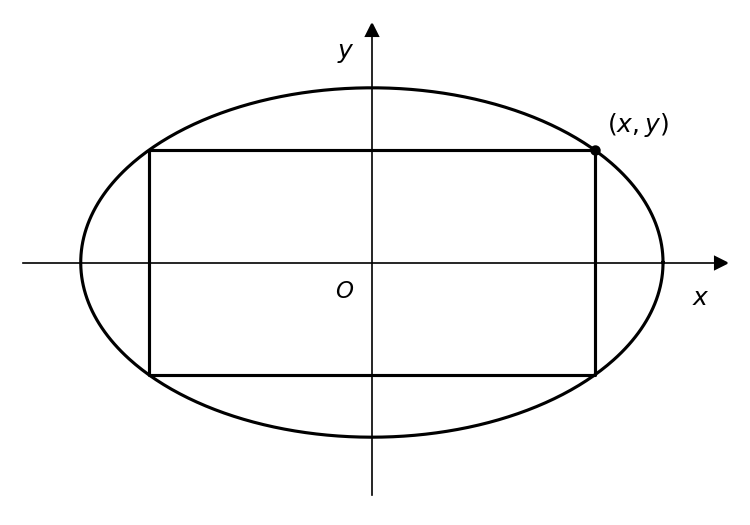
(a) Show that the area of the rectangle, , can be expressed as .
(b) Show that .
(c) Hence, find the exact dimensions of the rectangle with the maximum possible area.
The area of the rectangle is given by its width times its height. Express the width and height in terms of and . Then, use the equation of the ellipse to express in terms of and substitute this into your area formula.
You will need to use the product rule, , and the chain rule to differentiate the expression for the area with respect to .
To find the maximum area, you need to find the value of for which the derivative of the area is zero. Set the expression for from part (b) equal to zero and solve for . Then use this value of to find the corresponding value of and the dimensions of the rectangle.
Question 4
EasyPaper 1 · no calculator2 marksConsider the function , .
State the range of .
The range of a rational function of the form is determined by its horizontal asymptote. Recall how to find the equation of the horizontal asymptote from the coefficients of the function.
Question 5
MediumPaper 1 · no calculator7 marksThe function is defined for all . The line with equation is the tangent to the graph of at .
(a) Write down the value of .
(b) Find .
The function is defined for all where and .
(c) Find .
(d) Hence, find the equation of the tangent to the graph of at .
The derivative of a function at a point gives the gradient of the tangent line at that same point. What is the gradient of the given tangent line?
The point of tangency lies on both the function's graph and the tangent line. Substitute the x-coordinate of the point of tangency into the equation of the tangent line.
To find , you first need to calculate the value of the inner function, . Then, use this result as the input for the outer function, .
To find the equation of a tangent line, you need a point and a gradient. You found the point in part (c). To find the gradient, you need to calculate . Remember to use the chain rule to differentiate .
Question 6
HardPaper 1 · no calculator15 marksA drone takes off from a platform. Its height, metres, above the platform after seconds is given by , for . This is shown in the following diagram.
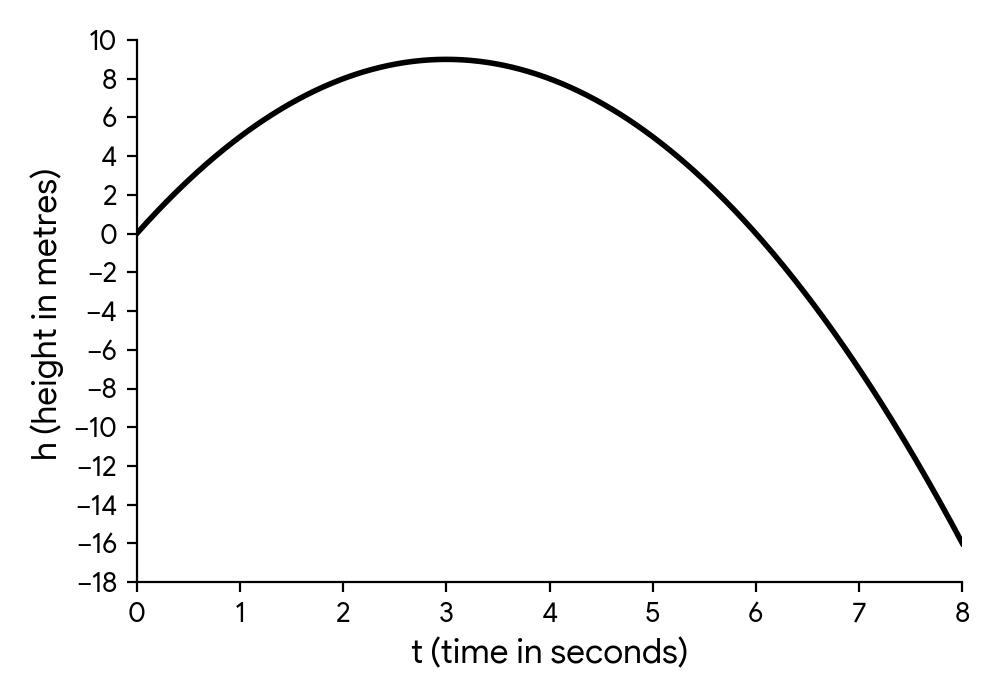
The drone lands back on the platform when .
Find the value of .
The drone reaches its maximum height when .
Find the value of .
Find the drone's maximum height above the platform.
Find the drone's vertical distance from the platform when .
The total vertical distance travelled by the drone in the first 8 seconds is given by .
Find the value of .
A second drone, Drone B, takes off from the same platform. Its velocity is given by , for .
When , the total vertical distance travelled by Drone B is equal to .
Find the value of .
The drone is on the platform when its height is zero. Set the height function equal to zero and solve for time .
The maximum height is reached when the drone's vertical velocity is zero. Find the derivative of the height function, which represents velocity, and set it to zero.
You found the time to reach maximum height in the previous part. Substitute this time back into the original height function.
Substitute into the height function. Remember that distance must be a positive value.
Total distance is not the same as displacement. The drone goes up and then comes down. You need to calculate the distance travelled on the way up and the distance travelled on the way down separately and add them together. The turning point you found in part (b) is crucial here.
First, find the total distance travelled by Drone B as a function of time . This will involve an integral of the absolute value of its velocity. You'll need to find when Drone B changes direction. Then, set this total distance equal to the value of you found in part (d) and solve for .
Question 7
EasyPaper 1 · no calculator4 marksConsider the function .
(a) State the largest possible domain for the function .
(b) State the largest possible range for the function .
(c) Find the coordinates of any points where the curve intersects the and -axes.
The domain of a rational function is all real numbers except for the values of x that make the denominator zero.
The range is restricted by the horizontal asymptote. Find the value that approaches as becomes very large by considering the ratio of the coefficients of in the numerator and denominator.
The y-intercept is found by calculating . The x-intercept is found by solving the equation .
Question 8
MediumPaper 1 · no calculator13 marksA function, , has its derivative given by , where . The following diagram shows part of the graph of .
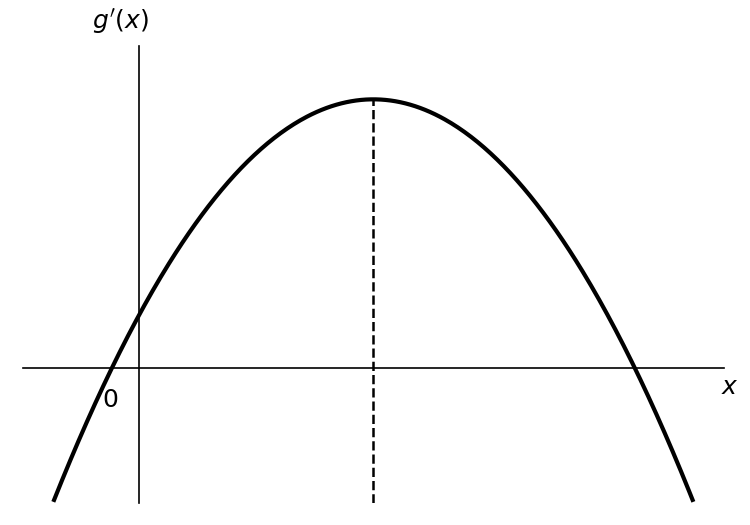
The graph of has an axis of symmetry .
(a) Find the value of .
(b) The vertex of the graph of has a y-coordinate of 10. Find the value of .
(c) Find the equation of the tangent to the graph of at .
The graph of has a point of inflexion at .
(d) (i) Find the value of .
(ii) Find the values of for which the graph of is concave-up. Justify your answer.
The axis of symmetry of a parabola is given by the formula . Alternatively, the vertex (and thus the axis of symmetry) occurs where the derivative of the function is zero.
The vertex lies on the axis of symmetry. Use the value of you found in part (a) as the x-coordinate of the vertex, and the given y-coordinate, to form an equation and solve for .
To find the equation of a tangent line, you need a point on the line and the gradient of the line. The point is found by evaluating . The gradient is found by evaluating the derivative of at .
A point of inflexion on the graph of occurs where the second derivative, , is equal to zero.
The graph of is concave-up when its second derivative, , is positive. Set up and solve the inequality .
Question 9
HardPaper 1 · no calculator14 marksConsider the function where and . The graph of contains the point .
(a) Show that .
(b) Write down an expression for .
(c) Find the value of .
Consider the arithmetic sequence , where and .
(i) Show that and are four consecutive terms in a geometric sequence.
Consider the arithmetic sequence , where and .
(ii) Find the value of and the value of .
Substitute the given coordinates into the function's equation and solve for the base 'a'. You will need to use the rules of exponents.
The inverse of an exponential function is a logarithmic function. Recall the relationship between the base of the exponential and the base of the logarithm.
Substitute into the expression for the inverse function you found in part (b). Then, use the properties of logarithms to evaluate the result. Ask yourself: '9 to what power equals 1/81?'
An arithmetic sequence has a common difference. Set up equations by equating the differences between consecutive terms. Then, use the laws of logarithms to simplify these equations and show that the arguments of the logarithms have a common ratio.
You can use the properties of the geometric sequence from part (d)(i) or the properties of the original arithmetic sequence. Using the geometric sequence, find the common ratio 'r' first. Using the arithmetic sequence, find the common difference 'd' first.
Question 10
EasyPaper 1 · no calculator8 marksFor each of the following functions, write down its greatest possible domain and range.
(a)
(b)
(c)
(d)
The domain is restricted when the denominator of a fraction is zero. The range is restricted by the horizontal asymptote of the function.
For a rational function of the form , the horizontal asymptote is given by the line .
The vertical asymptote has changed from the previous part. Re-evaluate the value of x for which the denominator is zero.
This function is a transformation of the basic reciprocal function . Consider its asymptotes.
Question 11
MediumPaper 1 · no calculator5 marksSolve the inequality .
The function is defined by , where .
Find the least value of for which exists, justifying your answer.
First, find the roots of the corresponding quadratic equation . Then, consider the shape of the parabola (does it open upwards or downwards?) to determine the intervals where the function's value is positive.
For an inverse function to exist, the original function must be one-to-one. Also, remember the condition for the expression inside a square root. How does this relate to your answer in part (a)?
Question 12
HardPaper 2 · calculator15 marksA landscape architect is designing a section of a garden path. The shape of one edge of the path can be modelled by the function for , where and are measured in metres.
(a) (i) Find , the inverse of , and state its domain.
(ii) Write down the range of .
(b) The graph of intersects the graph of at two points. Find the -coordinates of these two points.
(c) Find the area enclosed by the graph of and the graph of .
(d) Find .
(e) Find the value of for which the graph of and the graph of have the same gradient.
To find the inverse function, swap and in the equation and then solve for . Remember that the domain of is the range of .
The range of the inverse function is the domain of the original function.
The intersection points of a function and its inverse lie on the line . Therefore, you can solve or .
The area enclosed by and can be found by integrating the absolute difference between the two functions, with the limits of integration being the -coordinates found in part (b). You will need a GDC for this integral.
Use the power rule for differentiation: .
First, find the derivative of using the chain rule. Then, equate and and solve the resulting equation for . This may require a GDC to solve the cubic equation.
Question 13
EasyPaper 1 · no calculator5 marksA function is defined by .
(a) The asymptotes of the graph of are a vertical line and a horizontal line which intersect at the point . Find the value of and the value of .
(b) The graph of passes through the point . Find the value of .
Recall how the vertical and horizontal asymptotes of a rational function are determined by the denominator and the degrees of the polynomials and respectively.
If a graph passes through a certain point, the coordinates of that point must satisfy the function's equation. Substitute the known values of , , , and into the equation for .
Question 14
MediumPaper 1 · no calculator7 marksConsider the function , for .
Determine the range of .
The region bounded by the graph of , the -axis and the lines and is rotated radians about the -axis.
Find the volume of the solid generated.
To find the range of a function on a closed interval, you should check the values of the function at the endpoints and at any local maximum or minimum points within the interval. For a cosecant function, the minimum value occurs when its reciprocal, the sine function, is at its maximum.
The formula for the volume of a solid generated by rotating a curve about the x-axis between and is . You will need to know the integral of .
Question 15
HardPaper 2 · calculator15 marksA team of engineers is testing two autonomous robots, Alpha and Beta, on a straight track. Their positions are measured as the distance from a fixed starting point. The experiment runs for 10 minutes.
The position of Robot Alpha, metres, at time minutes can be modelled by the function , where .
The position of Robot Beta, metres, at time minutes can be modelled by the function , where .
Use the engineers' models to find the initial position of
(i) Robot Beta;
(ii) Robot Alpha correct to three significant figures.
Find the values of when Robot Alpha and Robot Beta are at the same position. Give your answers correct to three significant figures.
For , prove that Robot Alpha was always ahead of Robot Beta.
For , find the total amount of time when the speed of Robot Beta was greater than the speed of Robot Alpha. Give your answer correct to three significant figures.
The initial position corresponds to the time . Substitute this value into the function for Robot Beta.
Substitute into the function for Robot Alpha. Remember that the argument of the sine function is in radians.
Set the two position functions equal to each other, . This equation will involve a trigonometric term and a linear term, so you will need to use your GDC to find the solutions within the given domain .
To prove Robot Alpha was always ahead, show that for . Consider the minimum value of the trigonometric term in the difference function.
Speed is the magnitude of velocity, which is the derivative of position with respect to time. Find and . Then solve the inequality for within the given domain. This will involve a trigonometric inequality.
Question 16
EasyPaper 1 · no calculator5 marksConsider the function , where and is a real constant.
The axis of symmetry of the graph of has equation .
Show that .
Find the coordinates of the vertex of the graph of .
Hence, write down the range of .
The axis of symmetry lies exactly halfway between the two -intercepts of the quadratic function.
Substitute the -value of the axis of symmetry into the function to find the corresponding -coordinate.
Consider whether the parabola opens upwards or downwards to determine if the vertex is a maximum or a minimum.
Question 17
MediumPaper 2 · calculator6 marksA tech company's daily profit, , in thousands of dollars, from producing units of a new gadget is modelled by the function , for .
(a) Find the range of the company's daily profit.
Due to new environmental regulations, the company faces a levy that adjusts its profit. The adjusted profit, , is given by the function , where is a constant representing the levy's impact.
Given that the adjusted profit must be non-positive for all , determine the set of possible values for .
To find the range of a quadratic function, identify whether it opens upwards or downwards and then find the coordinates of its vertex.
Consider the maximum value of the composite function . For it to be non-positive for all , its maximum value must be less than or equal to zero. Alternatively, you can use the discriminant of the resulting quadratic function.
Question 18
HardPaper 2 · calculator20 marksA designer is creating a decorative glass container shaped like a dome. The outer profile of the container can be modelled by the function , where and and are measured in metres.
Sketch the curve , clearly indicating the coordinates of the endpoints.
Show that the inverse function of is given by .
State the domain and range of .
The container is formed by rotating the curve by about the y-axis. Show that the volume, , of liquid in the container when it is filled to a height of metres is given by .
Hence, determine the maximum volume of the container.
At , the container is empty. Liquid is then added to the container at a constant rate of .
Find the time it takes to fill the container to its maximum volume.
Find the rate of change of the height of the liquid when the container is filled to half its maximum volume.
Remember that the domain restricts the part of the curve you need to sketch. Identify the y-values at the given x-endpoints.
To find the inverse function, interchange and and then solve for . Remember the range of the original function.
The domain of an inverse function is the range of the original function, and vice versa.
The formula for volume of revolution about the y-axis is . Express in terms of from the original function.
The maximum height the liquid can reach is determined by the range of the original function.
Time equals total volume divided by the filling rate.
First, find the height when the volume is half the maximum. Then, use the chain rule . You'll need to differentiate the volume formula with respect to .
Question 19
MediumPaper 2 · calculator6 marksThe population, , in hundreds of plants, years after the study began, is modeled by the function , for .
(a) Find the range of .
Due to environmental changes, a new invasive plant species is introduced. The impact of this invasive species on the orchid's population is modeled by a function , where is the current orchid population (in hundreds of plants) and is a constant representing the environmental resilience. For the orchid species to survive and thrive, the combined effect must always be non-negative (i.e., ) for all . Determine the set of possible values for .
Recall that the range of a quadratic function depends on its vertex. If , the parabola opens downwards, and the range is .
Consider the composite function . For it to be always non-negative, analyze its properties as a quadratic function. What condition must its vertex or discriminant satisfy?
Question 20
HardPaper 1 · no calculator12 marksConsider the functions , , and .
(a) Find the range of .
(b) Find the range of .
(c) Find the range of .
(d) Find an expression for .
(e) Solve the equation .
(f) Solve the inequality .
The function is a quadratic. What is the vertex of the parabola and which way does it open? This will tell you the maximum or minimum value.
The function is a reciprocal function. Consider the horizontal asymptote of the graph of . The function can take any value except the value of the horizontal asymptote.
The function is an exponential function. What is the range of the basic exponential function ? How does the '+1' transform this range?
To find the composite function , you need to substitute the expression for into the variable in the function .
Use your expression from part (d) and set it equal to -1. Then, solve the resulting equation for .
First, find the composite function . Then set up the inequality and solve for . Remember the properties of exponential functions and how to solve quadratic inequalities.
No question on this page matches those filters. Try another difficulty or paper.
42 more Functions, domain, range questions in the app
Every answer is marked mark by mark, IB-style, and the AI tutor helps when you are stuck.
Where marks are lost
- Using your own wrong value after failing a "show that".