Power rule (standard derivative): notes and practice questions
The derivative of with respect to is:
$$
f'(x) = n \cdot a \cdot x^{n-1}
na$$ is a constant. This rule is fundamental for finding the slope of functions in calculus.
How it is examined
Never asked alone past the first line of a question. It is the tool for tangents, stationary points and optimization. The reliable error is differentiating a term like without first writing it as . 1 to 3 marks.
The derivative of is in the standard derivatives table.
- Derivative of is , .
- The derivative of functions of the form where all exponents are integers.
Extended at SL 5.6 to .
Linking questions
- The integer restriction here is real: rational exponents arrive at SL 5.6.
Practice questions
48 questions · 1 easy · 34 medium · 13 hardQuestion 1
EasyPaper 1 · no calculator9 marksConsider the function .
(a) Find .
(b) Find the equation of the tangent line at .
(c) For the equation of the normal line at .
This function contains a constant and terms of the shape so to derive use the power rule.
The point of tangency is a point common between the tangent line and the function's curve.
The normal and tangent lines are perpendicular to each other.
Question 2
MediumPaper 1 · no calculator7 marksConsider the functions and where .
(a) Find .
The graphs of and have a common tangent at the point where .
(b) Show that .
(c) Hence, find the value of .
To find the derivative of , you can use the power rule for differentiation.
For two functions to have a common tangent at a specific point, their gradients must be equal at that point. Start by finding the derivative of and then set .
If the functions have a common tangent at a point, they must also pass through that same point. This means their y-values are equal at . Set and use the value of you found in part (b).
Question 3
HardPaper 1 · no calculator15 marksA drone takes off from a platform. Its height, metres, above the platform after seconds is given by , for . This is shown in the following diagram.
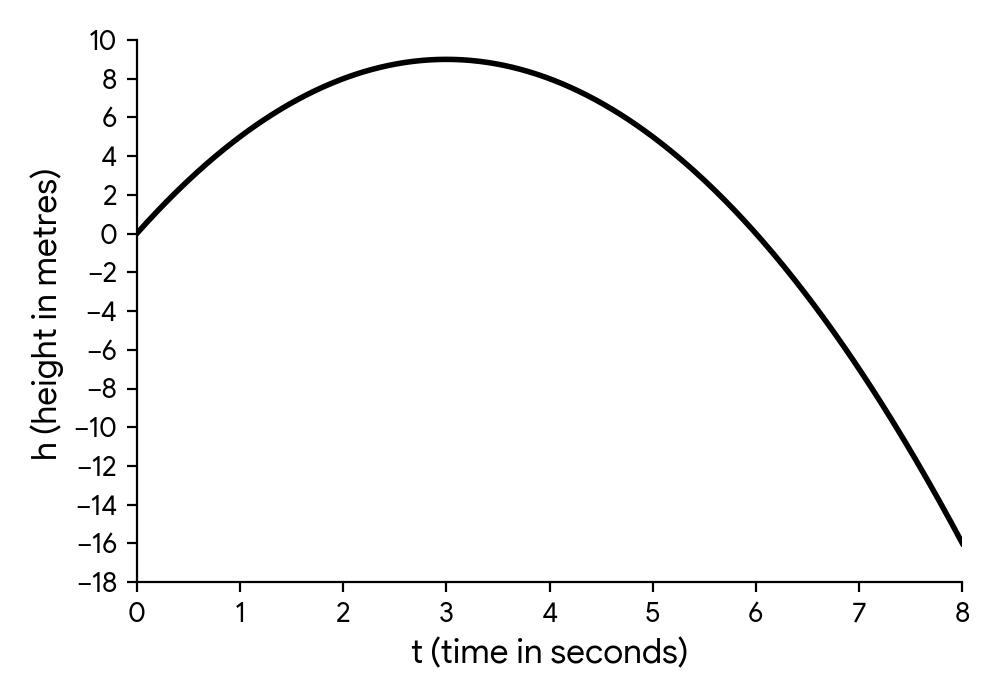
The drone lands back on the platform when .
Find the value of .
The drone reaches its maximum height when .
Find the value of .
Find the drone's maximum height above the platform.
Find the drone's vertical distance from the platform when .
The total vertical distance travelled by the drone in the first 8 seconds is given by .
Find the value of .
A second drone, Drone B, takes off from the same platform. Its velocity is given by , for .
When , the total vertical distance travelled by Drone B is equal to .
Find the value of .
The drone is on the platform when its height is zero. Set the height function equal to zero and solve for time .
The maximum height is reached when the drone's vertical velocity is zero. Find the derivative of the height function, which represents velocity, and set it to zero.
You found the time to reach maximum height in the previous part. Substitute this time back into the original height function.
Substitute into the height function. Remember that distance must be a positive value.
Total distance is not the same as displacement. The drone goes up and then comes down. You need to calculate the distance travelled on the way up and the distance travelled on the way down separately and add them together. The turning point you found in part (b) is crucial here.
First, find the total distance travelled by Drone B as a function of time . This will involve an integral of the absolute value of its velocity. You'll need to find when Drone B changes direction. Then, set this total distance equal to the value of you found in part (d) and solve for .
Question 4
MediumPaper 1 · no calculator5 marksFind the value of .
The first step is to rewrite the fraction inside the integral. Try splitting the fraction into two separate terms. Then, use the laws of indices to express each term in the form before you integrate.
Question 5
HardPaper 1 · no calculator17 marksA hollow pipe is manufactured by removing a smaller cylinder of radius from the centre of a larger cylinder of radius . Both cylinders have the same height, . This is shown in the following diagram.
All lengths are measured in centimetres.
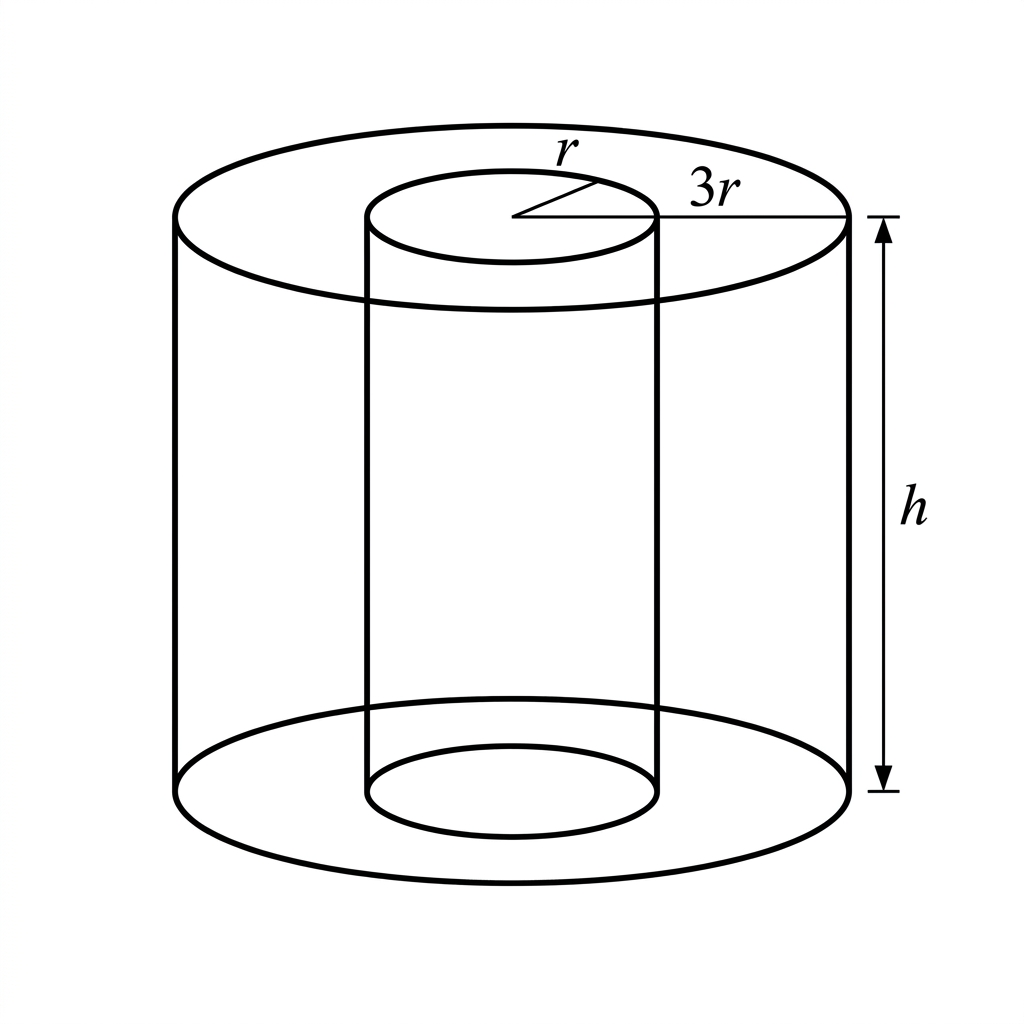
The total surface area of the hollow pipe, in cm, is given by .
(a) Show that .
The total surface area of the hollow pipe is .
(b) Show that the volume of the pipe, , is given by .
(c) Find an expression for .
(d) The hollow pipe has its maximum volume when , where . Find the value of .
(e) Hence, find this maximum volume, giving your answer in the form , where .
The total surface area is the sum of the areas of the top and bottom rings, the outer curved surface, and the inner curved surface.
First, use the given surface area to write an equation for in terms of . Then, write the formula for the volume of the pipe and substitute your expression for .
Use the power rule for differentiation on the expression for from part (b).
The volume is at a maximum when its derivative with respect to the radius is equal to zero. Set up and solve this equation.
Substitute the value of you found in part (d) into the volume formula from part (b). Be careful when simplifying the surds.
Question 6
MediumPaper 1 · no calculator7 marksConsider the functions and where .
The graphs of and have a common tangent at .
(a) Find .
(b) Show that .
(c) Hence, find the value of .
Recall the rule for differentiating a natural logarithm function, and apply the chain rule.
For two functions to have a common tangent at a point, their gradients must be equal at that point. Set the derivatives of and equal to each other at .
For the functions to have a common tangent, they must also pass through the same point. This means their y-values are equal at . Set and substitute the value of you found in part (b).
Question 7
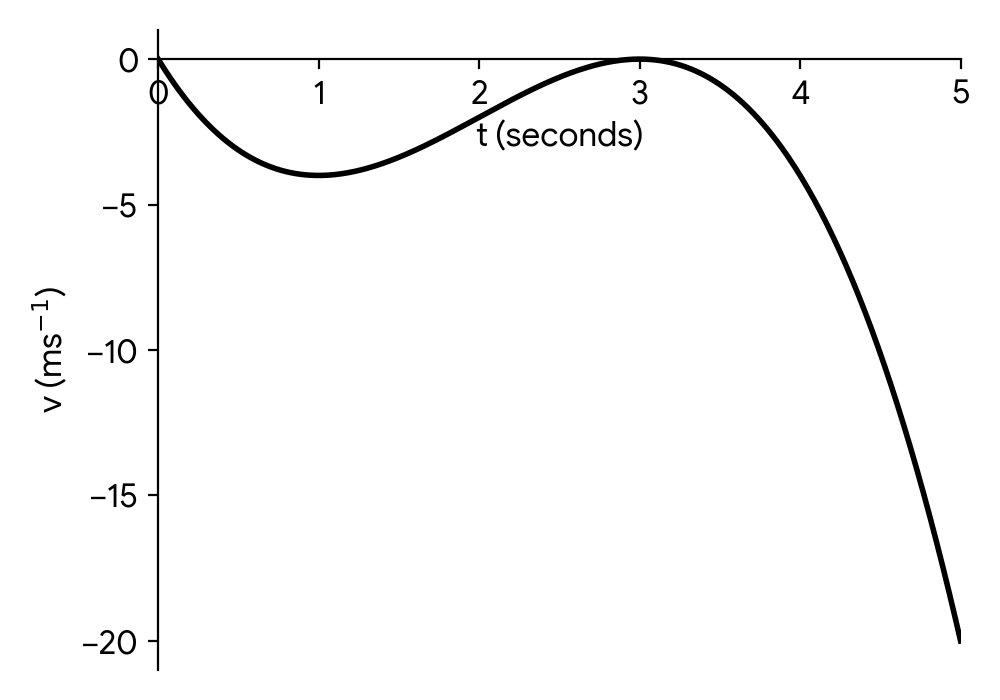
HardPaper 1 · no calculator16 marksA particle moves in a straight line. Its velocity, , at time seconds is given by , for . The particle is at the origin at .
The graph of is shown in the following diagram.
(a) Find the displacement of the particle from the origin at .
(b) Find an expression for the acceleration of the particle.
(c) The particle is momentarily at rest at and again at . Find the greatest speed of the particle in the interval .
(d) Find the greatest speed of the particle for .
(e) Write down an expression that represents the distance travelled by the particle while its speed is increasing. Do not evaluate the expression.
Displacement is the definite integral of the velocity function. Remember to use the initial condition that the particle starts at the origin to find the constant of integration.
Acceleration is the first derivative of the velocity function with respect to time.
First, find the value of by setting the velocity to zero. Then, to find the greatest speed, you need to find the maximum of the absolute value of velocity, , in the interval . This can occur at the endpoints or where the acceleration is zero.
You have already found the greatest speed up to . Now you just need to check the speed at the new endpoint, , and compare.
The speed of the particle is increasing when its velocity and acceleration have the same sign. Determine the sign of and over the domain to find the required time intervals. The distance travelled is the integral of the speed, , over these intervals.
Question 8
MediumPaper 1 · no calculator6 marksThe expression can be written in the form . Write down the value of and the value of .
Hence, find the value of .
Rewrite the cube root as a power of . Then, split the fraction into two separate terms and use the laws of exponents to simplify each term.
Use your answer from part (a) to set up the integral. Integrate each term using the power rule for integration. Then, evaluate the definite integral by substituting the upper and lower limits.
Question 9
HardPaper 1 · no calculator14 marksA function is defined by . The following diagram shows part of the graph of .
The graph has a vertex at V and intersects the y-axis at point P.
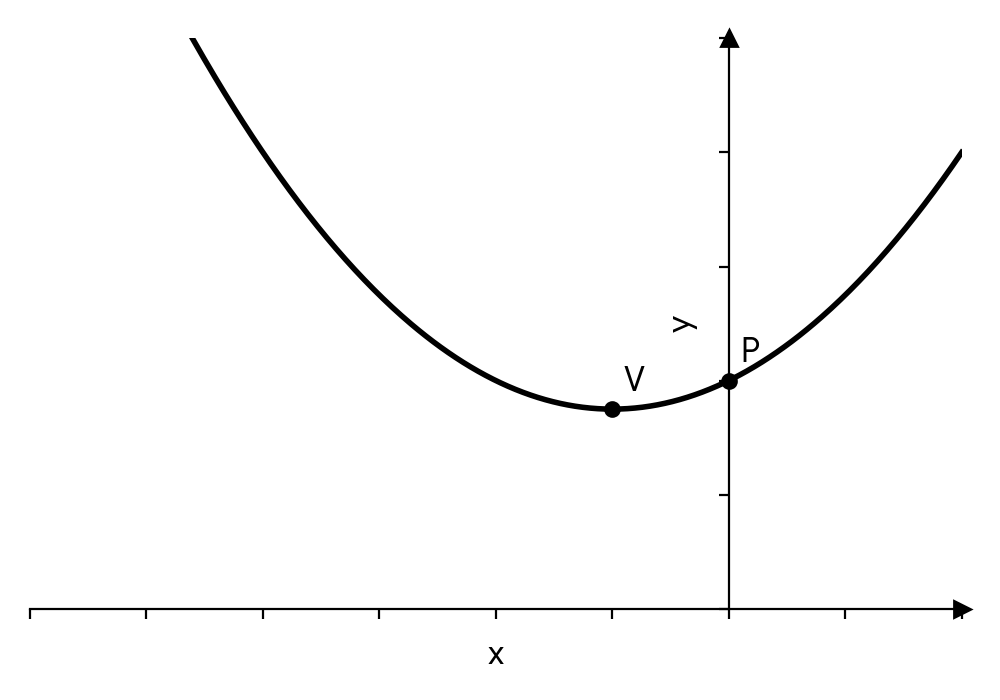
(a) Find the coordinates of the vertex V.
(b) Write down the coordinates of the y-intercept, P.
(c) The line L is the normal to the graph of at point P. Find the equation of L, giving your answer in the form .
(d) The line L intersects the graph of at a second point, Q. Calculate the distance between P and Q.
The x-coordinate of the vertex of a parabola can be found using the formula . Alternatively, you can find the derivative and solve for . Once you have the x-coordinate, substitute it back into the function to find the y-coordinate.
The y-intercept of a graph occurs when the x-coordinate is 0. Substitute into the function .
First, find the derivative of . Then, evaluate the derivative at the x-coordinate of P to find the gradient of the tangent. The gradient of the normal is the negative reciprocal of the tangent's gradient. Finally, use the point-slope form to find the equation of the line.
To find the coordinates of Q, set the equation for the function equal to the equation for the line L and solve the resulting quadratic equation for x. One solution will be the x-coordinate of P. The other will be for Q. Substitute this new x-value back into either equation to find the y-coordinate of Q. Finally, use the distance formula.
Question 10
MediumPaper 1 · no calculator6 marksConsider the curve with equation , where and .
The normal to the curve at the point where is parallel to the line with equation .
Find the value of .
First, find the derivative of the function using the product rule. Then, determine the gradient of the normal from the given line. Use the relationship between the gradient of the normal and the gradient of the tangent. Finally, evaluate the derivative at the given point and set it equal to the gradient of the tangent to solve for .
Question 11
HardPaper 2 · calculator15 marksA landscape architect is designing a section of a garden path. The shape of one edge of the path can be modelled by the function for , where and are measured in metres.
(a) (i) Find , the inverse of , and state its domain.
(ii) Write down the range of .
(b) The graph of intersects the graph of at two points. Find the -coordinates of these two points.
(c) Find the area enclosed by the graph of and the graph of .
(d) Find .
(e) Find the value of for which the graph of and the graph of have the same gradient.
To find the inverse function, swap and in the equation and then solve for . Remember that the domain of is the range of .
The range of the inverse function is the domain of the original function.
The intersection points of a function and its inverse lie on the line . Therefore, you can solve or .
The area enclosed by and can be found by integrating the absolute difference between the two functions, with the limits of integration being the -coordinates found in part (b). You will need a GDC for this integral.
Use the power rule for differentiation: .
First, find the derivative of using the chain rule. Then, equate and and solve the resulting equation for . This may require a GDC to solve the cubic equation.
Question 12
MediumPaper 1 · no calculator13 marksA function, , has its derivative given by , where . The following diagram shows part of the graph of .
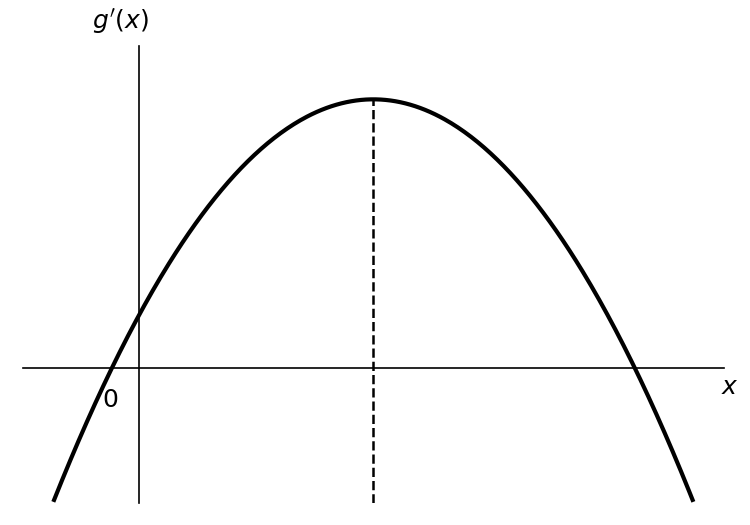
The graph of has an axis of symmetry .
(a) Find the value of .
(b) The vertex of the graph of has a y-coordinate of 10. Find the value of .
(c) Find the equation of the tangent to the graph of at .
The graph of has a point of inflexion at .
(d) (i) Find the value of .
(ii) Find the values of for which the graph of is concave-up. Justify your answer.
The axis of symmetry of a parabola is given by the formula . Alternatively, the vertex (and thus the axis of symmetry) occurs where the derivative of the function is zero.
The vertex lies on the axis of symmetry. Use the value of you found in part (a) as the x-coordinate of the vertex, and the given y-coordinate, to form an equation and solve for .
To find the equation of a tangent line, you need a point on the line and the gradient of the line. The point is found by evaluating . The gradient is found by evaluating the derivative of at .
A point of inflexion on the graph of occurs where the second derivative, , is equal to zero.
The graph of is concave-up when its second derivative, , is positive. Set up and solve the inequality .
Question 13
HardPaper 2 · calculator15 marksA remote-controlled drone is launched from a platform and moves horizontally in a straight line. Its velocity, m s, at time seconds after launch, is given by , for .
(a) Find the drone's initial velocity.
(b) Find the time when the drone is at rest.
(c) Find the drone's acceleration at the instant it comes to rest.
(d) Determine the time interval(s) when the drone is:
(i) slowing down
(ii) speeding up.
The initial velocity refers to the velocity at time . Substitute into the given velocity function.
The drone is at rest when its velocity is equal to zero. Set the velocity function to zero and solve for . Remember to check for extraneous solutions after squaring both sides of an equation.
Acceleration is the derivative of velocity with respect to time, . First, find the expression for , then substitute the time found in part (b) into .
The drone is slowing down when its velocity and acceleration have opposite signs. Analyze the signs of and over the domain . Remember that at and is always positive for .
The drone is speeding up when its velocity and acceleration have the same sign. Use your analysis from part (d.i).
Question 14
MediumPaper 1 · no calculator5 marksConsider the function , where .
The graph of has a local minimum point at where .
Find the value of and the value of .
To find the coordinates of a local minimum, you first need to find the derivative of the function. Then, set the derivative equal to zero to find the x-coordinates of the stationary points. Use the condition given in the question to select the correct x-coordinate.
Question 15
HardPaper 1 · no calculator22 marksDifferentiate each of the following expressions with respect to :
Remember the sum/difference rule for differentiation. Differentiate each term separately. The derivative of a constant is zero.
Use the chain rule. Let and differentiate with respect to .
This is a product of two functions. Use the product rule: .
Use the chain rule. The derivative of is .
Use the chain rule. Let and differentiate with respect to .
This is a quotient of two functions. Use the quotient rule: .
You can simplify the expression using logarithm properties before differentiating, or you can use the chain rule twice.
This requires the chain rule. The derivative of the exponent will require the product rule.
Question 16
MediumPaper 2 · calculator12 marksThe trajectory of a small drone flying over a landscape can be modelled by the function , where is the horizontal distance in meters from the launch point and is the altitude in meters. The drone passes through a checkpoint A at a horizontal distance of 2 meters.
(a) (i) Find the gradient of the tangent to the drone's trajectory at checkpoint A.
(a) (ii) Hence, write down the gradient of the normal to the drone's trajectory at checkpoint A.
(b) Write down the equation of the normal to the drone's trajectory at checkpoint A.
(c) A searchlight beam is directed along the normal line found in part (b). This beam intersects the drone's trajectory again at a second point B. Find the coordinates of B.
To find the gradient of the tangent, you need to calculate the derivative of the function, , and then evaluate it at the given x-coordinate of point A.
The product of the gradients of a tangent and its normal at the same point is -1.
You have the gradient of the normal from part (a.ii) and the coordinates of point A. Use the point-slope form: . Remember to find the y-coordinate of A first.
To find the intersection points, set the equation of the drone's trajectory equal to the equation of the normal line. This will result in a quadratic equation. One solution will be the x-coordinate of point A; the other will be the x-coordinate of point B.
Question 17
HardPaper 1 · no calculator13 marksA function is defined by .
(a) Find the equation of the tangent to the graph of at the point where .
(b) The tangent line found in part (a) intersects the graph of at a second point, P. Find the coordinates of P.
(c) Find the exact area of the finite region enclosed by the graph of and the tangent line.
To find the equation of a tangent line, you need a point on the line and its gradient. The gradient can be found by differentiating the function and evaluating it at the given x-value.
The points of intersection are found by setting the equation of the curve equal to the equation of the tangent line. You already know one solution to this equation, which corresponds to the point of tangency.
The area between two curves, and , from to is given by the integral . The limits of integration are the x-coordinates of the intersection points.
Question 18
MediumPaper 2 · calculator14 marksAn engineer is designing an open-top rectangular container with a square base. The container must have a volume of .
Let the side length of the square base be metres and the height of the container be metres.
Show that the total surface area, , of the material used for the container is given by .
Find an expression for .
Hence, find the exact value of for which the surface area is a local minimum or maximum.
Find an expression for .
Use the second derivative of to justify that is a minimum when .
Find the minimum surface area of the container.
Start by writing down the formula for the volume of the container in terms of and . Then, express the surface area in terms of and . Use the volume constraint to eliminate from the surface area formula.
Remember the power rule for differentiation: . Rewrite as before differentiating.
A local minimum or maximum occurs when the first derivative is equal to zero. Set your expression for to zero and solve for .
Differentiate your expression for with respect to . Remember that can be written as .
Substitute the value of found in part (b.ii) into the second derivative. If the result is positive, it indicates a local minimum. If it's negative, it's a local maximum.
Substitute the value of that gives the minimum surface area (found in part (b.ii) ) back into the original surface area formula, .
Question 19
HardPaper 2 · calculator19 marks(a) A deep-sea submersible's vertical displacement, in metres, from a reference depth is given by for time minutes. Positive indicates the submersible is above the reference depth, and negative indicates it is below.
Find the submersible's vertical velocity and acceleration at any time .
(b) Find the time intervals during when the submersible is moving upwards.
(c) Determine the time intervals during when the submersible's vertical velocity is decreasing.
(d) Calculate the total vertical distance travelled by the submersible during the time . Give your answer to three significant figures.
Remember that velocity is the first derivative of displacement with respect to time, and acceleration is the second derivative of displacement (or the first derivative of velocity) with respect to time. Apply the chain rule where necessary.
The submersible is moving upwards when its vertical velocity is positive. Set and use the identity to transform the inequality into a quadratic in terms of . Solve the quadratic inequality and then find the corresponding values of in the given domain.
The submersible's vertical velocity is decreasing when its acceleration is negative. Set and solve the trigonometric inequality in the given domain. You might need to use a graph or the unit circle to find the intervals.
To find the total distance travelled, you need to integrate the absolute value of the velocity function, . This means you must first find the times when the velocity is zero (the turning points) within the interval . Then, split the integral into sub-intervals where is consistently positive or negative, and sum the absolute values of the displacements in each sub-interval.
Question 20
MediumPaper 2 · calculator8 marksA civil engineer is designing a parabolic arch for a pedestrian bridge. The shape of the arch can be modelled by the function , where is the horizontal distance in meters from one end of the bridge and is the height of the arch above the ground in meters.
A support cable needs to be attached to the arch at a point A where .
(i) Calculate the gradient of the tangent to the arch at point A.
(ii) Hence, write down the gradient of the line perpendicular to the tangent at point A.
The support cable is designed to be perpendicular to the arch at point A. Write down the equation of the line representing this support cable.
The support cable (represented by the normal line) is extended and intersects the parabolic arch again at a second point B. Find the coordinates of point B.
Recall that the gradient of the tangent to a curve at a point is given by the derivative of the function evaluated at that point.
The product of the gradients of two perpendicular lines is -1.
Use the point-gradient form of a straight line equation: . Remember point A is .
Set the equation of the arch equal to the equation of the normal line and solve for . You already know one solution for (from point A).
No question on this page matches those filters. Try another difficulty or paper.
28 more Power rule (standard derivative) questions in the app
Every answer is marked mark by mark, IB-style, and the AI tutor helps when you are stuck.
Where marks are lost
- Using your own wrong value after failing a "show that".