Indefinite integrals + u-substitution: notes and practice questions
- Indefinite integral: The reverse process of differentiation, represented as:
where and is the constant of integration.
- **-substitution**: A method for simplifying integrals by substituting and . Used when includes a composite function.
How it is examined
The from a linear composite, and the constant of integration, are the two marks students give away. without the modulus is a real deduction. 3 to 6 marks, Paper 1.
The four standard integrals (, , , ) are given at SL 5.10, and at SL 5.5. The linear-composite forms are not given, so the factor is recall.
- Indefinite integral of (), , , and .
- The composites of any of these with the linear function .
- Integration by inspection (reverse chain rule) or by substitution for expressions of the form .
Extended at AHL 5.15 and AHL 5.16.
Linking questions
- The shape is the only substitution SL is asked to spot unaided. At HL (AHL 5.16) any other substitution will be provided.
Practice questions
49 questions · 2 easy · 28 medium · 19 hardQuestion 1
EasyPaper 1 · no calculator5 marksConsider the derivative of a function . Find the equation of given that .
Remember that when integrating, sometimes integration by substitution is recommended when the equation has a form similar to the ones in the formula booklet.
Question 2
MediumPaper 1 · no calculator4 marksThe gradient of a curve is given by . The curve passes through the point .
(a) Find the equation of the curve.
To find the equation of the curve from its gradient function, you need to integrate. Remember that indefinite integration introduces a constant, 'c'. Use the given point that the curve passes through to solve for this constant.
Question 3
HardPaper 1 · no calculator17 marksBy using an appropriate substitution, show that .
The following diagram shows part of the curve for .
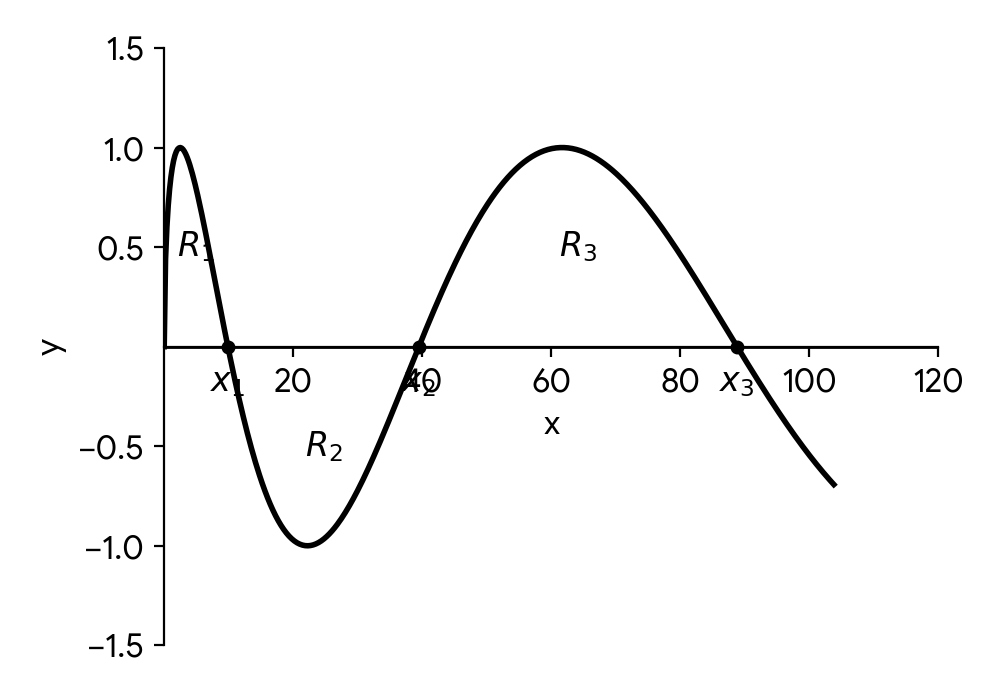
The curve intersects the x-axis at .
The nth x-intercept of the curve, , is given by , where .
Write down an expression for .
The regions bounded by the curve and the x-axis are denoted by as shown on the diagram.
Calculate the area of region .
Give your answer in the form , where .
Hence, show that the areas of the regions form an arithmetic sequence.
Try substituting . After substituting, you will need to use integration by parts.
Simply replace with in the given formula for .
The area of is given by the absolute value of the definite integral from to . Use the result from part (a) and the expressions for the intercepts from part (b).
An arithmetic sequence has a constant common difference. Calculate Area() - Area() and show that it is a constant.
Question 4
EasyPaper 1 · no calculator4 marksGiven that , and when , find in terms of .
To find from , you need to perform integration. Remember to include the constant of integration, , and use the given point to solve for it.
Question 5
MediumPaper 1 · no calculator5 marksThe gradient of the tangent to a curve is given by . The curve passes through the point .
(a) Find .
To find the function from its derivative , you need to integrate. Remember that integration introduces a constant of integration, . Use the given point that the curve passes through to find the value of this constant.
Question 6
HardPaper 1 · no calculator15 marksExpand and simplify in ascending powers of .
By using a suitable substitution for , show that .
Consider the function .
Show that , where is a positive real constant.
It is given that , where . Find the value of .
You can use the binomial theorem or simply multiply out the brackets .
Compare the given expression with your expansion from part (a)(i). What could 'a' be? Once you've made the substitution, you'll need to use a double angle identity for cosine.
Use your result from part (a)(ii) to simplify the expression for first. The resulting integral can be solved using a substitution.
You can evaluate the definite integral using the antiderivative found in part (b)(i). Alternatively, you can use the property .
Question 7
MediumPaper 1 · no calculator4 marksGiven that , and when , find in terms of .
To find the function from its derivative , you need to perform integration. Remember to include the constant of integration, and then use the given point to solve for it.
Question 8
HardPaper 1 · no calculator20 marksConsider the family of integrals defined by for , where .
(a) By using integration by parts, show that for .
(b) Hence, find an explicit expression for .
(c) The region is enclosed by the graph of and the -axis for . The region is rotated by radians about the -axis. Find the volume of the solid generated.
(d) Show that for any .
Consider the function .
(e) (i) Find the Maclaurin series for up to and including the term in .
(ii) Hence, find the value of the fourth derivative of at , i.e. .
Choose and and apply the integration by parts formula, .
Apply the reduction formula from part (a) repeatedly, starting with , until you reach an integral you can compute directly (). Then substitute back.
The formula for the volume of revolution about the x-axis is . You will need to evaluate an improper integral using the result from part (b).
Rewrite the expression as a fraction to get an indeterminate form and then apply L'Hôpital's rule.
Recall the standard Maclaurin series for . Substitute and then multiply the entire series by .
The general term in a Maclaurin series is . Compare the coefficient of the term in your series from part (e)(i) with this general form.
Question 9
MediumPaper 1 · no calculator4 marksGiven that , and the point lies on the graph of , find .
To find the function from its derivative , you need to integrate. Don't forget the constant of integration, which can be found using the given point.
Question 10
HardPaper 1 · no calculator8 marksConsider the homogeneous differential equation , for and .
It is given that when .
By using the substitution , show that the solution to the differential equation is .
Start by differentiating with respect to using the product rule. Then, substitute both and into the original differential equation to eliminate and create an equation in terms of and .
Question 11
MediumPaper 1 · no calculator8 marksThe continuous random variable has probability density function
(a) Find the value of .
(b) Find .
The total probability for any probability density function must be 1. This means the integral of the function over its domain must equal 1. You'll need to recognize the integral form for arctan.
The expected value is found by calculating the integral of over the domain of the function. You will need to use the value of k you found in part (a).
Question 12
HardPaper 1 · no calculator13 marksConsider the function defined by for . The graph of is shown in the following diagram.
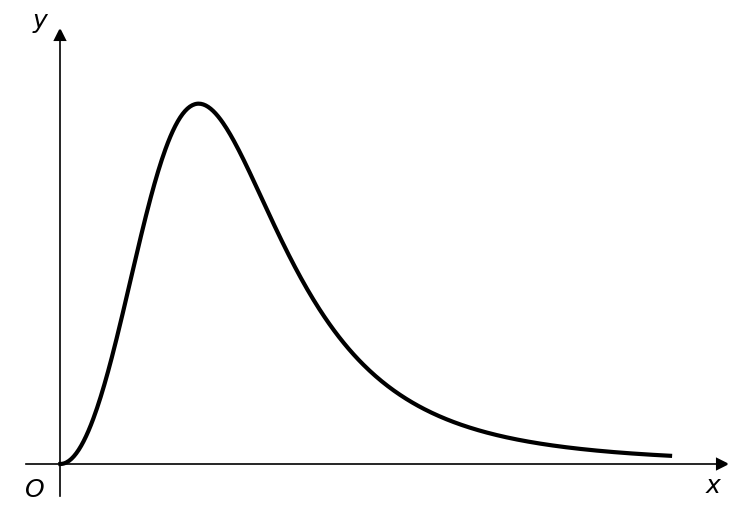
Show that .
Find .
Consider a function defined for . The derivative of is such that , for all .
Let be the region enclosed by the graph of , the graph of , the line and the line . The area of is .
Find the two possible expressions for .
You will need to use the quotient rule for differentiation. Remember to also apply the chain rule when differentiating the denominator, which is a composite function.
Look for a suitable substitution. Notice that the derivative of a part of the denominator is related to the numerator. Don't forget the constant of integration.
If two functions have the same derivative, how are the functions themselves related? The area between two curves and from to is given by the definite integral of the absolute difference of the functions, .
Question 13
MediumPaper 1 · no calculator7 marksBy using the substitution , find .
After performing the substitution, you will be left with an integral of a rational function. Consider how you can break this rational function down into simpler fractions that are easier to integrate.
Question 14
HardPaper 2 · calculator20 marksThe rate of change of a certain quantity with respect to a variable is given by , , , where is a positive constant.
The expression for can be written in the form , where .
Find and in terms of .
Hence, find an expression for .
The concentration of a certain chemical product, (in mol/L), in a reaction vessel at time (in minutes) can be modelled by the differential equation , where is the maximum possible concentration and mol/L is the initial concentration.
By solving the differential equation, show that .
At minutes, the concentration of the product has reached mol/L.
Find the value of , giving your answer correct to four significant figures.
Find the value of when the rate of change of the concentration is at its maximum.
To find and , combine the partial fractions on the right side by finding a common denominator. Then, equate the numerator of this combined expression to the numerator of the original expression for . You can then either compare coefficients of and the constant terms, or substitute specific convenient values for (like and ) to solve for and .
Integrate the partial fraction form of that you found in part (a). Remember that the integral of is and that you might need to use a substitution for terms like . Don't forget the constant of integration.
This is a separable differential equation. Separate the variables and , then integrate both sides. You can use the partial fraction decomposition from part (a) to integrate the terms. After integrating, apply the initial condition to solve for the constant of integration and then rearrange the equation to match the required form.
Substitute the given values for and into the formula derived in part (c). You will then have an equation with only as an unknown. Use your GDC to solve for .
For a logistic growth model, the rate of change is maximized when the quantity (concentration in this case) reaches half of its carrying capacity (maximum value ). Use the value of found in part (d) to determine this critical concentration, then substitute it back into the formula from part (c) to solve for .
Question 15
MediumPaper 1 · no calculator6 marksThe following diagram shows part of the graph of for .
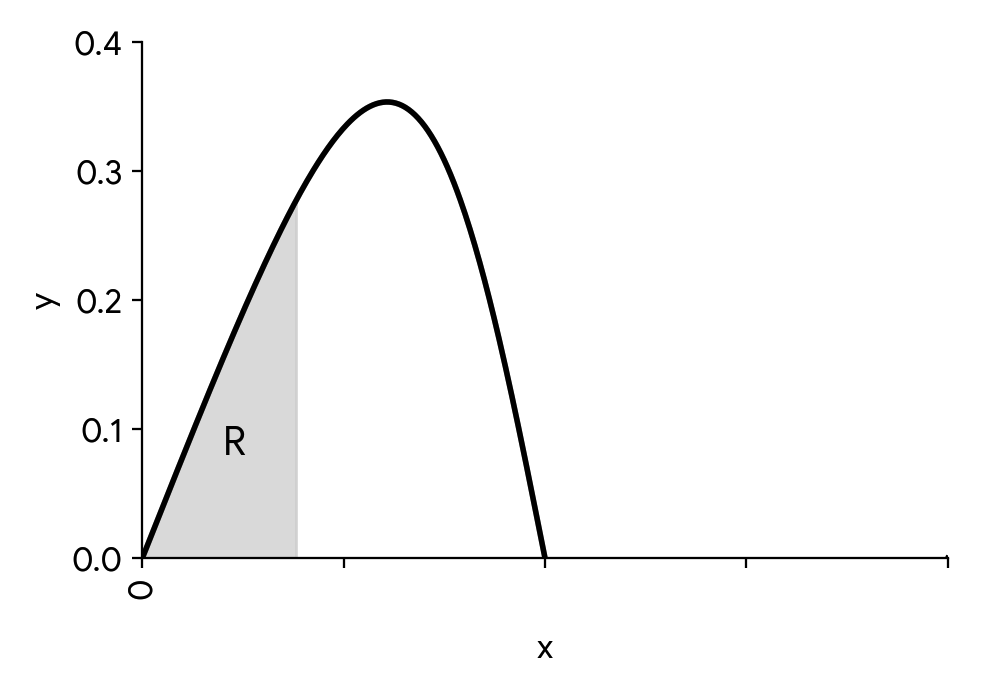
The shaded region is bounded by the curve, the x-axis, the y-axis and the line .
The area of is .
Find the value of .
To find the area of the region R, you need to set up a definite integral. The integral can be solved using a u-substitution. Let be the denominator of the fraction. Once you've found the integral, apply the limits of integration and set the result equal to the given area to solve for .
Question 16
HardPaper 2 · calculator21 marksThe growth of a bacterial colony, , in a petri dish can be modelled by the logistic differential equation
where is the time measured in hours and are positive constants.
The constant represents the maximum number of bacteria the petri dish can sustain indefinitely due to limited nutrients.
In the context of this bacterial growth model, interpret the meaning of .
Show that .
Hence show that the bacterial colony will grow at its maximum rate when . Justify your answer.
Hence determine the maximum value of in terms of and .
Let be the initial number of bacteria.
By solving the logistic differential equation, show that its solution can be expressed in the form
.
After 5 hours, the number of bacteria is . It is known that .
Find the value of for this bacterial growth model.
Consider what a derivative represents in a physical context, especially when it's a quantity with respect to time.
You will need to differentiate with respect to . Remember that is a function of , so implicit differentiation or the chain rule will be necessary. Consider expanding the expression for first, or using the product rule.
To find the maximum rate of growth, you need to find the maximum of . This involves setting the second derivative, , to zero. Remember to justify that it is indeed a maximum.
Substitute the value of at which the growth rate is maximum into the original differential equation.
This is a separable differential equation. Separate the variables and use partial fractions to integrate the term involving . Remember to apply the initial condition ( when ) to find the constant of integration.
Substitute the given values for , , and into the solution obtained in part (e) and solve for . Remember will cancel out.
Question 17
MediumPaper 1 · no calculator4 marksGiven that and , find .
To find the function from its derivative , you need to perform integration. Remember to include the constant of integration, 'c'. Use the given point to solve for this constant.
Question 18
HardPaper 2 · calculator24 marksA team of engineers is designing a new roller coaster ride. The path of a certain section of the ride can be modelled by the function , where is the horizontal distance in metres from the starting point and is the vertical height in metres. The domain of the function is .
Find the coordinates where the path of the roller coaster crosses the horizontal ground (x-axis).
Find the coordinates where the path of the roller coaster crosses the vertical axis (y-axis).
Write down the equation of the vertical asymptote of the graph of .
The oblique asymptote of the graph of can be written as where .
Find the value of and the value of .
Sketch the graph of for , clearly indicating the points of intersection with each axis and any asymptotes.
Engineers want to analyse the inverse of the roller coaster's height function, .
Express in partial fractions.
Hence find the exact value of , expressing your answer as a single logarithm.
To find where the graph crosses the x-axis, set the numerator of the function equal to zero and solve for x. Remember to express your answer as coordinates.
To find where the graph crosses the y-axis, substitute into the function.
The vertical asymptote occurs where the denominator of a rational function is zero.
To find the oblique asymptote, perform polynomial long division of the numerator by the denominator. The quotient will be the equation of the oblique asymptote.
Plot the intercepts and draw the asymptotes first. Then sketch the two branches of the hyperbola, ensuring they approach the asymptotes and pass through the intercepts.
First, write out by taking the reciprocal of . Then, factorize the quadratic denominator and set up the partial fraction decomposition. Solve for the unknown constants.
Integrate the partial fractions found in part (e.i). Remember that . Apply the limits of integration and use logarithm properties to simplify to a single logarithm.
Question 19
MediumPaper 1 · no calculator6 marksThe function is defined as , where .
Consider the shaded region R enclosed by the graph of , the -axis and the line , as shown in the following diagram.
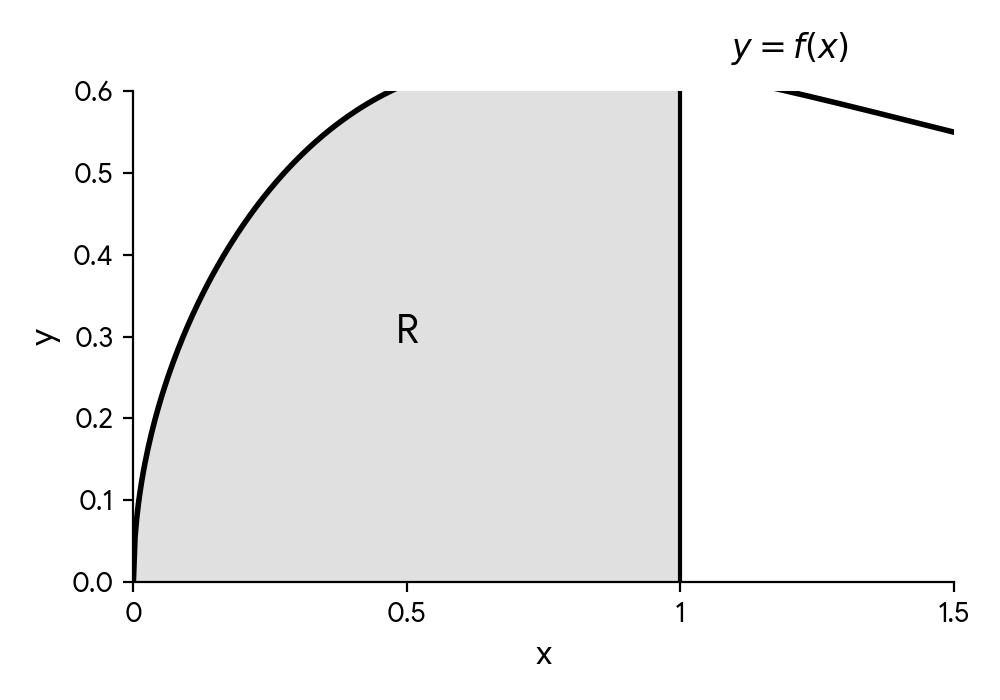
The shaded region R is rotated by radians about the -axis to form a solid.
Show that the volume of the solid is .
Start by setting up the integral for the volume of revolution. Look at the resulting integrand. Does it have a structure that suggests a particular integration technique, like substitution or integration by parts? Consider the relationship between the different parts of the integrand.
Question 20
HardPaper 2 · calculator19 marks(a) In a controlled biological experiment, the rate of change of the population of a certain microorganism with respect to time is modeled by the differential equation , where is in hours and is in thousands of organisms. It is known that at hour, the population is thousand.
Use Euler's method, with a step length of 0.1, to find an approximate value of when .
(b) Use the substitution to show that .
(c.i) By solving the differential equation from part (b), and given that , show that .
(c.ii) Find the actual value of when .
(c.iii) Using the graph of , suggest a reason why the approximation given by Euler's method in part (a) is not a good estimate to the actual value of at .
Remember Euler's method formula: . Carefully calculate the derivative at each step and ensure you are using the correct values for and . Keep sufficient decimal places in intermediate calculations.
Remember to differentiate with respect to using the product rule before substituting into the original differential equation.
After separating variables, you will need to use partial fractions to integrate the expression involving . Don't forget to find the constant of integration using the initial condition and substitute back at the end.
Substitute into the exact solution for you found in part (c.i).
Consider the behavior of the function as approaches . How does the gradient change?
No question on this page matches those filters. Try another difficulty or paper.
29 more Indefinite integrals + u-substitution questions in the app
Every answer is marked mark by mark, IB-style, and the AI tutor helps when you are stuck.
Where marks are lost
- Using your own wrong value after failing a "show that".