Polynomial functions + Sum & Products of roots: notes and practice questions
- Polynomials are expressions of the form . The degree is , and is the leading coefficient.
- The Division Algorithm states , where the degree of is less than the degree of .
- The Remainder Theorem: Dividing by gives a remainder of .
- The Factor Theorem: is a factor of if , meaning is a root.
- For quadratics , the discriminant determines the nature of roots.
- Vieta's formulas relate polynomial coefficients to sums and products of roots. For , sum of roots is , and product is .
- Complex and irrational roots of polynomials with real or rational coefficients, respectively, come in conjugate pairs.
How it is examined
The sum and product results turn a hard root-finding problem into two linear equations, and a question is usually built so that the intended route is that one. The factor and remainder theorems are Paper 1. Watch the in the product, it flips with the degree. 5 to 7 marks.
The sum and product of roots are given in exactly the forms above.
- Polynomial functions, their graphs and equations; zeros, roots and factors.
- The factor and remainder theorems.
- Sum and product of the roots of polynomial equations.
Linking questions
- Enrichment: Viete's theorem in full; Cardano and Bombelli.
Practice questions
30 questions · 17 medium · 13 hardQuestion 1
MediumPaper 1 · no calculator6 marks(a) Using an algebraic method, solve the inequality
Begin by rewriting the inequality in the form . Then, use the factor theorem to find one integer root of the polynomial . This will allow you to factorize the polynomial and find all its roots. Finally, use a sign table or a sketch of the graph to identify the intervals that satisfy the inequality.
Question 2
HardPaper 1 · no calculator7 marksConsider the equation , where and .
Two of the roots of the equation are and . The sum of all the roots is .
Show that .
Recall the conjugate root theorem for polynomials with real coefficients. Then, use Vieta's formulas for the sum and product of roots to find expressions for the coefficients p and s in terms of the roots you have found.
Question 3
MediumPaper 1 · no calculator6 marksThe cubic equation , where is a constant, has three distinct real roots.
Given that two of the roots are reciprocals of each other, find the value of .
Use Vieta's formulas, which relate the coefficients of a polynomial to the sums and products of its roots. Consider the three roots to be , and . What does this structure tell you about the product of the three roots?
Question 4
HardPaper 1 · no calculator8 marksConsider the quartic equation .
Two of the roots of this equation are and , where .
Find the possible values of .
Since the polynomial has real coefficients, what can you say about the other roots? Consider using Vieta's formulas which relate the coefficients of a polynomial to the sums and products of its roots.
Question 5
MediumPaper 1 · no calculator6 marksConsider the polynomial , where and .
Given that is a root of the equation , find the roots of .
If a polynomial has real coefficients, what can you say about its complex roots? Consider the relationships between the roots and the coefficients of the polynomial (sum of roots, product of roots, etc.).
Question 6
HardPaper 1 · no calculator16 marks(a) Find the binomial expansion of . Give your answer in the form where and are expressed in terms of and .
(b) By using De Moivre's theorem and your answer to part (a), show that .
(c) Hence, find the four distinct roots of the equation , expressing them in the form where .
(d) By considering the roots of the equation in part (c), or otherwise, find the exact value of .
Use the binomial theorem . Remember that .
De Moivre's theorem states . Equate the real parts of the two expressions for . You will need to use the identity .
Let and use the result from part (b). This transforms the polynomial equation into a trigonometric equation. Solve for to find the roots.
You can use Vieta's formulas for the product of roots of a polynomial. Alternatively, consider a substitution like to turn the quartic into a quadratic equation. A third approach might use trigonometric identities directly.
Question 7
MediumPaper 1 · no calculator15 marksConsider the function defined by .
Find the -intercepts of the graph of .
The graph of for is shown below. The graph encloses two regions with the -axis, shaded in the diagram.
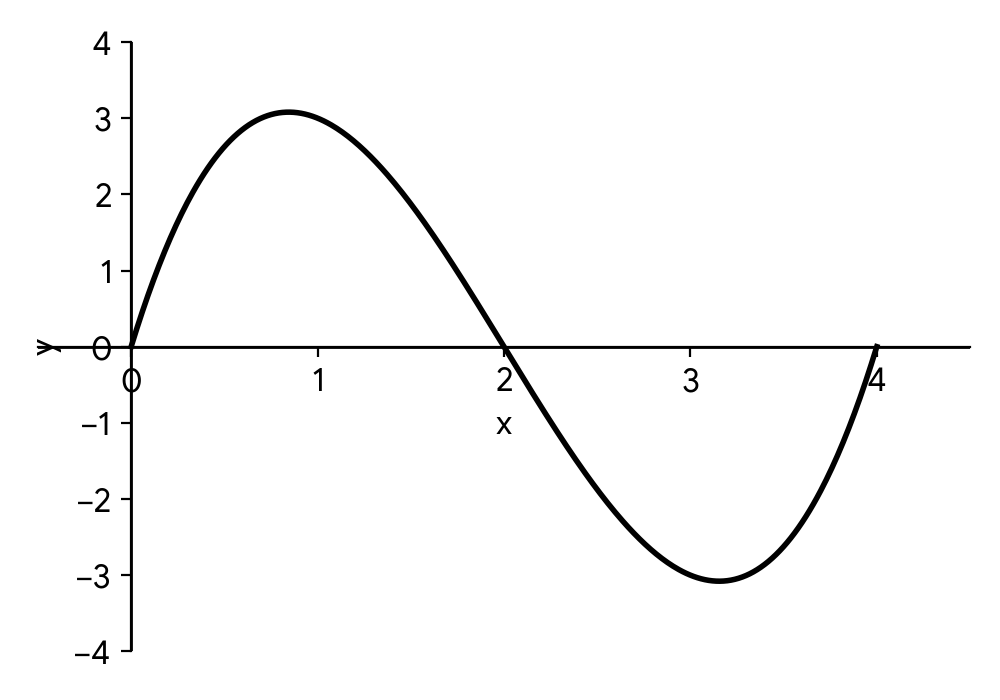
Find the total area of the shaded regions.
The total surface area of a closed right cylinder is 8, equal to the total shaded area found in part (b). The cylinder has a height of .
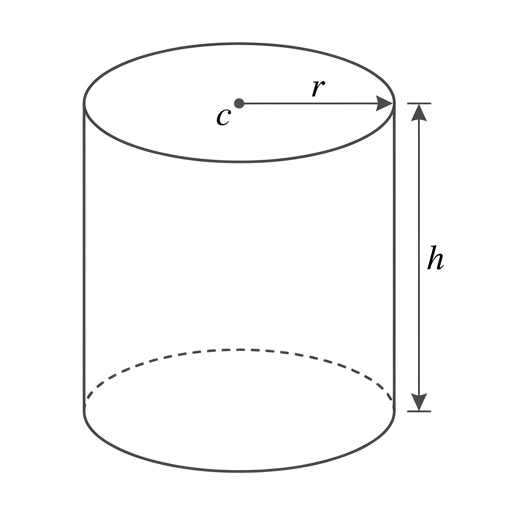
Find the radius, , of the cylinder.
Hence, find the volume of the cylinder.
To find the x-intercepts, you need to solve the equation . Look for a common factor first, then factorize the remaining quadratic.
The total area is the sum of two separate definite integrals. Remember that area must be positive, so you may need to take the absolute value of one of the integrals.
The formula for the total surface area of a closed cylinder is . Set this equal to the area you found, substitute the given height, and solve the resulting quadratic equation for .
The formula for the volume of a cylinder is . Use the values of and you now have.
Question 8
HardPaper 1 · no calculator22 marksConsider the complex number .
By finding the modulus and argument of , show that .
Find the smallest positive integer such that is a real number.
Find the value of when takes the value found in part (b)(i).
Consider the equation , where .
Given that is a root of this equation, find the other roots.
By using a suitable transformation from to , or otherwise, find the roots of the equation , where .
Consider the equation , where .
By expressing in the form , find the roots of the equation.
Recall the formulas for the modulus () and argument () of a complex number . Remember to consider the correct quadrant for the argument.
Express in polar or exponential form using De Moivre's theorem. For a complex number to be real, what must be true about its imaginary part (or its argument)?
Substitute the value of you found in the previous part into the expression for .
If a polynomial has real coefficients and a complex number is a root, what can you say about its conjugate? Once you have two roots, how can you find the third using the sum or product of roots of a cubic equation?
Compare the given equation with the one in part (c)(i). Look for a simple substitution, like or , that transforms one equation into the other. The roots of the new equation will then be related to the roots of the original equation by this transformation.
Substitute into the equation. Expand the terms and then equate the real parts on both sides and the imaginary parts on both sides. This will give you a system of two equations in terms of and to solve.
Question 9
MediumPaper 1 · no calculator5 marksThe cubic equation has roots and , where .
Given that the equation has a repeated root, find the values of and .
Start by applying Vieta's formulas for the sum and product of the roots. Then, consider the different possibilities for which two roots could be equal. Remember to check if any possibilities lead to a contradiction.
Question 10
HardPaper 1 · no calculator17 marksFind the binomial expansion of . Give your answer in the form where and are expressed in terms of and .
By using De Moivre's theorem and your answer to part (a), show that .
Hence, show that and are solutions of the equation .
Hence, find the exact value of .
Recall the binomial theorem . Remember to simplify the powers of : .
Use De Moivre's theorem to find another expression for . Then, equate the real parts of this expression and your answer from part (a). You will need to use the identity .
Consider the equation . What are the principal values of that satisfy this? How does this relate to the identity you proved in part (b)?
The equation from part (b) is a polynomial in terms of . Can you make a substitution, like , to turn it into a quadratic equation? Then you can find the roots of this quadratic and relate them to the specific values of from part (c)(i).
Question 11
MediumPaper 1 · no calculator7 marksThe functions and are defined for by
, where
.
Find the two possible functions such that .
Start by finding an expression for the composite function in terms of and . Then, expand this expression and compare the coefficients of the powers of with the given expression .
Question 12
HardPaper 1 · no calculator11 marksA function is defined by , where . The equation has three real roots, and .
(a) Write down the value of .
A polynomial is defined by , where . The roots of are also roots of the equation . It is given that is a root of .
(b) Find the other non-real root of , giving a reason for your answer.
(c) Find the value of .
(d) It is given that the roots form an arithmetic progression. Find the values of and .
Recall Vieta's formulas, which relate the coefficients of a polynomial to the sums and products of its roots. For a cubic polynomial , what is the sum of the roots?
Consider the properties of polynomials with real coefficients. What does this imply about any non-real roots?
Use Vieta's formulas for the quintic polynomial . You know all five roots in terms of . Relate their product to the coefficients of .
Represent the three roots that form an arithmetic progression as . Use the sum of the roots to find the value of , which is one of the roots. Then use the product of the roots to find the common difference .
Question 13
MediumPaper 2 · calculator8 marksProve the identity .
The equation has two real roots, and .
Consider the equation , where and which has roots and .
Without solving , determine the values of and .
Start by expanding the term . Remember the binomial expansion formula or simply multiply it out.
Recall Vieta's formulas for the sum and product of roots of a quadratic equation. Use the identity from part (a) to express the sum of the new roots.
Question 14
HardPaper 1 · no calculator9 marksThe graph of the function and the line with equation are shown in the diagram below. The graphs intersect at the origin O, and at points A and B.
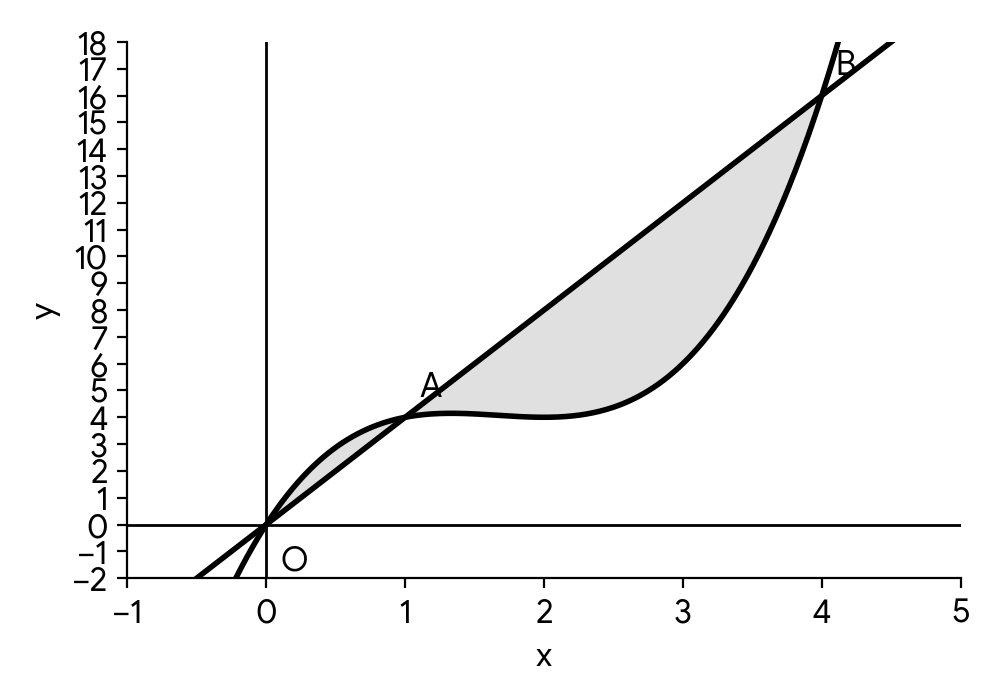
(a) Find the coordinates of A and B.
(b) The region enclosed by the graph of and the line is composed of two smaller regions. Find the total area of these two enclosed regions.
To find the points of intersection, you need to solve the two equations simultaneously. Set equal to the equation of the line .
The total area is the sum of the areas of the two separate regions. You will need to set up two definite integrals. Be careful to identify which function is the 'upper' function in each region.
Question 15
MediumPaper 2 · calculator7 marks(a) Find the binomial expansion of in ascending powers of .
(b) Hence, or otherwise, find the term independent of in the binomial expansion of .
Recall the binomial theorem for . Identify , , and , then expand each term carefully, simplifying powers of .
To find the term independent of , consider which terms from the factor multiply with which terms from the expansion of to result in a constant.
Question 16
HardPaper 1 · no calculator22 marksConsider the complex number .
(a) (i) Express in modulus-argument form.
(a) (ii) Find the smallest positive integer for which is a real number.
Consider the equation , where .
(b) Show that the roots of the equation are given by for .
(c) (i) By using the binomial expansion, show that the equation in part (b) can be written as .
(c) (ii) Let the roots of the equation in (c)(i) be . Without finding the roots, show that .
(d) Hence, find the exact value of .
Recall how to find the modulus and argument of a complex number . Be careful with the quadrant for the argument.
Use De Moivre's theorem to express in terms of . For a complex number to be real, what must be true about its imaginary part?
Start by rearranging the equation to the form . Then find the roots of unity for and solve for . You may need the identities and .
Expand both and using the binomial theorem. Observe which terms cancel when you subtract the two expansions.
Recall Vieta's formulas for the sum of roots and the sum of roots taken in pairs for a polynomial. There is an identity connecting the sum of squares with these two sums: .
The equation from part (c)(i) is a quadratic in . Solve for and determine which of the two solutions corresponds to by considering the behavior of the cotangent function in the first quadrant.
Question 17
MediumPaper 1 · no calculator7 marksThe polynomial is divisible by and has a remainder of 24 when divided by . Find the values of and ().
Use the Factor Theorem for the first piece of information and the Remainder Theorem for the second. This will give you two simultaneous equations involving and .
Question 18
HardPaper 1 · no calculator9 marksLet , for .
Given that is a root of the equation , find the other three roots.
If a polynomial has real coefficients, what can you say about its complex roots? Once you have two roots, you can find a quadratic factor of the polynomial. Then, use polynomial division to find the other quadratic factor.
Question 19
MediumPaper 1 · no calculator5 marksA polynomial is given by , where .
(a) The sum of the roots of the equation is 3. Find the value of .
(b) Hence, find the product of the roots of the equation .
Recall Vieta's formulas which relate the coefficients of a polynomial to the sums and products of its roots. For a general polynomial , what is the formula for the sum of the roots?
Use the value of you found in part (a) and the appropriate formula from Vieta's formulas for the product of the roots. Remember that the formula for the product of the roots depends on the degree of the polynomial.
Question 20
HardPaper 1 · no calculator11 marksFind all the solutions to the equation in the interval . Hence, show that the roots of the equation are , and .
Hence, find the exact value of .
Start by rewriting the equation in the form . Then, use the general solution for this type of trigonometric equation. To connect this to the polynomial, you will need to use the multiple angle identities for and in terms of .
Recall the relationship between the roots of a cubic polynomial and its coefficients (Vieta's formulas). How can you express the required sum of secants in terms of the roots of the polynomial found in part (a)?
No question on this page matches those filters. Try another difficulty or paper.
10 more Polynomial functions + Sum & Products of roots questions in the app
Every answer is marked mark by mark, IB-style, and the AI tutor helps when you are stuck.
Where marks are lost
- Using your own wrong value after failing a "show that".