Special functions derivatives + chain/product/quotient rules: notes and practice questions
- Chain Rule: If , then .
- Product Rule: .
- Quotient Rule: .
How it is examined
Because the rules are in the booklet, the marks are for applying them cleanly, not for quoting them. Nested chain rules and a quotient with a chain inside are the standard Paper 1 difficulty. appearing in an SL question is an out-of- syllabus error worth checking for in generated content. 4 to 7 marks.
The five standard derivatives and the chain, product and quotient rules are all given.
- Derivative of (), , , and .
- Differentiation of a sum and a multiple of these functions.
- The chain rule for composite functions.
- The product and quotient rules.
Extended at AHL 5.15 to , , , , , , , , .
Linking questions
- Links to other subjects: uniform circular motion and induced emf (physics).
Practice questions
108 questions · 2 easy · 60 medium · 46 hardQuestion 1
EasyPaper 1 · no calculator5 marksConsider the function , where . At there is a point of inflection. Find the value of .
When two terms containing the variable "x" are multiplied remember to use the product rule to find the derivative of the equation.
Question 2
MediumPaper 1 · no calculator7 marksConsider the function , where . At , the normal line holds the equation .
Find the value of in the form where and .
This exercise shows how a product rule differentiation can include while applying it a quotient rule differentiation.
Question 3
HardPaper 1 · no calculator14 marks(a) Prove by mathematical induction that for .
(b) Hence or otherwise, determine the Maclaurin series of in ascending powers of , up to and including the term in .
(c) Hence or otherwise, determine the value of .
Start by verifying the base case for n=1. Then, assume the formula holds for n=k and use this assumption to prove it for n=k+1 by differentiating the k-th derivative expression.
You can use the formula from part (a) to find the values of the derivatives at x=0, which are the coefficients in the Maclaurin series. Alternatively, you can use the known series for and substitute , then multiply by x.
Substitute the first few terms of the Maclaurin series you found in part (b) into the expression. Simplify the numerator before taking the limit. Alternatively, you can try to simplify the expression and apply L'Hôpital's rule.
Question 4
EasyPaper 1 · no calculator5 marksConsider the function and the function which is obtained through horizontally translating 1 unit to the right also vertically translating it by 2 units downwards.
Find .
The function has a minimum at . Find .
Moving to the right means substituting x by (x-a) and moving downwards mean subtracting by a constant at the end of the function.
There is a minimum or a maximum point when the derivative of a function is equal to zero.
Question 5
MediumPaper 1 · no calculator7 marksThe function is defined for all . The line with equation is the tangent to the graph of at .
(a) Write down the value of .
(b) Find .
The function is defined for all where and .
(c) Find .
(d) Hence, find the equation of the tangent to the graph of at .
The derivative of a function at a point gives the gradient of the tangent line at that same point. What is the gradient of the given tangent line?
The point of tangency lies on both the function's graph and the tangent line. Substitute the x-coordinate of the point of tangency into the equation of the tangent line.
To find , you first need to calculate the value of the inner function, . Then, use this result as the input for the outer function, .
To find the equation of a tangent line, you need a point and a gradient. You found the point in part (c). To find the gradient, you need to calculate . Remember to use the chain rule to differentiate .
Question 6
HardPaper 1 · no calculator19 marksLet for .
(a) Show that .
(b) Use mathematical induction to prove that for .
Let , where is a real constant.
Consider the function defined by for .
It is given that the coefficient of the term in the Maclaurin series for is .
(c) Find the possible values of .
Rewrite the function as and apply the chain rule twice.
Start by showing the formula holds for the base case, n=2, using your result from part (a). Then, assume the formula is true for n=k, and differentiate this expression to find the (k+1)th derivative. Finally, manipulate your result to show it matches the given formula for n=k+1.
You can solve this in two ways. Either find the first few terms of the Maclaurin series for f(x) and g(x) and then multiply them to find the x^2 term of h(x). Or, you can use the formula for the Maclaurin series coefficient, which involves finding the second derivative of h(x) at x=0.
Question 7
MediumPaper 1 · no calculator7 marksConsider the functions and where .
(a) Find .
The graphs of and have a common tangent at the point where .
(b) Show that .
(c) Hence, find the value of .
To find the derivative of , you can use the power rule for differentiation.
For two functions to have a common tangent at a specific point, their gradients must be equal at that point. Start by finding the derivative of and then set .
If the functions have a common tangent at a point, they must also pass through that same point. This means their y-values are equal at . Set and use the value of you found in part (b).
Question 8
HardPaper 3 · calculator16 marksIn a study of wave propagation, a mathematical model uses the function , where , to describe a certain physical quantity. This function is also known as the hyperbolic sine function, .
Verify that satisfies the differential equation .
Another related function, the hyperbolic cosine, is defined as , also known as . Show that .
The functions and can be extended to complex numbers. Using Euler's formula , where , express in terms of and .
Similarly, express in terms of and .
Hence, show that .
In a design project, a component's profile is described by a hyperbola with parametric equations and , where are positive constants and .
Given that the component's profile passes through the point and has asymptotes , find the values of and .
Recall the derivatives of and . Differentiate the function twice.
Substitute the definitions of and into the expression and simplify.
Substitute into the definition of and use Euler's formula.
Substitute into the definition of and use Euler's formula.
Use your results from part (c) and trigonometric identities.
Substitute the parametric equations into the standard hyperbola form . Use the given point to find one constant and the asymptote equation to find the other.
Question 9
MediumPaper 1 · no calculator5 marksUse l'Hôpital's rule to find .
Recall that l'Hôpital's rule can be applied when a limit results in an indeterminate form like 0/0 or ∞/∞. You will need to differentiate the numerator and the denominator separately.
Question 10
HardPaper 1 · no calculator20 marksLet for .
(a) Show that .
(b) Use mathematical induction to prove that for .
Let .
Consider the function defined by for .
It is given that the term in the Maclaurin series for has a coefficient of .
(c) Find the possible values of .
Rewrite the function using a negative fractional exponent, i.e., . Then, apply the chain rule twice to find the first and second derivatives.
Start by verifying the base case for n=1. Then, assume the formula is true for n=k. Differentiate the expression for to find and manipulate the resulting expression, particularly the factorial and power terms, to show it matches the formula for n=k+1.
You can solve this in two ways. Method 1: Use the formula for the Maclaurin series coefficient, which involves the second derivative: . Find using the product rule and evaluate it at . Method 2: Write out the first few terms of the Maclaurin series for and separately, multiply them, and collect the terms for .
Question 11
MediumPaper 1 · no calculator20 marksThe function is defined by , where .
Find the Maclaurin series for up to and including the term.
Hence, find an approximate value for .
The function is defined by , where .
Show that .
Hence, find the values of and .
Using the result from part (c), find the Maclaurin series for up to and including the term.
Hence, or otherwise, determine the value of .
You can find the Maclaurin series by either multiplying the known series for and , or by repeatedly differentiating and evaluating at . A third method involves using the definition .
Substitute into the Maclaurin series you found in part (a). Then, integrate the resulting polynomial term by term.
Find the first and second derivatives of using the product rule. Remember that and . Alternatively, express in terms of exponential functions first.
Use the relationship and differentiate it repeatedly to find expressions for and . You will need to evaluate first.
You have the values for and from the previous part. You also need to find , , and . Then substitute these values into the Maclaurin series formula.
Substitute the Maclaurin series for that you found in part (d) into the numerator of the limit expression. Simplify and then evaluate the limit. Alternatively, you can use L'Hôpital's rule.
Question 12
HardPaper 1 · no calculator14 marks(a) Prove by mathematical induction that for .
(b) Hence or otherwise, find the Maclaurin series of in ascending powers of , up to and including the term in .
(c) Hence or otherwise, determine the value of .
Start by showing the formula holds for the base case, n=1. Then, assume the formula is true for n=k and use this assumption to prove it is true for n=k+1 by differentiating the k-th derivative expression.
You can either use the general formula for a Maclaurin series, , and the result from part (a) to find the derivatives at x=0. Alternatively, you can use the known Maclaurin series for and substitute , then multiply the resulting series by .
Substitute the first few terms of the Maclaurin series you found in part (b) into the numerator of the limit expression. Simplify the numerator and then evaluate the limit. Alternatively, you can apply L'Hôpital's rule.
Question 13
MediumPaper 1 · no calculator5 marksConsider the curve with equation , where and .
The normal to the curve at the point where is parallel to the line .
Find the value of .
First, find the derivative of the function using the product rule. Then, determine the gradient of the tangent at the given point. Remember the relationship between the gradient of a tangent and the gradient of the normal. Finally, find the gradient of the given line and set up an equation.
Question 14
HardPaper 1 · no calculator14 marks(a) Prove by mathematical induction that for .
(b) Hence or otherwise, determine the Maclaurin series of in ascending powers of , up to and including the term in .
(c) Hence or otherwise, determine the value of .
Start by verifying the formula for n=1. Then, assume the formula is true for n=k and use this assumption to prove it is true for n=k+1 by differentiating the expression for the k-th derivative.
You can either use the general formula for a Maclaurin series and the result from part (a), or you can rewrite the function and use the well-known geometric series expansion.
Consider substituting the Maclaurin series you found in part (b) into the expression. Alternatively, try to simplify the expression inside the limit algebraically before evaluating it.
Question 15
MediumPaper 1 · no calculator8 marksThe functions and are defined by and , for .
The curves and intersect at a point P whose x-coordinate is .
Show that .
Hence, show that the tangent to the curve at P and the tangent to the curve at P are perpendicular.
Find the value of . Give your answer in the form , where and .
At the point of intersection, the y-values of the two functions are equal. Use a trigonometric identity for .
Find the derivatives of both functions. To show that two lines are perpendicular, what must be true about the product of their gradients?
Use the result from part (a) and the Pythagorean identity to form a quadratic equation in terms of .
Question 16
HardPaper 1 · no calculator19 marksA ladder must be placed against a tall vertical building, clearing a monument that is 8 m high and stands on horizontal ground 1 m away from the building's base. The ladder touches the ground, the top corner of the monument, and the wall of the building.
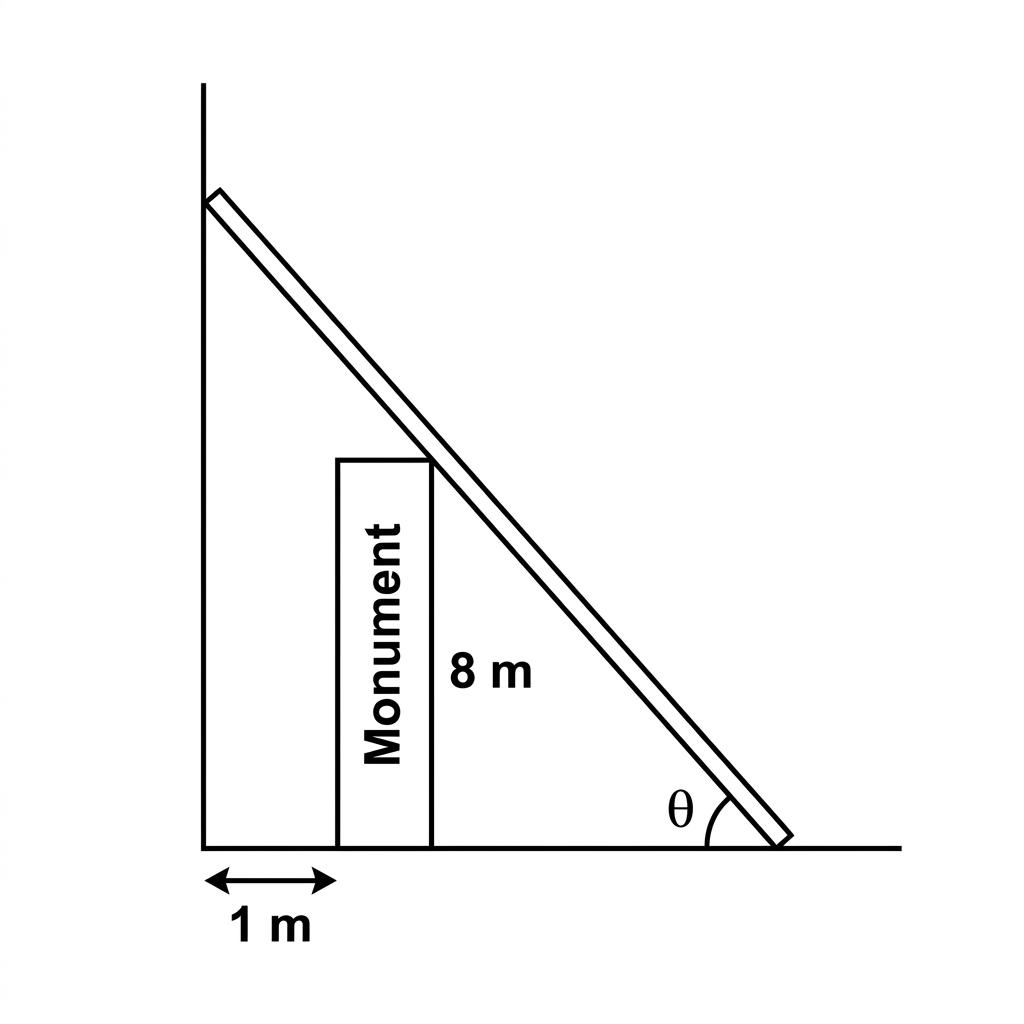
Let be the length of the ladder in metres.
Let be the angle that the ladder makes with the ground, where .
(a) Show that .
(b) (i) Find .
(b) (ii) When , show that .
(c) (i) Find .
(c) (ii) When , find the value of .
(d) (i) Hence, justify that is a minimum when .
(d) (ii) Determine this minimum value of .
(e) A construction company only has ladders with a maximum length of 11 m. Determine whether it is possible to position a ladder against the building over the monument, giving a reason for your answer.
Use trigonometry on the two right-angled triangles formed by the ladder, the ground, the monument, and the wall. Express the two segments of the ladder, divided by the monument's corner, in terms of .
Differentiate the expression for with respect to . You will need to know the derivatives of and .
Set your expression from part (b)(i) equal to zero. Rewrite all trigonometric functions in terms of and and then simplify the equation to find an expression for .
Differentiate your expression for from part (b)(i). You will need to use the product rule for both terms.
If , you can construct a right-angled triangle with opposite side 2 and adjacent side 1. Use this to find the values of , , and any other required trigonometric ratios, then substitute them into your expression for the second derivative.
Use the second derivative test. What does the sign of the second derivative at a stationary point tell you about the nature of that point?
Substitute the trigonometric values corresponding to back into the original expression for from part (a).
Compare the maximum available ladder length (11 m) with the minimum required length you calculated in part (d)(ii). To compare and without a calculator, you can compare their squares.
Question 17
MediumPaper 1 · no calculator7 marksConsider the functions and where .
The graphs of and have a common tangent at .
(a) Find .
(b) Show that .
(c) Hence, find the value of .
Recall the rule for differentiating a natural logarithm function, and apply the chain rule.
For two functions to have a common tangent at a point, their gradients must be equal at that point. Set the derivatives of and equal to each other at .
For the functions to have a common tangent, they must also pass through the same point. This means their y-values are equal at . Set and substitute the value of you found in part (b).
Question 18
HardPaper 1 · no calculator14 marksA rectangle is inscribed in an ellipse with equation . The sides of the rectangle are parallel to the coordinate axes. The vertices of the rectangle are located at , where and .
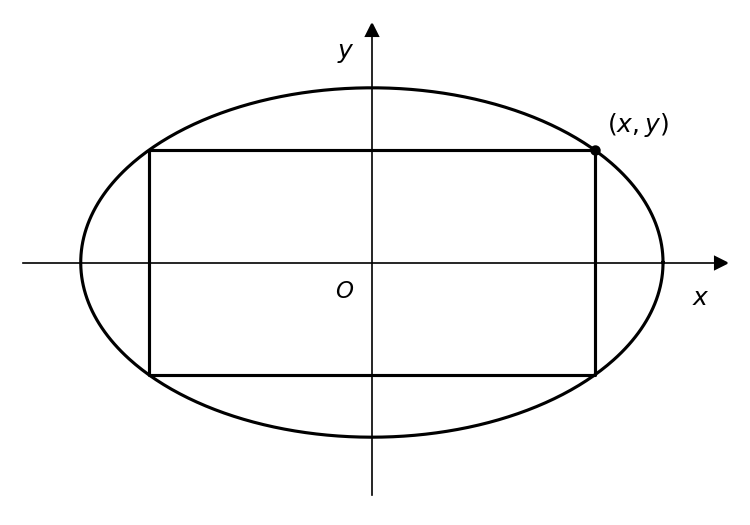
(a) Show that the area of the rectangle, , can be expressed as .
(b) Show that .
(c) Hence, find the exact dimensions of the rectangle with the maximum possible area.
The area of the rectangle is given by its width times its height. Express the width and height in terms of and . Then, use the equation of the ellipse to express in terms of and substitute this into your area formula.
You will need to use the product rule, , and the chain rule to differentiate the expression for the area with respect to .
To find the maximum area, you need to find the value of for which the derivative of the area is zero. Set the expression for from part (b) equal to zero and solve for . Then use this value of to find the corresponding value of and the dimensions of the rectangle.
Question 19
MediumPaper 1 · no calculator9 marksConsider the function f defined by for .
The following diagram shows part of the graph of f which crosses the x-axis at point A, with coordinates . The line L is the tangent to the graph of f at the point B.
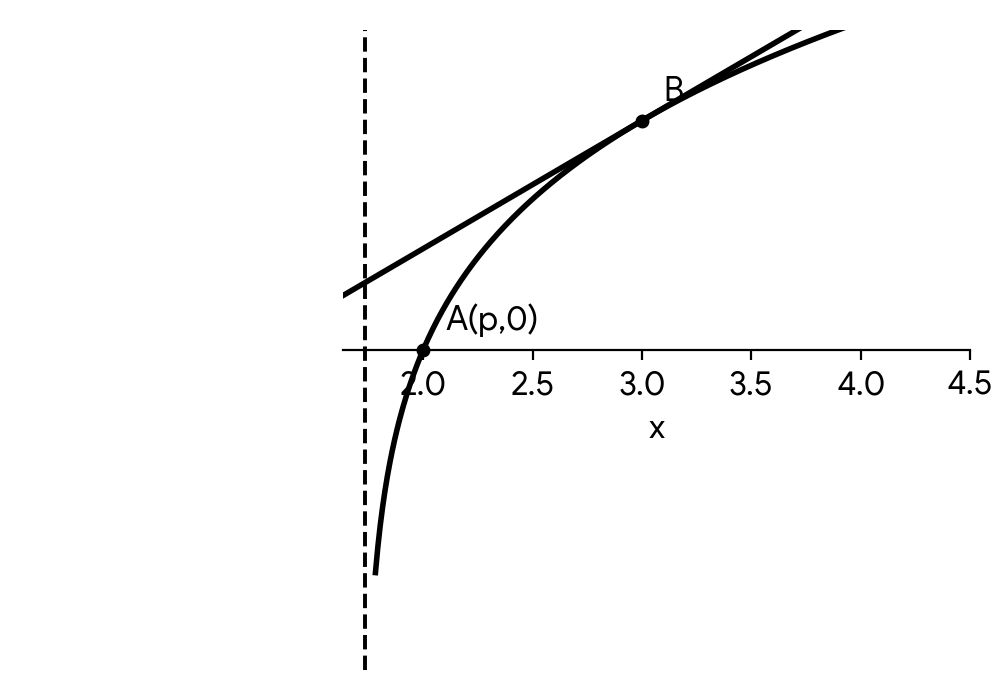
(a) Find the exact value of .
(b) Given that the gradient of L is , find the x-coordinate of B.
To find the x-intercept, you need to solve the equation . Remember the property that if , then .
First, you need to find the derivative of the function . Then, set the derivative equal to the given gradient and solve the resulting equation for .
Question 20
HardPaper 1 · no calculator7 marksConsider the functions and , where .
The graphs of and are shown in the following diagram.
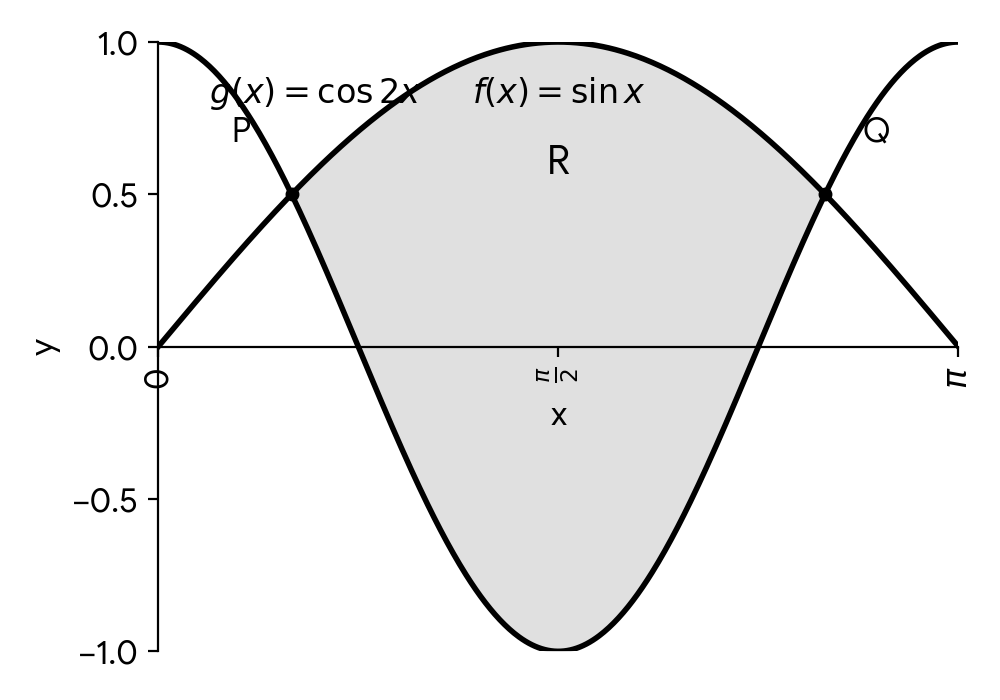
The graphs intersect at points P and Q. The region enclosed by the two graphs is shaded and labelled R.
(a) Find the -coordinates of P and Q.
(b) Find the area of R.
To find the intersection points, set the two functions equal to each other. You will need to use a trigonometric identity to transform the equation into a form that you can solve, likely a polynomial in terms of or .
The area between two curves and from to is given by the definite integral . Use the intersection points you found in part (a) as your limits of integration. You'll need to determine which function is greater on the interval to remove the absolute value.
No question on this page matches those filters. Try another difficulty or paper.
88 more Special functions derivatives + chain/product/quotient rules questions in the app
Every answer is marked mark by mark, IB-style, and the AI tutor helps when you are stuck.
Where marks are lost
- Using your own wrong value after failing a "show that".