Distance between two points, midpoint (up to 3d), angle between two lines: notes and practice questions
- Distance between two points and in 3D:
- Midpoint of two points and :
- Angle between two lines:
where and are direction vectors of the lines.
How it is examined
The SL restriction is the important line: a three-dimensional question at SL cannot require the sine or cosine rule, only right-angled trigonometry. That makes the work identifying the right triangle inside the solid. Paper 2, 5 to 7 marks.
The 3D distance and midpoint formulas, and the volume and surface area formulas for the named solids, are all in the prior learning and topic 3 sections of the booklet.
- The distance between two points in three-dimensional space, and their midpoint.
- Volume and surface area of three-dimensional solids including right-pyramid, right cone, sphere, hemisphere and combinations of these solids.
- The size of an angle between two intersecting lines or between a line and a plane.
Linking questions
- Other contexts: architecture and design.
- Links to other subjects: design technology; volumes of stars and the inverse square law (physics).
Practice questions
14 questions · 2 easy · 6 medium · 6 hardQuestion 1
EasyPaper 1 · no calculator5 marksA map is drawn on a Cartesian plane. A straight road connects two towns, Ashton, located at A(1, 7), and Brixton, located at B(9, -1).
(a) A service station is planned to be built at the midpoint of the road connecting the two towns. Find the coordinates of the service station.
A new road, represented by the line , is to be built perpendicular to the road [AB]. This new road will pass through the service station.
(b) Find the gradient of the line .
(c) Hence, write down the equation of the line .
Recall the midpoint formula: the coordinates of the midpoint are the average of the x-coordinates and the average of the y-coordinates of the endpoints.
First, find the gradient of the line segment [AB]. Then, use the relationship between the gradients of perpendicular lines () to find the gradient of .
You have the gradient of line and a point it passes through (the service station). Use the point-slope form .
Question 2
MediumPaper 1 · no calculator8 marksA kite PQRS is shown on the following set of axes.
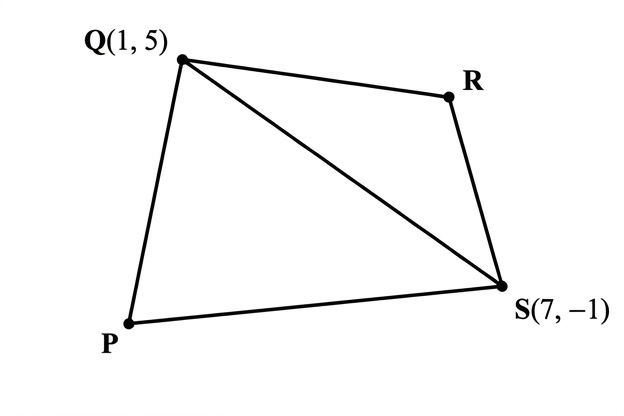
The kite has vertices Q(1, 5) and S(7, -1) and is symmetrical about the diagonal [PR].
(i) Write down the coordinates of the midpoint of [QS].
(ii) Hence, find the equation of the line containing the diagonal [PR].
(b) Given that vertex P lies on the y-axis and the x-coordinate of R is 6, find the area of the kite PQRS.
Recall the midpoint formula, which finds the average of the x-coordinates and the average of the y-coordinates.
The diagonal of symmetry in a kite is the perpendicular bisector of the other diagonal. You will need to find the gradient of [QS] and then use the property of perpendicular lines.
First, determine the coordinates of vertices P and R using the given information and the equation you found in part (a)(ii). Then, calculate the lengths of the two diagonals, [PR] and [QS], and use the formula for the area of a kite.
Question 3
HardPaper 3 · calculator16 marksIn a study of wave propagation, a mathematical model uses the function , where , to describe a certain physical quantity. This function is also known as the hyperbolic sine function, .
Verify that satisfies the differential equation .
Another related function, the hyperbolic cosine, is defined as , also known as . Show that .
The functions and can be extended to complex numbers. Using Euler's formula , where , express in terms of and .
Similarly, express in terms of and .
Hence, show that .
In a design project, a component's profile is described by a hyperbola with parametric equations and , where are positive constants and .
Given that the component's profile passes through the point and has asymptotes , find the values of and .
Recall the derivatives of and . Differentiate the function twice.
Substitute the definitions of and into the expression and simplify.
Substitute into the definition of and use Euler's formula.
Substitute into the definition of and use Euler's formula.
Use your results from part (c) and trigonometric identities.
Substitute the parametric equations into the standard hyperbola form . Use the given point to find one constant and the asymptote equation to find the other.
Question 4
EasyPaper 2 · calculator7 marksA modern art sculpture features several interconnected points in 3D space. Three key connection points are , and .
(a) Find the length of the segment .
(b) Find the midpoint of the segment .
(c) Find the length of the segment .
Use the distance formula for two points in 3D space: .
The midpoint of a segment with endpoints and is given by .
Remember to apply the distance formula correctly for points and .
Question 5
MediumPaper 2 · calculator6 marksA temporary exhibition structure is being designed. The coordinates of three points on the ground are P(0,0,0), Q(8,0,0), and R(0,6,0). A supporting mast is erected at point S(4,3,10).
(a) Calculate the length of the structural cable .
(b) Determine the angle QR, in radians.
To find the length of a cable connecting two points, first determine the displacement vector between the points, then calculate its magnitude using the distance formula in 3D space.
To find the angle between two vectors originating from the same point (S in this case), use the scalar product formula: . Remember to find the vectors and first.
Question 6
HardPaper 1 · no calculator18 marksBy considering De Moivre's theorem, show that .
Let . Show that .
Hence, find the four roots of the equation in Cartesian form.
The four roots are represented by points A, B, C, D on an Argand diagram, forming a square. Find the area of this square.
Each of the points A, B, C, D is rotated counter-clockwise about the origin by an angle of to form new points A', B', C', D'. These points are the roots of an equation . Find in Cartesian form.
It is given that the eight points represented by the roots of and are all solutions of for some and . Find the smallest positive value of .
Use the binomial theorem to expand and then equate the real parts of the result with the real part of . Remember the identity .
You can either expand by first squaring it to get , then squaring the result, or you can convert to polar form first and then apply De Moivre's theorem.
Remember that for a polynomial with real coefficients, complex roots come in conjugate pairs. Also, consider the symmetry of the roots of on the Argand diagram; they are equally spaced on a circle.
First, plot the four roots on an Argand diagram to identify the shape. Then use the appropriate formula for its area. You can find the side length by calculating the distance between two adjacent vertices.
A rotation by an angle corresponds to multiplication by . First, find one of the new roots, say , by rotating . The new equation will be .
The roots of are equally spaced around a circle. What is the angle between them? Find the arguments of all eight points and determine the smallest angle that could be a common divisor for all the angular separations.
Question 7
MediumPaper 1 · no calculator7 marksA particle moves along a path defined by the equation for . The origin, , represents a fixed sensor. Let be the position of the particle.
(a) Show that the square of the distance from the sensor to the particle, , can be expressed as .
(b) Find the coordinates of the points on the path that are closest to the sensor.
Use the distance formula between two points and , which is . Remember that the point P lies on the curve, so its y-coordinate can be expressed in terms of its x-coordinate.
To find the minimum distance, you need to find the minimum of the expression for the squared distance. Use calculus: find the derivative of the expression with respect to x, set it to zero, and solve for x. Then find the corresponding y-coordinates.
Question 8
HardPaper 1 · no calculator14 marksA function is defined by . The following diagram shows part of the graph of .
The graph has a vertex at V and intersects the y-axis at point P.
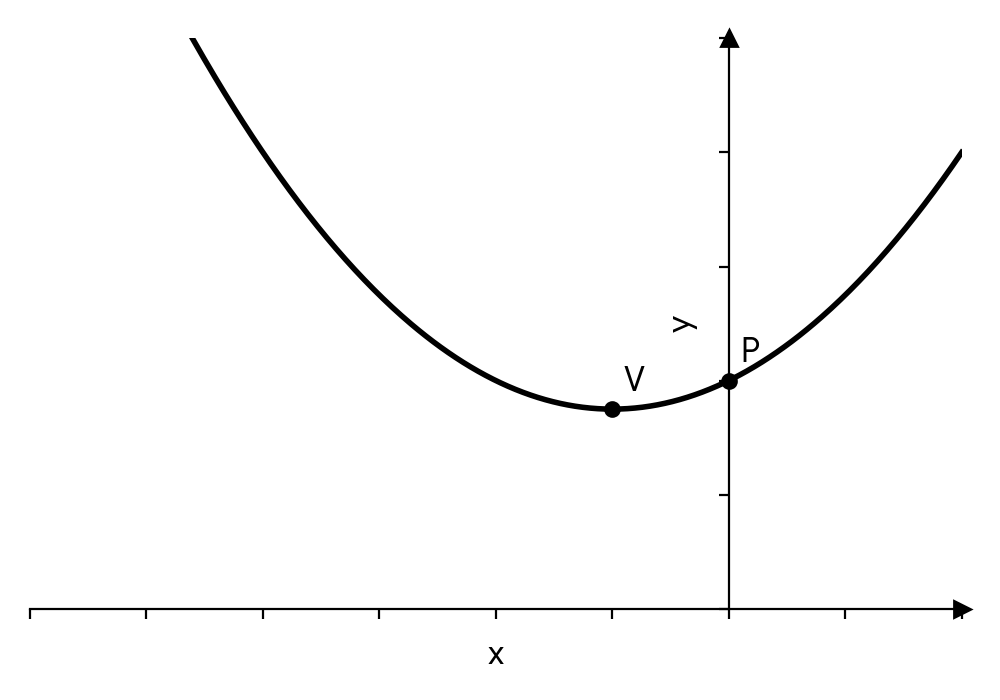
(a) Find the coordinates of the vertex V.
(b) Write down the coordinates of the y-intercept, P.
(c) The line L is the normal to the graph of at point P. Find the equation of L, giving your answer in the form .
(d) The line L intersects the graph of at a second point, Q. Calculate the distance between P and Q.
The x-coordinate of the vertex of a parabola can be found using the formula . Alternatively, you can find the derivative and solve for . Once you have the x-coordinate, substitute it back into the function to find the y-coordinate.
The y-intercept of a graph occurs when the x-coordinate is 0. Substitute into the function .
First, find the derivative of . Then, evaluate the derivative at the x-coordinate of P to find the gradient of the tangent. The gradient of the normal is the negative reciprocal of the tangent's gradient. Finally, use the point-slope form to find the equation of the line.
To find the coordinates of Q, set the equation for the function equal to the equation for the line L and solve the resulting quadratic equation for x. One solution will be the x-coordinate of P. The other will be for Q. Substitute this new x-value back into either equation to find the y-coordinate of Q. Finally, use the distance formula.
Question 9
MediumPaper 1 · no calculator6 marksA plan for a garden is drawn on a coordinate grid, where 1 unit represents 1 metre. The garden consists of a paved patio and a flower bed.
The patio is a quadrilateral with vertices A(-4, 2), B(0, 5), C(4, 2), and D(0, -1).
(a) Find the area of the patio ABCD.
The flower bed is a triangle with vertices C(4, 2), E(9, 4), and F(9, 0).
(b) Find the area of the flower bed CEF.
(c) Hence, find the total area of the garden.
The area of a kite or rhombus can be found using the lengths of its diagonals. First, find the lengths of the diagonals AC and BD. Alternatively, you can split the quadrilateral into two triangles.
The area of a triangle is given by the formula . Identify a suitable base and its corresponding perpendicular height from the coordinates.
The total area of the garden is the sum of the areas of the patio and the flower bed that you calculated in the previous parts.
Question 10
HardPaper 1 · no calculator7 marksConsider the curve defined by the equation , where is a positive constant. The tangent to the curve at a point on the curve intersects the x-axis at the point and the y-axis at the point .
Show that the length of the line segment is equal to .
Start by finding the derivative using implicit differentiation. Then, find the equation of the tangent line at the general point . Use this equation to find the coordinates of the intercepts and . Finally, use the distance formula and the fact that lies on the curve to simplify your expression for the length of .
Question 11
MediumPaper 2 · calculator4 marksA data server rack is shaped like a rectangular prism. One corner of the rack is placed at the origin of a 3D coordinate system. The opposite corner, , has coordinates metres. The faces of the rack are parallel to the coordinate planes.
(a) Calculate the length of the main diagonal of the server rack.
(b) Determine the coordinates of the midpoint of the segment connecting vertex to vertex .
The length of the main diagonal of a rectangular prism with one corner at the origin and the opposite corner at can be found using the 3D distance formula from the origin.
The midpoint of a segment connecting two points and is given by the formula .
Question 12
HardPaper 1 · no calculator9 marksA laser beam is emitted from a source at point . The beam reflects off a flat mirror which lies on the plane . The reflected beam appears to originate from a virtual source at point , where is the reflection of in the plane .
Determine the coordinates of .
Find the exact distance between the laser source and the virtual source .
The line segment is perpendicular to the plane of the mirror. First, find the equation of the line that passes through and is normal to the plane. Then, find the point where this line intersects the plane. This intersection point is the midpoint of the segment .
You can use the distance formula between two points in 3D space, using the coordinates of A and the coordinates of B you found in part (a). Alternatively, you can find the perpendicular distance from point A to the plane and double it.
Question 13
MediumPaper 2 · calculator6 marks(a) The main antenna of a communication tower is located at point . The centre of the rectangular base of the tower is at point . A vertical support beam connects the antenna to the centre of the base. Calculate the length of this support beam, .
(b) The rectangular base of the tower has dimensions m by m. Calculate the length of the diagonal of this base.
(c) A support cable runs from the antenna to one of the corners of the base, say point . Find the size of the angle that this support cable makes with the base platform.
Use the distance formula in three dimensions: .
For a rectangle with sides and , the diagonal .
Consider the right-angled triangle formed by the vertical support beam (), the distance from the centre of the base to a corner (), and the support cable (). The distance is half the diagonal of the base.
Question 14
HardPaper 1 · no calculator14 marksLet P(1, 0, 1), Q(1, 2, 0), and R(k+1, 1, -1) be three points in , where k > 0.
Let be the plane containing the points P, Q, and R.
(a) Find a Cartesian equation for the plane in terms of k.
(b) Let N be the midpoint of the line segment [PR]. A line L passes through N and is perpendicular to the plane . Find a vector equation for the line L in terms of k.
(c) Let be the line defined by the equations . Show that the line L does not intersect the line for any k > 0.
To find the equation of a plane, you need a point on the plane and a vector normal to the plane. You can find the normal vector by taking the cross product of two non-parallel vectors that lie in the plane, such as and .
The direction vector of a line perpendicular to a plane is the normal vector of that plane. You also need a point on the line, which is given as the midpoint of [PR].
To check for intersection, set the corresponding components of the two lines' equations equal to each other. This will give you a system of equations. Try to solve this system and see if you arrive at a contradiction.
No question on this page matches those filters. Try another difficulty or paper.
Every Distance between two points, midpoint (up to 3d), angle between two lines question, marked for you
Every answer is marked mark by mark, IB-style, and the AI tutor helps when you are stuck.
Where marks are lost
- Using your own wrong value after failing a "show that".