Volume & surface area of 3D objects: notes and practice questions
- Volume formulas:
- Cube:
- Rectangular prism:
- Sphere:
- Cylinder:
- Cone:
- Surface area formulas:
- Cube:
- Rectangular prism:
- Sphere:
- Cylinder:
- Cone:
How it is examined
The SL restriction is the important line: a three-dimensional question at SL cannot require the sine or cosine rule, only right-angled trigonometry. That makes the work identifying the right triangle inside the solid. Paper 2, 5 to 7 marks.
The 3D distance and midpoint formulas, and the volume and surface area formulas for the named solids, are all in the prior learning and topic 3 sections of the booklet.
- The distance between two points in three-dimensional space, and their midpoint.
- Volume and surface area of three-dimensional solids including right-pyramid, right cone, sphere, hemisphere and combinations of these solids.
- The size of an angle between two intersecting lines or between a line and a plane.
Linking questions
- Other contexts: architecture and design.
- Links to other subjects: design technology; volumes of stars and the inverse square law (physics).
Practice questions
25 questions · 2 easy · 19 medium · 4 hardQuestion 1
EasyPaper 1 · no calculator5 marksA company produces artisanal candles. One of their products is a large conical candle with a base radius of 6 cm and a height of 10 cm.
(a) Find the volume of the conical candle, giving your answer in terms of .
The wax from one of these conical candles is melted down and recast to create 20 identical cylindrical tea light candles, each with a height of 5 cm.
(b) Find the radius of a tea light candle.
Recall the formula for the volume of a cone, which is . Substitute the given values for the radius and height.
The total volume of wax remains the same. First, calculate the volume of a single cylindrical candle. Then, use the formula for the volume of a cylinder, , to solve for the radius.
Question 2
MediumPaper 1 · no calculator15 marksConsider the function defined by .
Find the -intercepts of the graph of .
The graph of for is shown below. The graph encloses two regions with the -axis, shaded in the diagram.
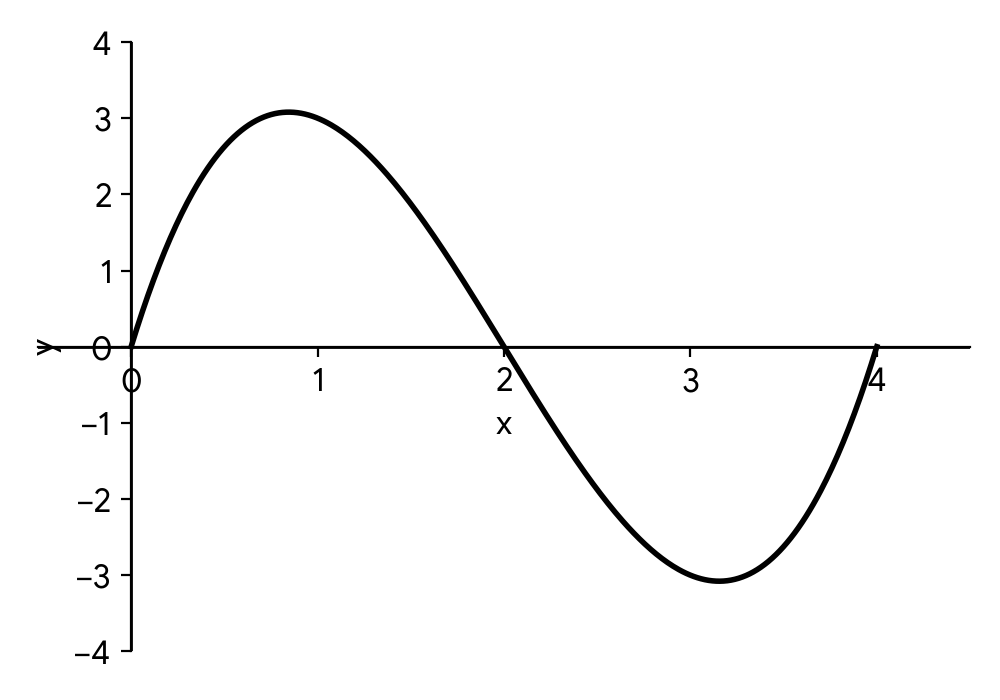
Find the total area of the shaded regions.
The total surface area of a closed right cylinder is 8, equal to the total shaded area found in part (b). The cylinder has a height of .
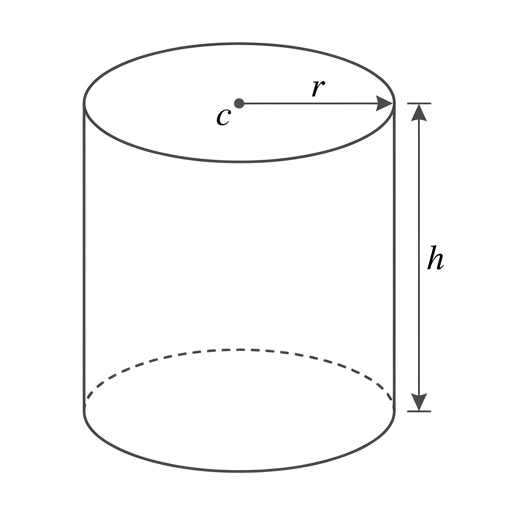
Find the radius, , of the cylinder.
Hence, find the volume of the cylinder.
To find the x-intercepts, you need to solve the equation . Look for a common factor first, then factorize the remaining quadratic.
The total area is the sum of two separate definite integrals. Remember that area must be positive, so you may need to take the absolute value of one of the integrals.
The formula for the total surface area of a closed cylinder is . Set this equal to the area you found, substitute the given height, and solve the resulting quadratic equation for .
The formula for the volume of a cylinder is . Use the values of and you now have.
Question 3
HardPaper 1 · no calculator19 marksTwo spacecraft, S1 and S2, travel along straight paths, represented by the lines and respectively. The paths of the spacecraft intersect at a docking station D. A probe is located at a point P on the path of . This is shown in the following diagram.
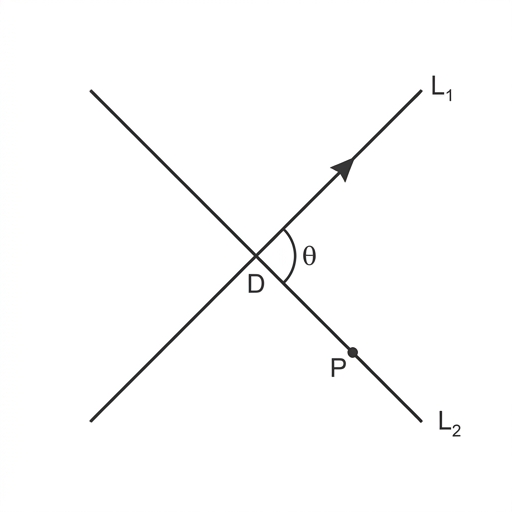
The direction vector of is . The vector is given by , where .
The acute angle between the paths and is , where .
(a) Show that .
(b) Find the value of .
(c) Hence, find the shortest distance from the probe at P to the path .
The paths and lie on a plane, .
(d) Find a vector normal to the plane .
A satellite dish is modelled as a right circular cone with its vertex at V. The base of the cone lies in the plane and is centred at P. The path is tangent to the circular base of the cone. The volume of the cone is cubic units. The position vector of P is .
(e) Find the two possible position vectors for V.
Use the scalar product formula for the angle between two vectors, .
Square both sides of the equation from part (a) to eliminate the square root, then solve the resulting quadratic equation.
The shortest distance from a point P to a line L1 can be found using trigonometry. Consider the right-angled triangle formed by P, D, and the point on L1 closest to P. The distance is given by . Alternatively, use the vector product formula for the distance.
A normal vector to a plane containing two lines can be found by taking the vector product of their direction vectors.
The radius of the cone's base is the shortest distance from P to L1. Use the volume formula to find the cone's height, . The vertex V is located at a distance from the centre P, along the direction of the normal vector to the plane. Remember there are two possible directions along the normal.
Question 4
EasyPaper 1 · no calculator3 marksA rectangular chocolate bar has dimensions length 200 mm, width 8 cm, and height 5 mm.
Find the volume of the chocolate bar, in cm³.
First, ensure all the dimensions are in the same unit (cm) before you calculate the volume. Remember that 1 cm = 10 mm. The formula for the volume of a rectangular prism (cuboid) is length × width × height.
Question 5
MediumPaper 1 · no calculator4 marksA scientist is studying a spherical microbe. The radius of the microbe is measured to be cm.
(a) Write down the diameter of the microbe.
(b) The volume of the microbe can be expressed in the form where and .
Find the value of and the value of .
The diameter of a sphere is twice its radius. How can you apply this to the given radius in scientific notation?
The formula for the volume of a sphere is . Substitute the radius and use the laws of exponents to simplify. Remember to adjust the final answer to match the required scientific notation format.
Question 6
HardPaper 1 · no calculator14 marksA rectangle is inscribed in an ellipse with equation . The sides of the rectangle are parallel to the coordinate axes. The vertices of the rectangle are located at , where and .
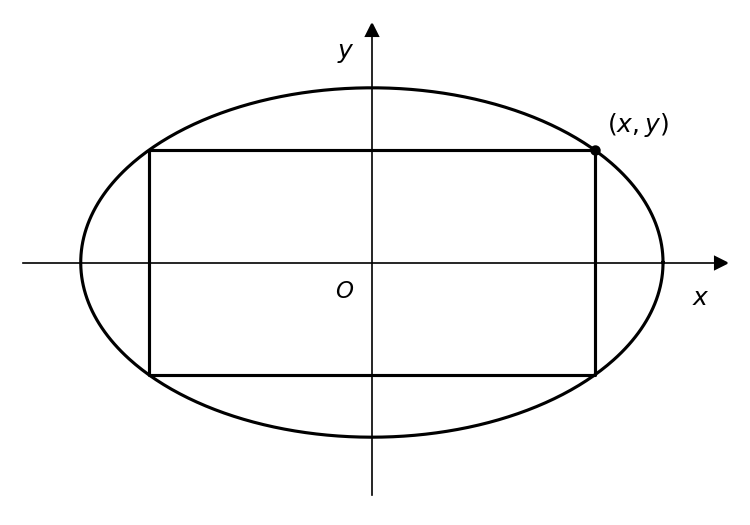
(a) Show that the area of the rectangle, , can be expressed as .
(b) Show that .
(c) Hence, find the exact dimensions of the rectangle with the maximum possible area.
The area of the rectangle is given by its width times its height. Express the width and height in terms of and . Then, use the equation of the ellipse to express in terms of and substitute this into your area formula.
You will need to use the product rule, , and the chain rule to differentiate the expression for the area with respect to .
To find the maximum area, you need to find the value of for which the derivative of the area is zero. Set the expression for from part (b) equal to zero and solve for . Then use this value of to find the corresponding value of and the dimensions of the rectangle.
Question 7
MediumPaper 1 · no calculator8 marksA kite PQRS is shown on the following set of axes.
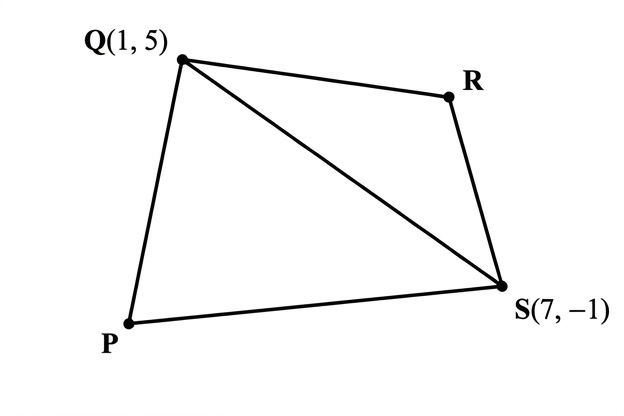
The kite has vertices Q(1, 5) and S(7, -1) and is symmetrical about the diagonal [PR].
(i) Write down the coordinates of the midpoint of [QS].
(ii) Hence, find the equation of the line containing the diagonal [PR].
(b) Given that vertex P lies on the y-axis and the x-coordinate of R is 6, find the area of the kite PQRS.
Recall the midpoint formula, which finds the average of the x-coordinates and the average of the y-coordinates.
The diagonal of symmetry in a kite is the perpendicular bisector of the other diagonal. You will need to find the gradient of [QS] and then use the property of perpendicular lines.
First, determine the coordinates of vertices P and R using the given information and the equation you found in part (a)(ii). Then, calculate the lengths of the two diagonals, [PR] and [QS], and use the formula for the area of a kite.
Question 8
HardPaper 1 · no calculator17 marksA hollow pipe is manufactured by removing a smaller cylinder of radius from the centre of a larger cylinder of radius . Both cylinders have the same height, . This is shown in the following diagram.
All lengths are measured in centimetres.
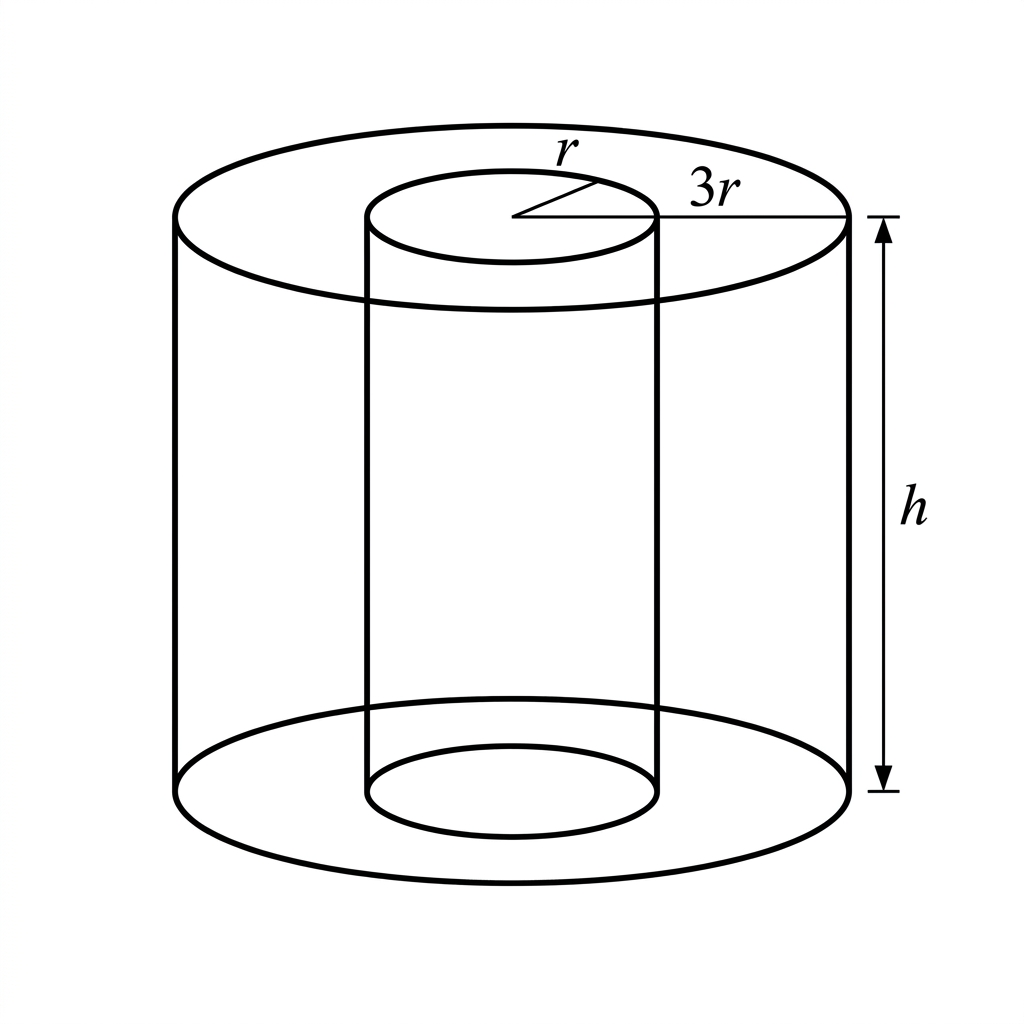
The total surface area of the hollow pipe, in cm, is given by .
(a) Show that .
The total surface area of the hollow pipe is .
(b) Show that the volume of the pipe, , is given by .
(c) Find an expression for .
(d) The hollow pipe has its maximum volume when , where . Find the value of .
(e) Hence, find this maximum volume, giving your answer in the form , where .
The total surface area is the sum of the areas of the top and bottom rings, the outer curved surface, and the inner curved surface.
First, use the given surface area to write an equation for in terms of . Then, write the formula for the volume of the pipe and substitute your expression for .
Use the power rule for differentiation on the expression for from part (b).
The volume is at a maximum when its derivative with respect to the radius is equal to zero. Set up and solve this equation.
Substitute the value of you found in part (d) into the volume formula from part (b). Be careful when simplifying the surds.
Question 9
MediumPaper 2 · calculator14 marksAn engineer is designing an open-top rectangular container with a square base. The container must have a volume of .
Let the side length of the square base be metres and the height of the container be metres.
Show that the total surface area, , of the material used for the container is given by .
Find an expression for .
Hence, find the exact value of for which the surface area is a local minimum or maximum.
Find an expression for .
Use the second derivative of to justify that is a minimum when .
Find the minimum surface area of the container.
Start by writing down the formula for the volume of the container in terms of and . Then, express the surface area in terms of and . Use the volume constraint to eliminate from the surface area formula.
Remember the power rule for differentiation: . Rewrite as before differentiating.
A local minimum or maximum occurs when the first derivative is equal to zero. Set your expression for to zero and solve for .
Differentiate your expression for with respect to . Remember that can be written as .
Substitute the value of found in part (b.ii) into the second derivative. If the result is positive, it indicates a local minimum. If it's negative, it's a local maximum.
Substitute the value of that gives the minimum surface area (found in part (b.ii) ) back into the original surface area formula, .
Question 10
HardPaper 1 · no calculator17 marksThe function is defined by , for .
(a) Show that the curve has only one point of inflection in its domain, and determine its coordinates.
(b) Find the equations of the tangent and the normal to the curve at the point where .
(c) Calculate the area of the triangle formed by this tangent, this normal, and the -axis.
To find a point of inflection, you need to analyze the second derivative of the function, . Find where and check if the concavity changes at that point.
The equation of a line is . For the tangent, the gradient is the value of the first derivative at the given point. The normal is perpendicular to the tangent.
The three lines form a triangle. Find the coordinates of the three vertices of this triangle. Two of the vertices will be the y-intercepts of the tangent and normal. The third vertex is where the tangent and normal intersect.
Question 11
MediumPaper 2 · calculator14 marksA packaging company is designing a new cylindrical can. The can must have a fixed volume of cm. The company wants to minimize the amount of material used, which corresponds to minimizing the total surface area of the can.
Let the radius of the can be cm and its height be cm.
Show that the total surface area, cm, of the can is given by .
The total surface area of the can has a local minimum value when .
(i) Find an expression for .
(ii) Hence, find the exact value of .
(i) Find an expression for .
(ii) Use the second derivative of to justify that is a minimum when .
(iii) Find the minimum surface area of the can.
Start by writing down the formula for the volume of a cylinder and the total surface area of a closed cylinder. Use the given volume to express the height in terms of the radius, then substitute this into the surface area formula.
Remember the power rule for differentiation: . Rewrite as before differentiating.
To find the minimum value, set the first derivative equal to zero and solve for .
Differentiate your expression for with respect to .
Evaluate the second derivative at the critical point . If the value is positive, it indicates a local minimum.
Substitute the value of (the radius that minimizes the surface area) back into the original surface area formula .
Question 12
MediumPaper 2 · calculator5 marks(a) A spherical ice sculpture is melting such that its volume is decreasing at a constant rate of . Find the rate at which the surface area of the ice sculpture is decreasing when its radius is .
Recall the formulas for the volume () and surface area () of a sphere in terms of its radius (). Remember to use the chain rule when differentiating these formulas with respect to time ().
Question 13
MediumPaper 2 · calculator11 marks(a) A decorative rocket toy is designed with a cylindrical body topped by a cone. The cylindrical part has a radius of cm and a height of cm. The conical part also has a radius of cm and a height of cm.
Calculate the total surface area of the rocket toy, giving your answer to one decimal place.
(b) Calculate the total volume of the rocket toy, giving your answer to one decimal place.
(c) The rocket toy is to be placed inside a rectangular prism-shaped display case with internal dimensions cm by cm by cm. Determine the percentage of the volume of the display case that is occupied by the rocket toy. Give your answer to one decimal place.
Remember to include the lateral surface area of both the cone and the cylinder, as well as the base area of the cylinder. You will need to calculate the slant height of the cone first.
The total volume is the sum of the volume of the cone and the volume of the cylinder.
First, calculate the volume of the rectangular prism. Then, divide the volume of the rocket toy by the volume of the display case and multiply by to find the percentage.
Question 14
MediumPaper 2 · calculator6 marks(a) A confectioner prepares a batch of spherical chocolate truffles, each with a diameter of .
Calculate the total volume of all truffles, giving your answer to the nearest whole number.
(b) The truffles are melted down and poured into a rectangular mold to form a solid chocolate bar. The base of the mold has dimensions by .
Calculate the height of the chocolate bar, correct to three significant figures.
Remember the formula for the volume of a sphere. Pay attention to whether the given measurement is a radius or a diameter.
The total volume calculated in part (a) will be the volume of the rectangular chocolate bar. Use the formula for the volume of a rectangular prism.
Question 15
MediumPaper 1 · no calculator5 marksA decorative object is in the shape of a right square-based pyramid. The base of the pyramid is a square with side length . The perpendicular height of the pyramid is .
Find the total surface area of the object.
The total surface area is the sum of the area of the base and the area of the four triangular faces. To find the area of the triangular faces, you will first need to calculate their slant height using the pyramid's perpendicular height and the dimensions of the base.
Question 16
MediumPaper 2 · calculator10 marksA decorative perfume bottle is designed with a cylindrical base and a conical top. The cylindrical part has a radius of and a height of . The conical part has the same radius as the cylinder and a height of .
(a) Calculate the total volume of the perfume bottle.
(b) The external surface of the bottle needs to be coated with a protective layer. Calculate the total external surface area of the bottle, assuming the base of the cylinder is flat and also coated, but the interface between the cylinder and cone is not coated.
Remember the formulas for the volume of a cylinder and a cone. The total volume will be the sum of these two volumes.
The total external surface area will consist of the lateral surface area of the cylinder, the area of the circular base of the cylinder, and the lateral surface area of the cone. Don't forget to calculate the slant height of the cone first.
Question 17
MediumPaper 1 · no calculator5 marksA solid cylinder has a volume of . The height of the cylinder is equal to its radius. Find the exact value of its total surface area.
The formula for the volume of a cylinder is and the total surface area is . Use the given information to first find the radius and height of the cylinder.
Question 18
MediumPaper 2 · calculator8 marks(a) A deep-sea research capsule is designed in the shape of a cylinder of length and diameter , with a hemispherical dome welded to each end.
Calculate the total internal volume of the research capsule.
(b) The external surface of the capsule needs to be coated with a protective layer.
Determine the total external surface area of the research capsule.
Consider the capsule as a combination of a cylinder and a sphere. Remember to correctly identify the radius from the given diameter.
Remember that the flat ends of the cylinder and hemispheres are internal and do not contribute to the external surface area. You need the curved surface area of the cylinder and the surface area of a full sphere.
Question 19
MediumPaper 2 · calculator7 marksA decorative garden pillar is constructed from a solid cylindrical base topped by a solid hemisphere. The radius of both the cylinder and the hemisphere is cm, and the height of the cylindrical part is cm.
(a) Calculate the total volume of the decorative pillar.
(b) Calculate the total exterior surface area of the decorative pillar.
Recall the formulas for the volume of a cylinder and a hemisphere. The total volume will be the sum of these two parts.
Consider the different surfaces that are exposed to the outside: the curved surface of the cylinder, the base of the cylinder, and the curved surface of the hemisphere. Do not include the area where the hemisphere meets the cylinder.
Question 20
MediumPaper 2 · calculator18 marks(a) A glamping tent is designed in the shape of a rectangular-based pyramid. The base of the tent measures m by m, and the vertical height of the tent from the centre of the base to the apex is m.
Calculate the volume of the tent.
(b) The tent is advertised to accommodate a certain number of people, with each person requiring of air space. Using your answer from part (a), calculate the maximum number of people the tent can accommodate.
(c) Show that the length of the longest sloping edge of the tent is m, correct to 3 significant figures.
(d) Find the angle at the apex between two adjacent longest sloping edges, specifically the angle formed by the two sloping edges that meet at the apex and span the m width of the base. Give your answer in degrees, correct to one decimal place.
(e) Calculate the total surface area of the tent fabric, excluding the base. Give your answer correct to one decimal place.
Recall the formula for the volume of a pyramid: .
Divide the total volume of the tent by the air space required per person.
The longest sloping edge connects a corner of the rectangular base to the apex. You will need to use the Pythagorean theorem twice: first to find half the diagonal of the base, and then with the vertical height.
Consider the isosceles triangle formed by the apex and the two corners of the base along the m width. Use the cosine rule.
The tent has four triangular faces. You will need to calculate two different slant heights using Pythagoras, as the base is rectangular.
No question on this page matches those filters. Try another difficulty or paper.
5 more Volume & surface area of 3D objects questions in the app
Every answer is marked mark by mark, IB-style, and the AI tutor helps when you are stuck.
Where marks are lost
- Using your own wrong value after failing a "show that".