Summary
- Radians: (in radians) = .
- Arc Length: .
- Sector Area: .
Where is in radians.
How it is examined
Segment area (sector minus triangle) is the standard composite question and it uses , neither half of which is given as a single formula. Both papers. A calculator left in degree mode ruins the whole question, which is why radians being the default matters. 5 to 7 marks.
and , both in radians. The degree versions are not given in AA (they are an AI formula).
The circle: radian measure of angles; length of an arc; area of a sector.
Practice questions
30 questions · 6 easy · 23 medium · 1 hardQuestion 1
EasyPaper 2 · calculator6 marksA garden sprinkler rotates through an angle of 2.5 radians, watering a sector of a circular lawn. The maximum reach of the water from the sprinkler is 15 metres.
(a) Calculate the length of the arc along the edge of the watered lawn.
(b) Determine the total length of the boundary of the watered sector.
(c) Find the area of the garden watered by the sprinkler.
Recall the formula for the arc length of a sector when the angle is given in radians.
The boundary of a sector includes the arc length and two radii.
Remember the formula for the area of a sector when the angle is given in radians.
Question 2
MediumPaper 1 · no calculator6 marksA lighthouse, L, is situated on a cliff. It emits a beam of light that scans a sector of the sea. The diagram below is a top-down view of the area scanned by the light.
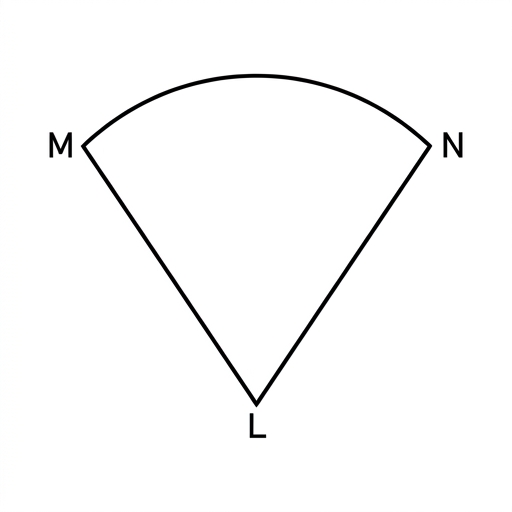
The points M and N represent the furthest points on the edge of the scanned area. The angle of the sector, MÊN, is 1.5 radians.
The perimeter of the sector of the sea scanned by the light is 70 km.
(a) Find the maximum distance the light beam reaches from the lighthouse.
(b) Find the length of the arc MN.
(c) Find the area of the sea scanned by the light beam.
The perimeter of a sector is the sum of two radii and the arc length. Remember the formula for arc length in terms of radius and angle, and use this to form an equation.
Use the formula for the length of an arc, , with the values you know or have found.
Recall the formula for the area of a sector. You have all the necessary values from the previous parts.
Question 3
HardPaper 3 · calculator28 marksA landscape architect is designing various garden beds where the numerical value of the area is the same as the numerical value of the perimeter. For each garden bed, let the numerical value of its area be and let the numerical value of its perimeter be .
(a) Find the side length, , where , of a square-shaped garden bed such that .
An -sided regular polygon is considered for a circular-like garden bed design. Such a polygon can be divided into congruent isosceles triangles, with their vertices meeting at the centre of the polygon. Let be the length of each of the two equal sides of one such isosceles triangle (distance from the centre to a vertex) and let be the length of the third side (a side of the polygon). The included angle between the two equal sides has magnitude .
Part of such an -sided regular polygon is shown in the following diagram.
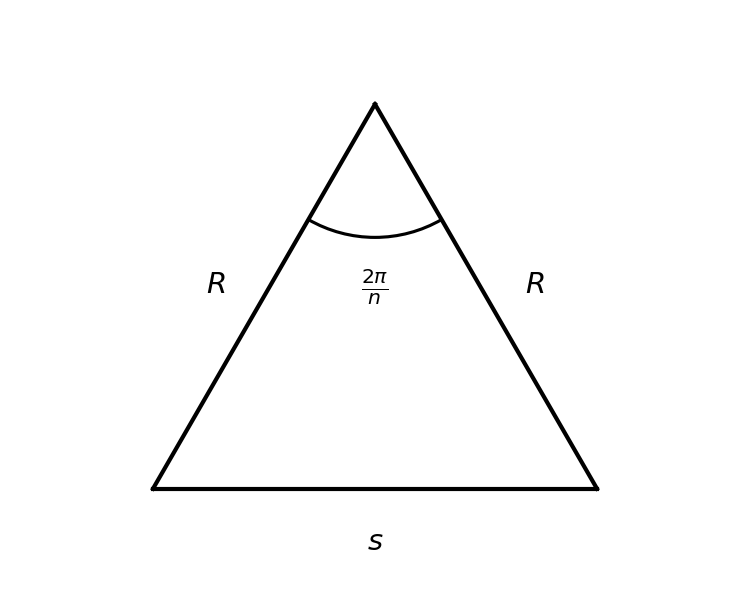
(b) Write down, in terms of and , an expression for the area, , of one of these isosceles triangles.
(c) Show that .
(d) Consider an -sided regular polygon garden bed such that .
Use the results from parts (b) and (c) to show that .
(e) The landscape architect considers a very large number of sides for the regular polygon garden bed.
(i) The Maclaurin series for is
Use the Maclaurin series for to find .
(ii) Interpret your answer to part (e)(i) geometrically in the context of the garden bed design.
(f) The landscape architect also considers a right-angled triangular garden bed with perpendicular side lengths and , where , such that .
Show that .
(g) The landscape architect wants to use integer side lengths for the right-angled triangular garden beds.
(i) By using the result of part (f) or otherwise, determine the three side lengths of the only two right-angled triangles for which .
(ii) Determine the area and perimeter of these two right-angled triangles.
Recall the formulas for the area and perimeter of a square in terms of its side length, . Then, set these two expressions equal to each other and solve for . Remember that .
The area of a triangle can be found using the formula , where and are two sides and is the included angle. In this case, the two equal sides are and the included angle is .
Consider dividing the isosceles triangle into two right-angled triangles by dropping a perpendicular from the vertex angle to the side . This bisects the angle and the side . Then use basic trigonometry (SOH CAH TOA).
The total area of the polygon is . The total perimeter of the polygon is . Set these two expressions equal to each other, substitute the formulas from parts (b) and (c), and simplify using trigonometric identities, especially the double angle formula for sine.
Substitute into the Maclaurin series for . Then multiply the entire expression by and evaluate the limit as . Remember that terms with in the denominator will approach zero.
As the number of sides of a regular polygon approaches infinity, what shape does the polygon approximate? Consider the area and perimeter of that shape.
Write down the formulas for the area and perimeter of a right-angled triangle. Set them equal to each other. Isolate the square root term and then square both sides to eliminate it. Simplify the resulting algebraic expression to derive the required relationship.
For to be an integer, must be an integer divisor of 8. Consider the positive divisors of 8. Also, remember the condition and that side lengths must be positive. Additionally, for to be real, the term must be non-negative.
For each triangle, calculate its area using and its perimeter using . You should find that for both.
Question 4
EasyPaper 1 · no calculator6 marksA pendulum swings from a fixed point O. The length of the pendulum is cm. It swings through an angle of radians and sweeps out a sector with an area of .
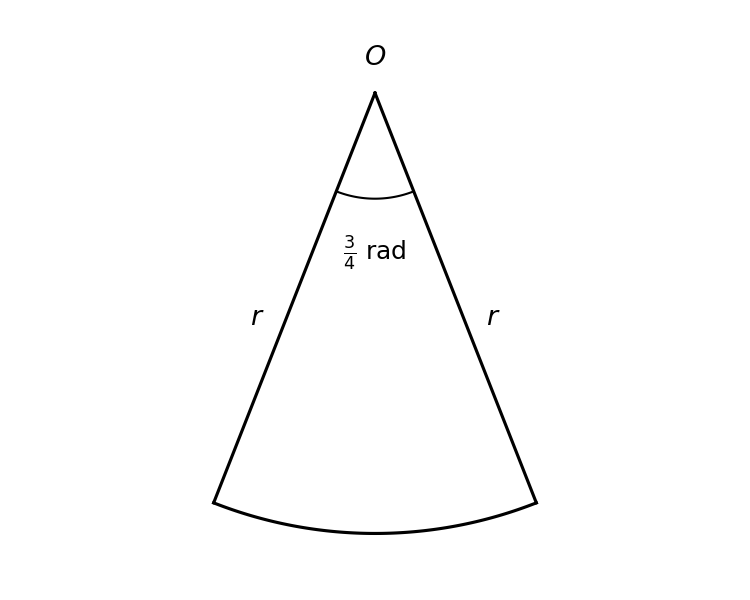
(a) Find the length of the pendulum, .
(b) Find the length of the arc traced by the pendulum's bob.
(c) Find the perimeter of the sector swept by the pendulum.
Recall the formula for the area of a sector in terms of its radius and angle in radians. Substitute the given values and solve for the radius.
Use the formula for the length of an arc, which involves the radius and the angle in radians. You found the radius in part (a).
The perimeter of a sector is the sum of the lengths of the two radii and the arc length. You have calculated both of these values in the previous parts.
Question 5
MediumPaper 1 · no calculator8 marksA company is designing a new logo in the shape of a sector of a circle with centre O and radius cm. The angle of the sector is radians.
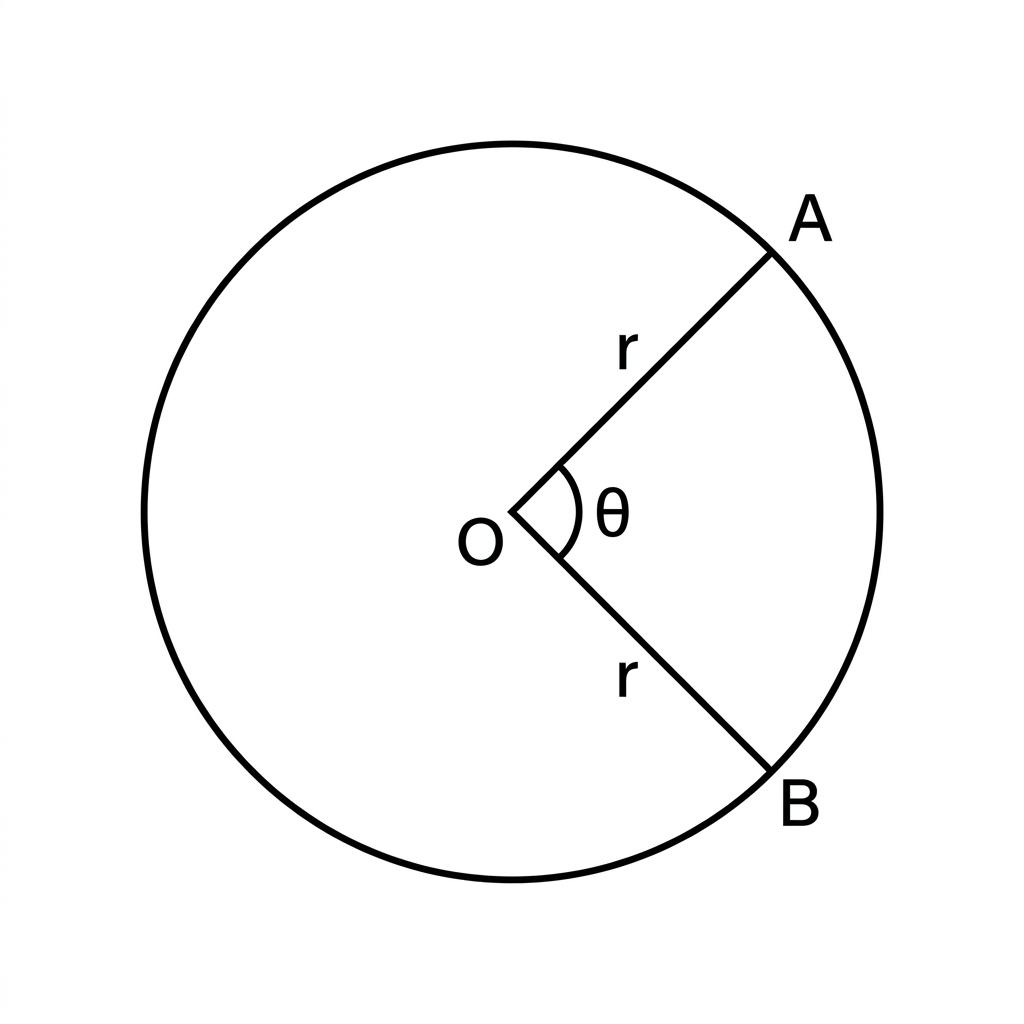
The perimeter of the logo is 24 cm and its area is 32 cm.
(a) Show that .
(b) Find the two possible values for and the corresponding values for .
Write down the formulas for the perimeter and area of a sector in terms of and . You will have a system of two equations with two unknowns. Try to eliminate one of the variables.
The equation from part (a) is a quadratic equation in . Solve it to find the possible values for the radius. Remember that there might be more than one valid solution. For each value of , find the corresponding angle .
Question 6
EasyPaper 1 · no calculator8 marksRewrite each of the following angles from radians to degrees.
(a)
(b)
(c)
(d)
(e)
(f)
(g)
(h)
To convert an angle from radians to degrees, multiply the radian measure by .
To convert an angle from radians to degrees, multiply the radian measure by .
To convert an angle from radians to degrees, multiply the radian measure by .
To convert an angle from radians to degrees, multiply the radian measure by .
To convert an angle from radians to degrees, multiply the radian measure by . Remember to keep the negative sign.
To convert an angle from radians to degrees, multiply the radian measure by . Remember to keep the negative sign.
To convert an angle from radians to degrees, multiply the radian measure by . Remember to keep the negative sign.
To convert an angle from radians to degrees, multiply the radian measure by .
Question 7
MediumPaper 1 · no calculator6 marksThe following diagram shows a sector of a circle with centre O and radius r. The points A and B are on the circumference.
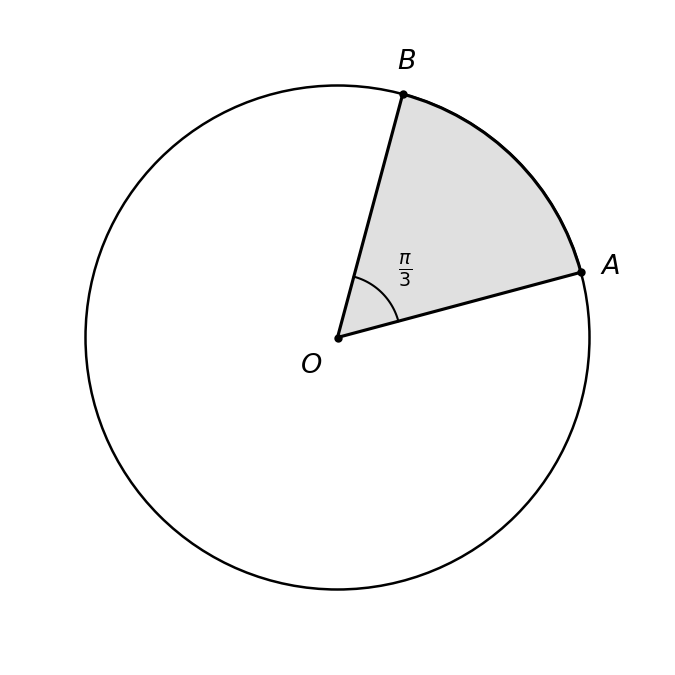
The angle radians. The area of the shaded sector is .
(a) Find the value of r.
(b) Hence, find the exact perimeter of the non-shaded region.
Recall the formula for the area of a sector when the angle is in radians. Substitute the given values and solve for the radius r.
The non-shaded region is the major sector. First, find its central angle. Then, calculate the perimeter, which consists of two radii and the arc length of the major sector.
Question 8
EasyPaper 1 · no calculator4 marksA sprinkler on a golf course rotates and sprays water in a sector shape. The water reaches a distance of 8 metres from the sprinkler, and the arc length of the watered lawn is 10 metres.
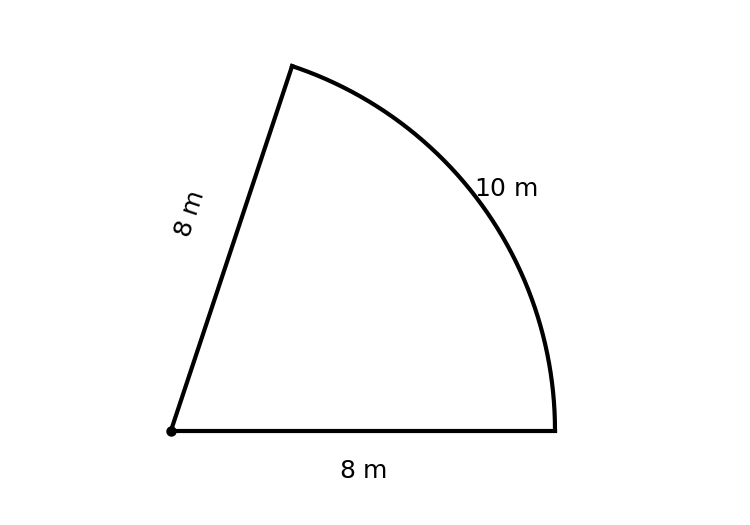
(a) Find the angle, in radians, through which the sprinkler rotates.
(b) Find the area of the lawn watered by the sprinkler.
Recall the formula that connects arc length, radius, and the central angle in radians.
There are two common formulas for the area of a sector. One uses the radius and the angle, and the other uses the radius and the arc length. You can use either.
Question 9
MediumPaper 1 · no calculator5 marksA decorative paper fan is made in the shape of a sector of a circle with centre O and radius . The angle of the sector is radians.
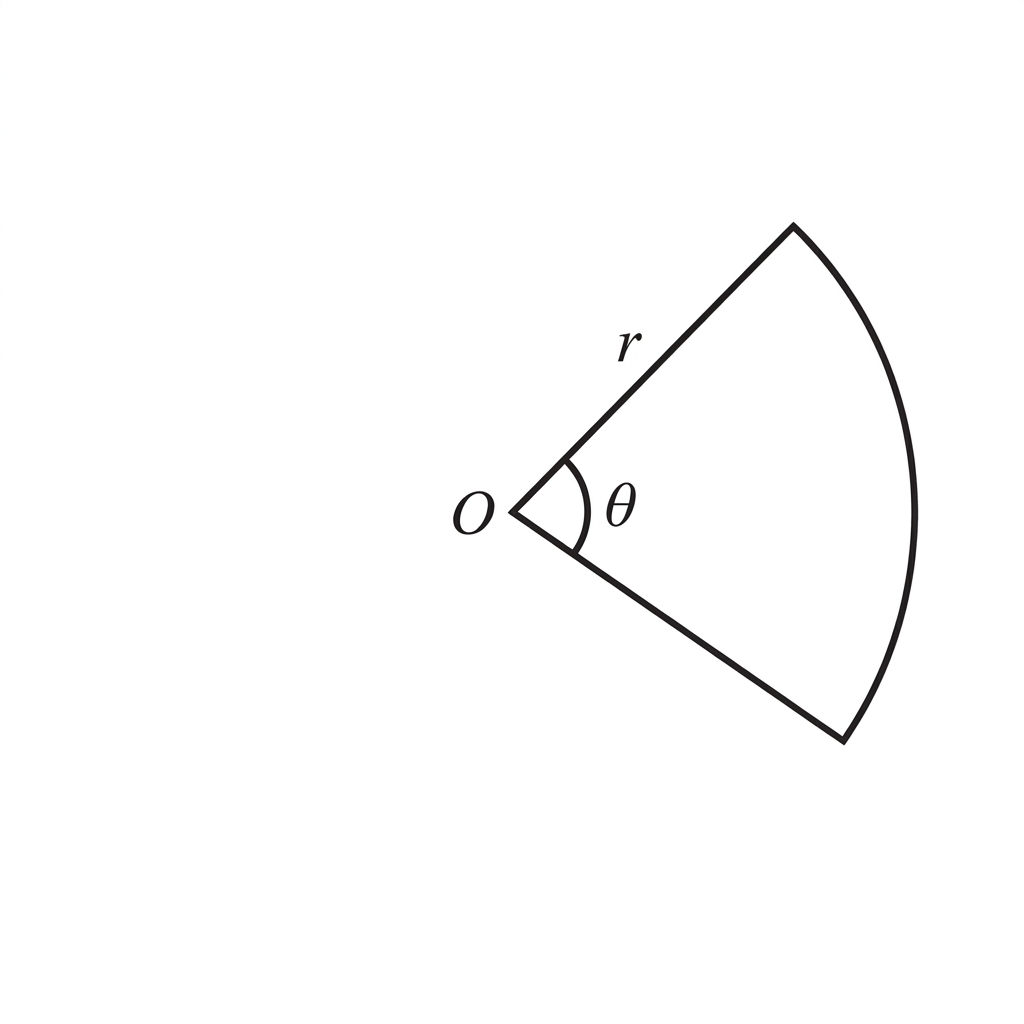
The arc length of the fan is 24 cm and its area is 180 cm².
(a) Find the value of .
(b) Find the value of .
Write down the formulas for the arc length and the area of a sector in terms of and . You will have a system of two equations with two unknowns. Try to solve for .
Use the value of you found in part (a) and one of the formulas for arc length or area to solve for .
Question 10
EasyPaper 1 · no calculator6 marksA sector of a circle with centre and radius is shown in the following diagram. The angle is .
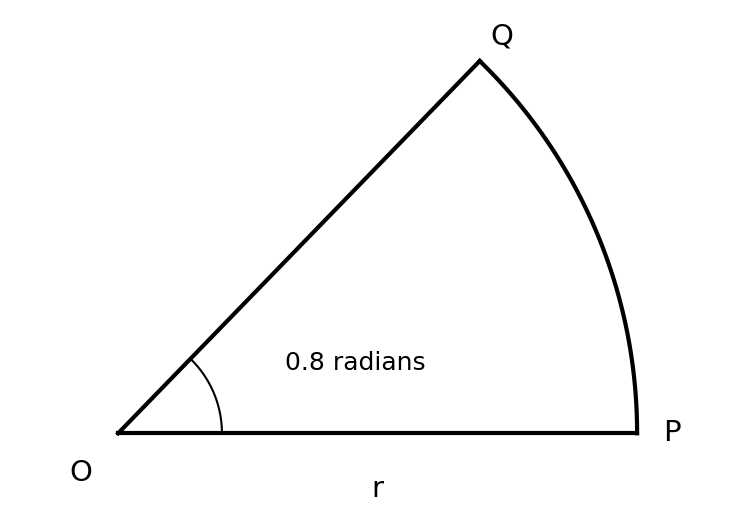
Find an expression for the length of arc in terms of .
(a.ii) Hence, find an expression for the perimeter of sector in terms of .
(b) Given that the perimeter of the sector is , find the value of .
(c) Hence, find the area of sector .
Use the formula for arc length, , where is in radians.
The perimeter of a sector includes the arc length and the two straight edges (radii).
Set your expression for the perimeter equal to and solve for .
Use the formula for the area of a sector, .
Question 11
MediumPaper 2 · calculator6 marksA circular metal disc with centre O and radius is used to create a decorative art piece. A diameter is drawn from point A on the circumference, through O, to point B on the circumference.
Another point C is marked on the circumference such that the angle radians, where .
The region bounded by the chord AC and the arc AC is to be painted blue. The triangle BOC is to be painted red.
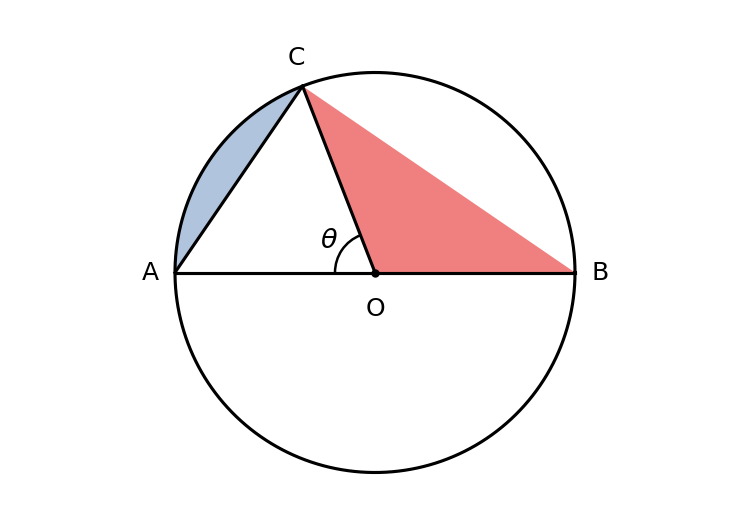
Given that the area of the blue region is equal to the area of the red region, show that .
Hence determine the value of .
Recall the formulas for the area of a circular segment and the area of a triangle given two sides and the included angle. Pay attention to the angles formed by the diameter.
This equation cannot be solved analytically. Use a graphing calculator (GDC) to find the intersection point of two functions or the root of a single function.
Question 12
EasyPaper 1 · no calculator6 marksA sector POQ of a circle with centre O and radius r cm is shown in the following diagram. The angle is radians.
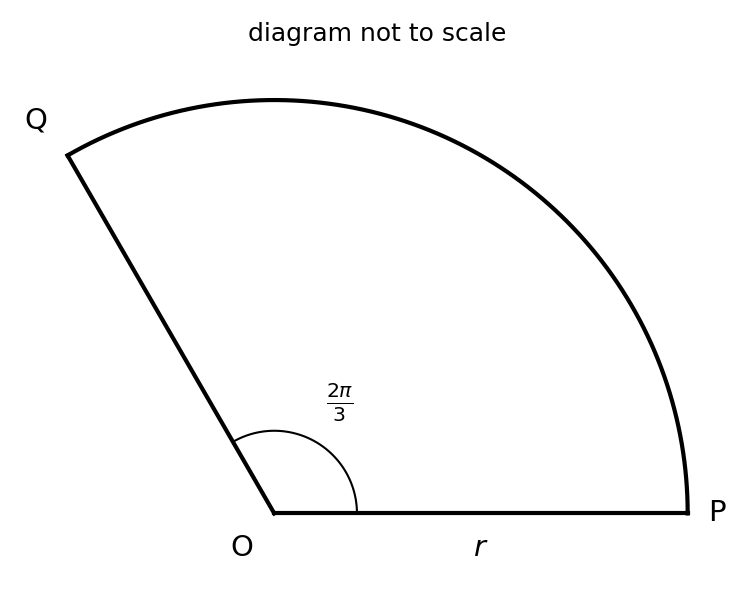
Find an expression for the length of arc PQ in terms of r and .
Hence, write down an expression for the perimeter of sector POQ in terms of r and .
Given that the perimeter of the sector POQ is cm, find the value of r.
Hence, find the exact area of sector POQ.
Recall the formula for the arc length of a sector when the angle is given in radians.
The perimeter of a sector includes the arc length as well as the two straight radial edges.
Set your expression for the perimeter equal to the given value and solve the resulting equation for r.
Use the formula for the area of a sector, substituting your calculated value of r.
Question 13
MediumPaper 2 · calculator6 marksA circular pizza has a radius of cm. A chef makes a straight cut from point A on the crust to point B on the crust, such that the angle subtended at the centre O, , is radians, where . This cut creates a circular segment of pizza (the region bounded by the chord AB and the arc AB).
Another cut is made from the centre O to a point C on the crust, such that A, O, and C are collinear (i.e., AC is a diameter). This creates a triangular slice .
Given that the area of the circular segment (bounded by chord AB and arc AB) is equal to the area of the triangular slice , show that .
Hence determine the value of .
Start by expressing the area of the circular segment in terms of and . Then, consider the geometry of triangle OBC and how its angle at O relates to to find its area.
You need to solve the equation numerically. Consider using a GDC and graphing and to find their intersection point, or using a numerical solver.
Question 14
MediumPaper 2 · calculator7 marksA landscape architect is designing a curved seating area for a public park. The seating area is shaped like a crescent, formed between two concentric circular paths with a common centre O. The outer path has a radius of 8 m. The inner path has a radius of m, where . The seating area covers a reflex angle of 5.2 radians at the centre O. The shaded region in the diagram below represents the seating area.
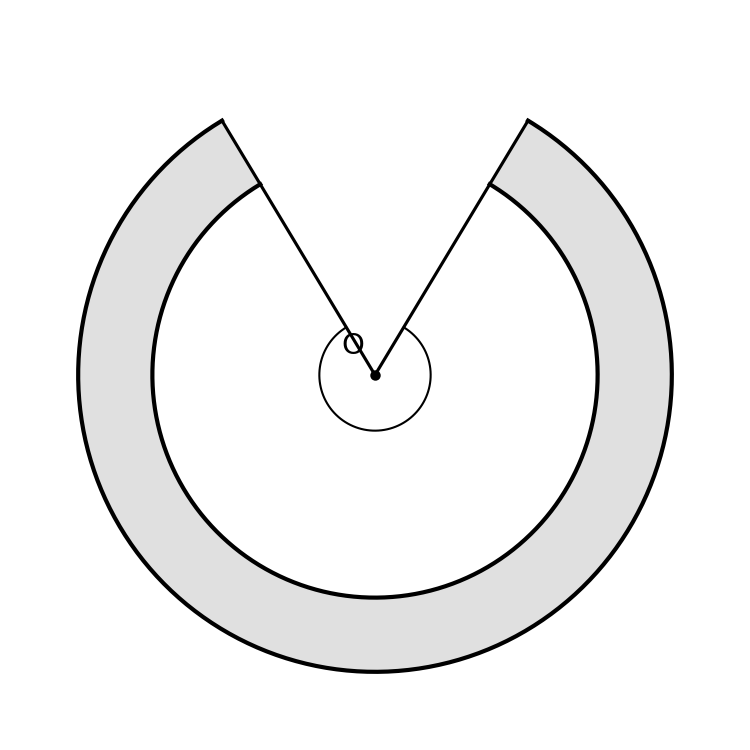
Show that the area of the seating area is given by .
The actual area of the seating area is .
Find the value of .
Find the perimeter of the seating area.
Recall the formula for the area of a sector in radians, which is . The shaded area is the difference between the areas of two sectors.
Use the expression for the area from part (a) and the given actual area to form an equation for .
The perimeter consists of two arc lengths (outer and inner) and two straight radial sections.
Question 15
MediumPaper 2 · calculator7 marksA designer is creating a curved section for a modern art sculpture. This section is cut from a flat sheet of metal and is formed between two concentric circular arcs with centre O.
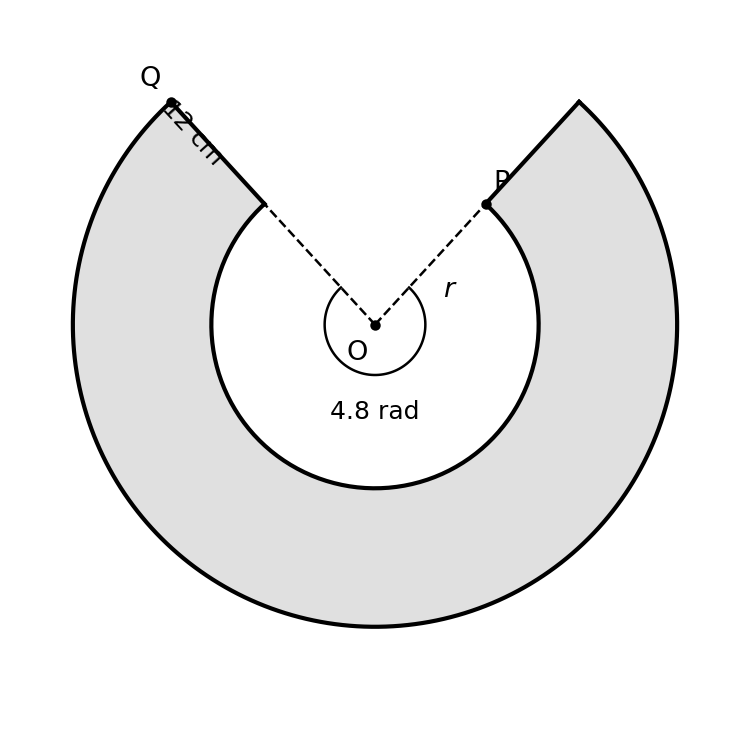
The point P lies on the inner arc with radius cm, where .
The point Q lies on the outer arc with radius 12 cm.
The reflex angle PQ is 4.8 radians. The metal section is shown by the shaded area in the following diagram.
Show that the area of the metal section is given by .
(i) The area of the metal section is 135 cm. Find the value of .
(ii) Find the perimeter of the metal section.
Recall the formula for the area of a sector of a circle: , where is the radius and is the angle in radians. The shaded area is the difference between the areas of the two sectors.
Set the expression for the area from part (a) equal to the given area and solve for . Remember that must be positive.
The perimeter consists of two arc lengths and two straight radial segments. Use the formula for arc length and the value of you found in part (b.i).
Question 16
MediumPaper 2 · calculator6 marksA craftsman is designing a decorative metal panel. A section of the design involves a circular arc within a larger piece. The arc is part of a circle with centre O and radius cm. Two points, P and Q, lie on the circle such that the angle POQ is radians, where .
Find the area of the circular segment defined by the arc PQ and the chord PQ, in terms of .
The craftsman cuts this segment from a rectangular metal sheet measuring cm by cm. The remaining area of the rectangular sheet is cm.
Find the value of .
Recall the formula for the area of a circular sector and the area of a triangle within a circle. The area of the segment is the difference between these two areas.
First, calculate the total area of the rectangular sheet. Then, use the given remaining area to find the area of the cut segment. Set this equal to your expression from part (a) and solve for using your GDC.
Question 17
MediumPaper 2 · calculator15 marksAn engineer is designing a ventilation duct for a large building.
The duct will be open at the top and is made by folding a piece of sheet metal 48 cm wide and 500 cm long.
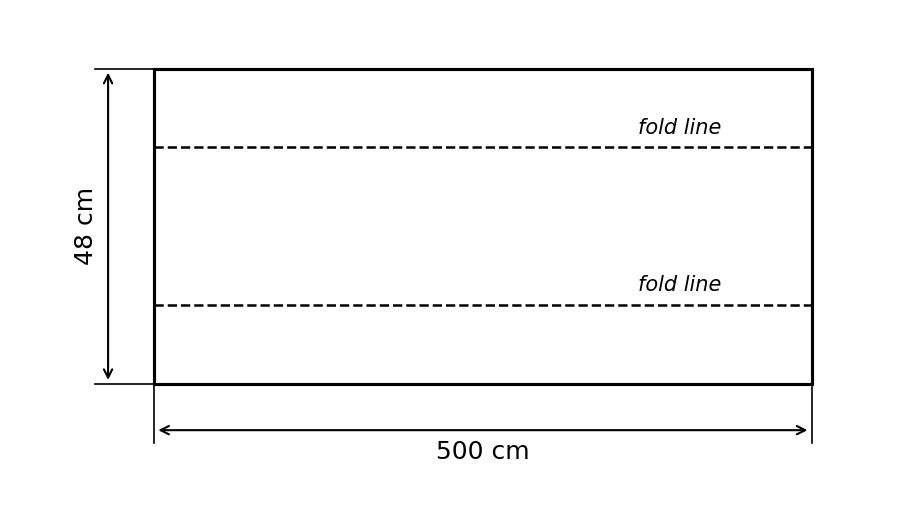
The cross-section of the duct is shaded in the following diagram.
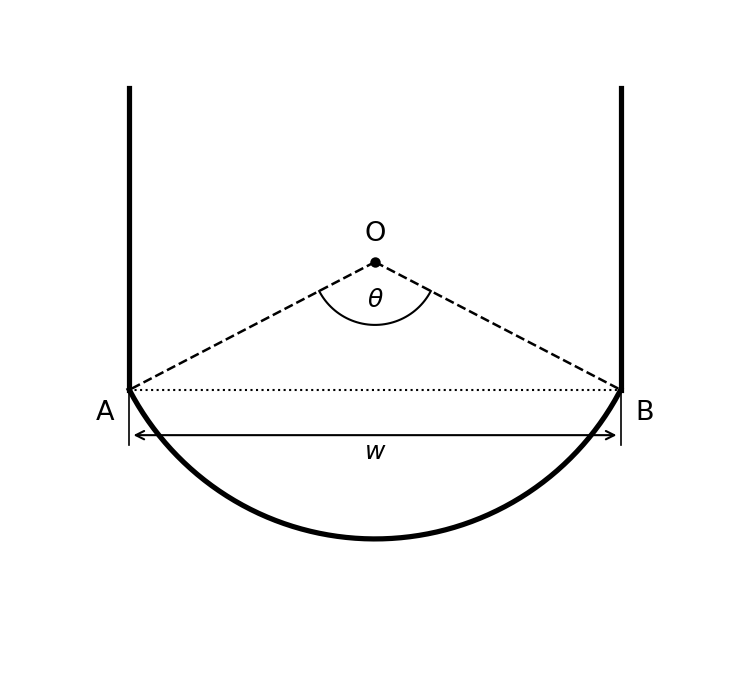
The height of both vertical sides is 12 cm. The width of the base of the curved section is cm.
Arc AB lies on the circumference of a circle with centre O and radius 11 cm.
Let AÔB = radians, where .
Show that , correct to three significant figures.
Find the area of the cross-section of the ventilation duct.
During operation, the total volume, in cm, of air that flows into the duct can be modelled by a function , where is the time, in seconds, since the start of operation.
It was determined that the rate at which air entered the duct could be modelled by
.
During any 60-second period, if the volume of air entering the duct is greater than the total capacity of the duct, the system will be overloaded.
Determine whether the system will be overloaded in a 60-second period. Justify your answer.
Consider how the total width of the sheet metal relates to the vertical sides and the arc length. Remember the formula for arc length in radians.
The cross-section can be broken down into simpler geometric shapes. You'll need to find the chord length of the circular arc and the area of the circular segment.
First, calculate the total volume capacity of the duct. Then, integrate the rate function over the given time period to find the total volume of air that enters. Compare these two volumes.
Question 18
MediumPaper 2 · calculator7 marksA manufacturer is designing a new fan blade. A segment of the blade is formed between two concentric circles with centre O.
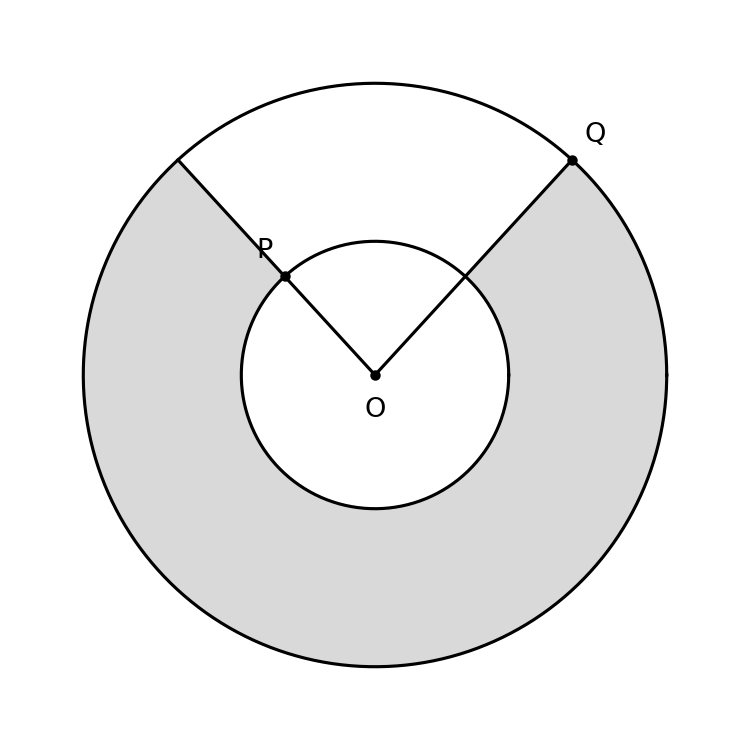
The point P lies on the circumference of the inner circle with radius cm, where .
The point Q lies on the circumference of the outer circle with radius cm.
The reflex angle POQ is radians. The fan blade segment is shown by the shaded area in the following diagram.
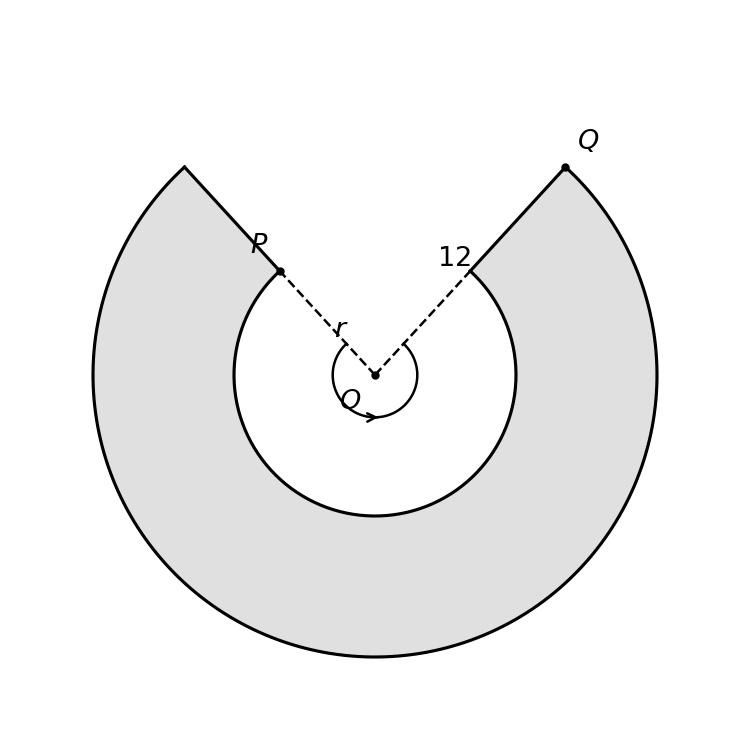
(a) Show that the area of the fan blade segment is given by .
(b) The area of the fan blade segment is cm.
(i) Find the value of .
(ii) Find the perimeter of the fan blade segment.
Recall the formula for the area of a sector of a circle: . The area of the blade segment is the difference between the area of the larger sector and the smaller sector.
Set the given area equal to the expression derived in part (a) and solve for . Remember that must be a positive length.
The perimeter consists of two arc lengths (outer and inner) and two straight line segments. Recall the formula for arc length: .
Question 19
MediumPaper 1 · no calculator7 marksA lighthouse at point L illuminates a triangular region of the sea, LMN. It is given that km, km, and the area of triangle LMN is . The angle is obtuse.
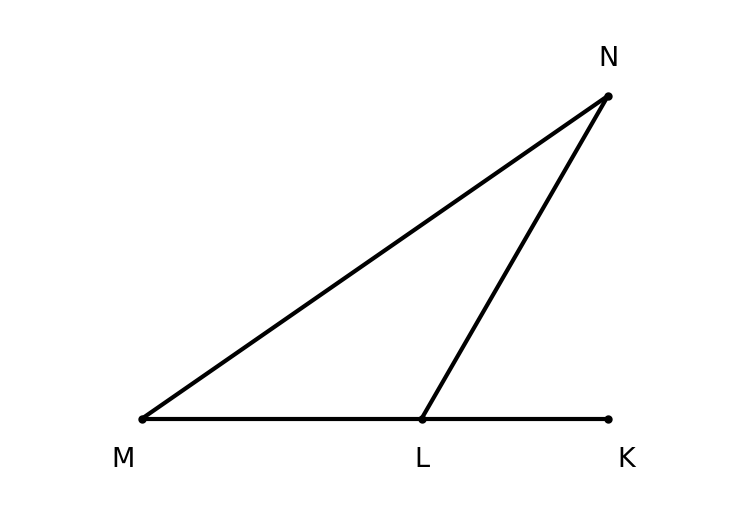
(a) Find the size of angle in radians.
A point K lies on the line passing through M and L, such that M, L, and K are collinear. The lighthouse beam sweeps from LN to LK.
(b) Find the exact area of the sector LNK.
Recall the formula for the area of a triangle given two sides and the included angle. Remember that for any angle , . Since the angle is obtuse, you must choose the angle in the second quadrant.
The points M, L, and K are on a straight line, which means they form a straight angle ( or radians). Use this fact and your answer from part (a) to determine the angle of the sector, . Then, apply the formula for the area of a sector.
Question 20
MediumPaper 1 · no calculator7 marksA circular metal disc with centre O and radius cm is used to create a pendant. A straight cut is made, removing a chord AB of length cm. The diagram below shows the disc and the chord.
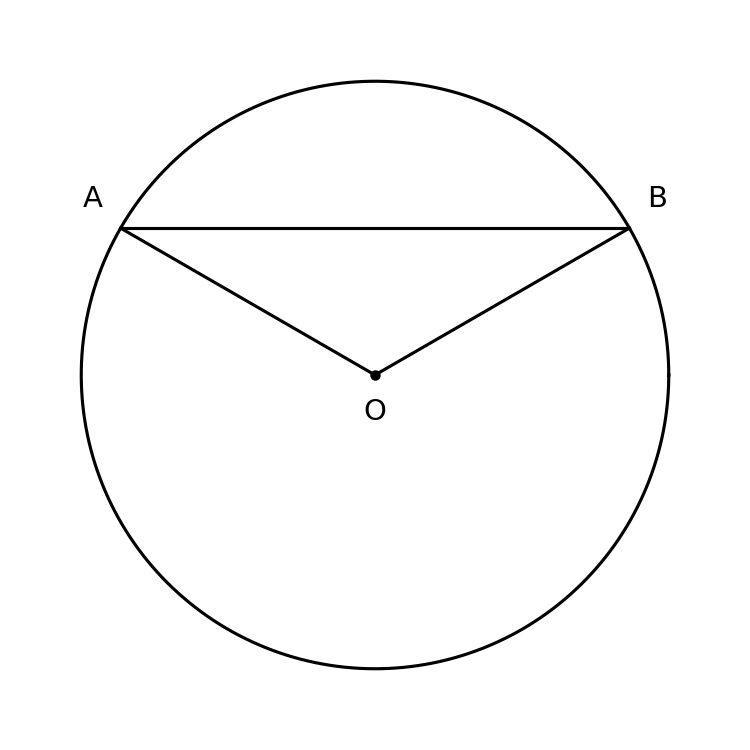
(a) Show that the angle subtended by the chord at the centre, , is .
(b) Find the exact area of the minor segment of the disc that is removed.
Consider the triangle AOB formed by the two radii and the chord. You know all three side lengths. Which rule can you use to find an angle when all three sides are known?
The area of a segment is the area of the sector minus the area of the triangle. You will need the formulas for both.
No question on this page matches those filters. Try another difficulty or paper.
1,129 more IB Math AA questions in the app
Every answer is marked mark by mark, IB-style, and the AI tutor helps when you are stuck.
Where marks are lost
- Using your own wrong value after failing a "show that".
Links to other topics and subjects
- Links to other subjects: diffraction patterns and circular motion (physics).
- International-mindedness: why are there 360 degrees in a complete turn?