Kinematics: notes and practice questions
Kinematics involves the motion of objects described using displacement (), velocity (), acceleration (), and time ():
- Velocity:
- Acceleration:
- Displacement from velocity:
- Velocity from acceleration:
How it is examined
Displacement versus total distance is the whole point of the subtopic, and the modulus sign is the marking point. A question that sets changing sign inside the interval is testing exactly that. Paper 2 mostly, because the integrals are GDC work. 6 to 8 marks across parts.
, and are given. is not, though it is hard to imagine a student losing a mark for it.
Kinematic problems involving displacement , velocity , acceleration and total distance travelled.
Linking questions
- Links to other subjects: kinematics (physics). Note that the SUVAT equations from physics are not on this syllabus and must not be used or expected.
Practice questions
23 questions · 15 medium · 8 hardQuestion 1
MediumPaper 2 · calculator10 marksIf the velocity, , of a particle which is moving in a straight line after time, seconds, is for .
Find the maximum speed.
At what time there would be a change in direction?
Find acceleration after 3 seconds
Find the total travelled distance.
Remember speed is the scalar (absolute) version of velocity
This happens when the velocity changes sign.
Remember that acceleration is the derivative of velocity with respect to time
Remember that distance is the definite integral of velocity with respect to time.
Question 2
HardPaper 1 · no calculator20 marksThe acceleration, , of a particle moving in a straight line at time seconds, , is given by , where is the particle's velocity. At , the particle is at the origin O and has an initial velocity , where .
By solving an appropriate differential equation, show that the particle's velocity at time is given by .
The particle moves in the positive direction until it reaches its maximum displacement from O at time . Show that .
Find an expression for the maximum displacement, , in terms of .
Let represent the particle's velocity seconds before it reaches , where . By using the result from part (b)(i), show that .
Similarly, let represent the particle's velocity seconds after it reaches . Deduce a similar expression for in terms of .
Hence, show that the speed of the particle seconds before it reaches is greater than or equal to its speed seconds after it reaches .
Recall that acceleration is the rate of change of velocity. Set up a differential equation and solve it by separating the variables.
What is the velocity of the particle when it is at its maximum displacement from the origin?
Displacement is the integral of velocity. Remember to use the initial conditions to find the constant of integration, and then substitute the time to find the maximum displacement.
Substitute into the expression for and use the relationship you found in part (b)(i).
Follow a similar process to part (c), but this time substitute .
Speed is the magnitude (absolute value) of velocity. Set up an inequality using your results from parts (c) and (d) and rearrange it to show it is always true.
Question 3
MediumPaper 2 · calculator7 marksA small reconnaissance drone is performing a vertical ascent and descent. Its vertical velocity, , at time seconds, for , is modelled by the function .
The following diagram shows the graph of .
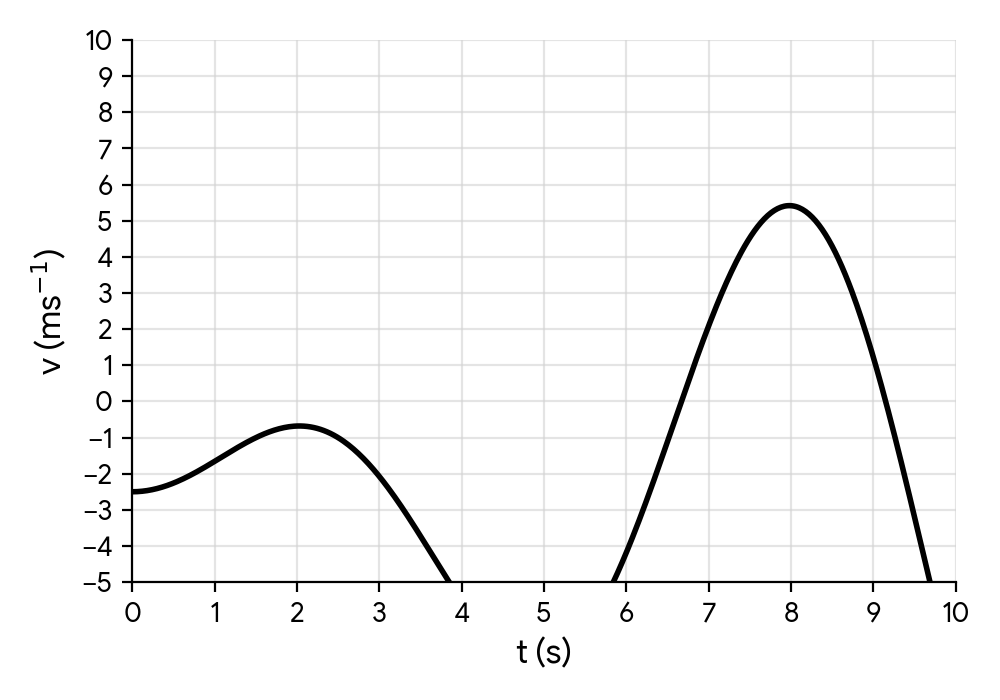
(a) Find the smallest value of for which the drone is momentarily stationary.
(b) Find the total vertical distance travelled by the drone during the first 10 seconds.
(c) Find the vertical acceleration of the drone when seconds.
The drone is momentarily stationary when its vertical velocity is zero. You will need to solve for the smallest positive . A GDC will be useful for this.
Total distance travelled is the integral of the absolute value of velocity over the given time interval. Remember to use your GDC for this calculation.
Acceleration is the derivative of velocity with respect to time. Differentiate to find , then substitute .
Question 4
HardPaper 1 · no calculator15 marksA drone takes off from a platform. Its height, metres, above the platform after seconds is given by , for . This is shown in the following diagram.
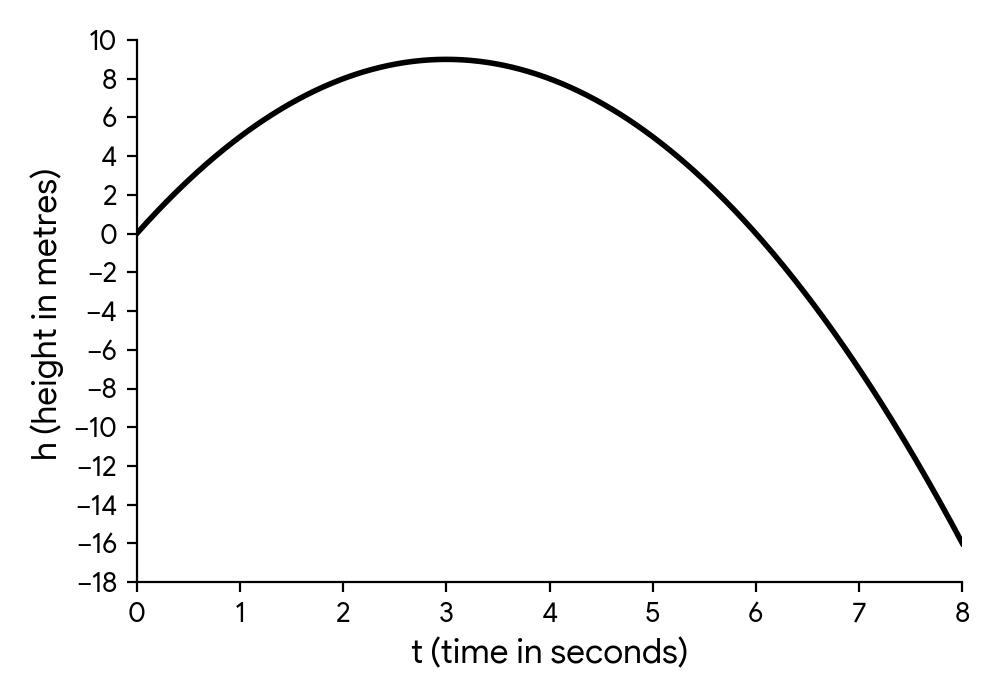
The drone lands back on the platform when .
Find the value of .
The drone reaches its maximum height when .
Find the value of .
Find the drone's maximum height above the platform.
Find the drone's vertical distance from the platform when .
The total vertical distance travelled by the drone in the first 8 seconds is given by .
Find the value of .
A second drone, Drone B, takes off from the same platform. Its velocity is given by , for .
When , the total vertical distance travelled by Drone B is equal to .
Find the value of .
The drone is on the platform when its height is zero. Set the height function equal to zero and solve for time .
The maximum height is reached when the drone's vertical velocity is zero. Find the derivative of the height function, which represents velocity, and set it to zero.
You found the time to reach maximum height in the previous part. Substitute this time back into the original height function.
Substitute into the height function. Remember that distance must be a positive value.
Total distance is not the same as displacement. The drone goes up and then comes down. You need to calculate the distance travelled on the way up and the distance travelled on the way down separately and add them together. The turning point you found in part (b) is crucial here.
First, find the total distance travelled by Drone B as a function of time . This will involve an integral of the absolute value of its velocity. You'll need to find when Drone B changes direction. Then, set this total distance equal to the value of you found in part (d) and solve for .
Question 5
MediumPaper 2 · calculator7 marksA mini-submarine is performing a test dive. Its velocity, in m/s, at time seconds is given by , for .
(a) Calculate the time(s) when the submarine is momentarily at rest.
(b) Find the acceleration of the submarine when it first changes direction.
(c) Determine the total distance travelled by the submarine during the first 8 seconds of its dive.
The submarine is momentarily at rest when its velocity is zero. You will need to use your GDC to solve the equation .
The submarine changes direction when its velocity is zero and the sign of the velocity changes. Acceleration is the derivative of the velocity function.
To find the total distance travelled, you need to integrate the absolute value of the velocity function over the given time interval. Remember to use your GDC for numerical integration.
Question 6
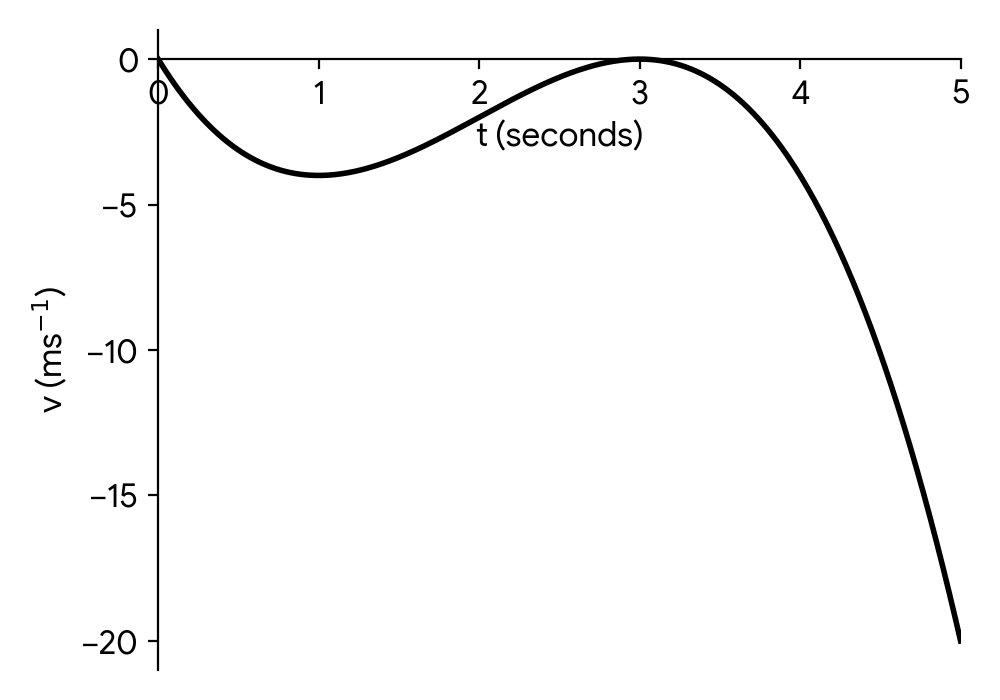
HardPaper 1 · no calculator16 marksA particle moves in a straight line. Its velocity, , at time seconds is given by , for . The particle is at the origin at .
The graph of is shown in the following diagram.
(a) Find the displacement of the particle from the origin at .
(b) Find an expression for the acceleration of the particle.
(c) The particle is momentarily at rest at and again at . Find the greatest speed of the particle in the interval .
(d) Find the greatest speed of the particle for .
(e) Write down an expression that represents the distance travelled by the particle while its speed is increasing. Do not evaluate the expression.
Displacement is the definite integral of the velocity function. Remember to use the initial condition that the particle starts at the origin to find the constant of integration.
Acceleration is the first derivative of the velocity function with respect to time.
First, find the value of by setting the velocity to zero. Then, to find the greatest speed, you need to find the maximum of the absolute value of velocity, , in the interval . This can occur at the endpoints or where the acceleration is zero.
You have already found the greatest speed up to . Now you just need to check the speed at the new endpoint, , and compare.
The speed of the particle is increasing when its velocity and acceleration have the same sign. Determine the sign of and over the domain to find the required time intervals. The distance travelled is the integral of the speed, , over these intervals.
Question 7
MediumPaper 2 · calculator6 marksA drone is flying vertically. Its vertical velocity, , at time seconds is given by , for .
The following diagram shows the graph of .
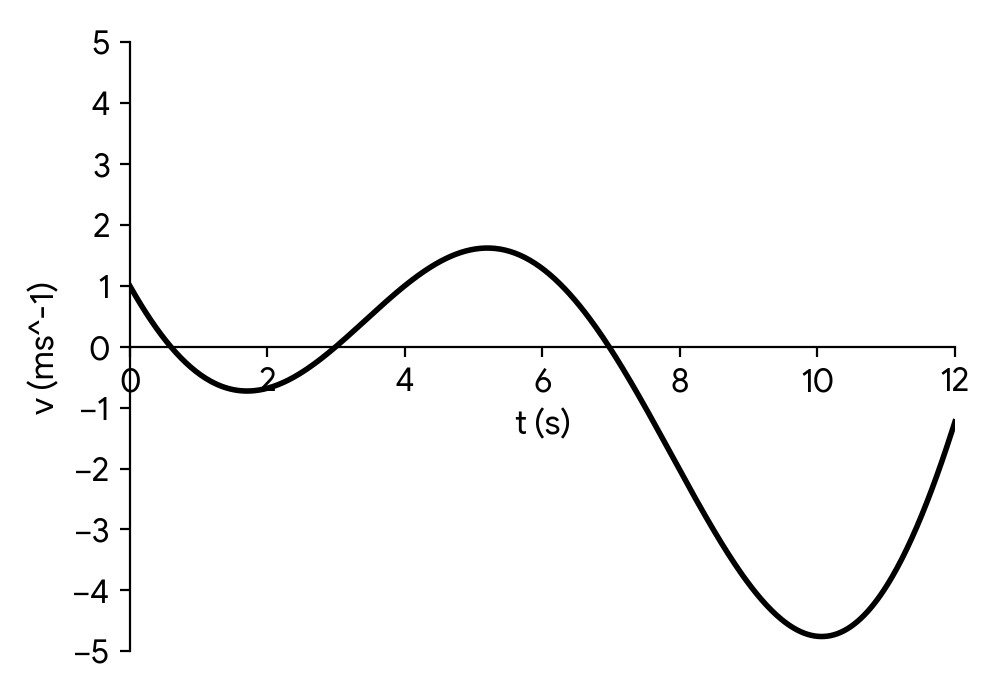
Find the smallest value of for which the drone is momentarily stationary.
Find the total vertical distance travelled by the drone during the first 12 seconds.
Find the acceleration of the drone when seconds.
The drone is momentarily stationary when its vertical velocity is zero. Use your GDC to solve the equation within the given time interval.
Total distance travelled is the definite integral of the absolute value of the velocity function over the given time interval. Use your GDC's integration feature.
Acceleration is the derivative of the velocity function with respect to time, . You can find the derivative analytically or use your GDC's derivative feature.
Question 8
HardPaper 2 · calculator15 marksA team of engineers is testing two autonomous robots, Alpha and Beta, on a straight track. Their positions are measured as the distance from a fixed starting point. The experiment runs for 10 minutes.
The position of Robot Alpha, metres, at time minutes can be modelled by the function , where .
The position of Robot Beta, metres, at time minutes can be modelled by the function , where .
Use the engineers' models to find the initial position of
(i) Robot Beta;
(ii) Robot Alpha correct to three significant figures.
Find the values of when Robot Alpha and Robot Beta are at the same position. Give your answers correct to three significant figures.
For , prove that Robot Alpha was always ahead of Robot Beta.
For , find the total amount of time when the speed of Robot Beta was greater than the speed of Robot Alpha. Give your answer correct to three significant figures.
The initial position corresponds to the time . Substitute this value into the function for Robot Beta.
Substitute into the function for Robot Alpha. Remember that the argument of the sine function is in radians.
Set the two position functions equal to each other, . This equation will involve a trigonometric term and a linear term, so you will need to use your GDC to find the solutions within the given domain .
To prove Robot Alpha was always ahead, show that for . Consider the minimum value of the trigonometric term in the difference function.
Speed is the magnitude of velocity, which is the derivative of position with respect to time. Find and . Then solve the inequality for within the given domain. This will involve a trigonometric inequality.
Question 9
MediumPaper 2 · calculator5 marksA buoy floats on the surface of a lake. Its vertical displacement, metres, from its equilibrium position at time seconds is modelled by the function , for .
(a) Find the first time, seconds, when the buoy momentarily comes to rest.
(b) Find the total distance that the buoy travels in the first seconds.
The buoy comes to rest when its velocity is zero. Remember to differentiate the displacement function to find the velocity function.
The total distance travelled is the sum of the absolute displacements between turning points. Since is the first time the buoy comes to rest, it only changes direction once (or not at all) within this interval. Consider the initial displacement and the displacement at time .
Question 10
HardPaper 2 · calculator20 marksA designer is creating a decorative glass container shaped like a dome. The outer profile of the container can be modelled by the function , where and and are measured in metres.
Sketch the curve , clearly indicating the coordinates of the endpoints.
Show that the inverse function of is given by .
State the domain and range of .
The container is formed by rotating the curve by about the y-axis. Show that the volume, , of liquid in the container when it is filled to a height of metres is given by .
Hence, determine the maximum volume of the container.
At , the container is empty. Liquid is then added to the container at a constant rate of .
Find the time it takes to fill the container to its maximum volume.
Find the rate of change of the height of the liquid when the container is filled to half its maximum volume.
Remember that the domain restricts the part of the curve you need to sketch. Identify the y-values at the given x-endpoints.
To find the inverse function, interchange and and then solve for . Remember the range of the original function.
The domain of an inverse function is the range of the original function, and vice versa.
The formula for volume of revolution about the y-axis is . Express in terms of from the original function.
The maximum height the liquid can reach is determined by the range of the original function.
Time equals total volume divided by the filling rate.
First, find the height when the volume is half the maximum. Then, use the chain rule . You'll need to differentiate the volume formula with respect to .
Question 11
MediumPaper 2 · calculator5 marksA drone's altitude, metres, above the ground at time seconds is modelled by the function , for .
(a) Find the first time, seconds, when the drone's vertical velocity is zero.
(b) Find the total vertical distance that the drone travels in the first seconds.
To find when the vertical velocity is zero, you need to first find the velocity function by differentiating the altitude function with respect to time. Then, set the velocity function equal to zero and solve for . Remember to find the first positive value of .
Since is the first time the drone's vertical velocity is zero, it represents the first turning point in its motion. The total distance travelled up to this point can be found by calculating the absolute difference between its initial altitude and its altitude at time .
Question 12
HardPaper 2 · calculator15 marksA remote-controlled drone is launched from a platform and moves horizontally in a straight line. Its velocity, m s, at time seconds after launch, is given by , for .
(a) Find the drone's initial velocity.
(b) Find the time when the drone is at rest.
(c) Find the drone's acceleration at the instant it comes to rest.
(d) Determine the time interval(s) when the drone is:
(i) slowing down
(ii) speeding up.
The initial velocity refers to the velocity at time . Substitute into the given velocity function.
The drone is at rest when its velocity is equal to zero. Set the velocity function to zero and solve for . Remember to check for extraneous solutions after squaring both sides of an equation.
Acceleration is the derivative of velocity with respect to time, . First, find the expression for , then substitute the time found in part (b) into .
The drone is slowing down when its velocity and acceleration have opposite signs. Analyze the signs of and over the domain . Remember that at and is always positive for .
The drone is speeding up when its velocity and acceleration have the same sign. Use your analysis from part (d.i).
Question 13
MediumPaper 2 · calculator6 marksA drone is programmed to ascend vertically from the ground. Its height, metres, seconds after launch, is modelled by the function .
(a) Find an expression for the vertical velocity, , of the drone at time .
(b) Calculate the maximum height reached by the drone.
Recall that velocity is the rate of change of displacement (height) with respect to time. This means you need to differentiate the height function.
The maximum height occurs when the vertical velocity of the drone is momentarily zero. Set your velocity expression from part (a) to zero to find the time, then substitute this time back into the height function.
Question 14
HardPaper 1 · no calculator12 marksThe vertical displacement, metres, of a buoy from its equilibrium position in the water is modelled by the equation , where is the time in seconds, .
(a) Find an expression for the acceleration of the buoy at time .
(b) Find the values of at which the buoy is momentarily at rest.
(c) Find the values of for which the velocity of the buoy is at a maximum.
Acceleration is the second derivative of displacement with respect to time. You will need to use the chain rule to find the velocity (first derivative), and then the product rule and chain rule to find the acceleration.
The buoy is 'at rest' when its velocity is zero. Set the expression for velocity you found in part (a) equal to zero and solve for the possible values of the trigonometric functions. Then use these to find the corresponding values of .
The velocity is at a maximum when its derivative, the acceleration, is equal to zero. Set the expression for acceleration from part (a) to zero. The solutions will give the times of maximum or minimum velocity. You must then determine which of these corresponds to a maximum velocity and find the value of at these times.
Question 15
MediumPaper 2 · calculator17 marksA hot air balloon takes off from a launch platform. Its height above the ground, metres, minutes after takeoff, is modelled by the function .
Determine the height of the hot air balloon after 5 minutes and after 10 minutes.
Find an expression for the vertical velocity of the hot air balloon, , in terms of .
Calculate the time at which the hot air balloon reaches its maximum height.
Determine the total duration of the balloon's flight before it lands.
Sketch the graph of for the duration of the flight, clearly indicating the intercepts with the -axis and the coordinates of the maximum point. State the domain of the model.
Find the vertical velocity of the hot air balloon at the instant it lands.
Show that the vertical acceleration of the hot air balloon is constant, stating its value.
Substitute the given time values into the height function .
Recall that velocity is the first derivative of displacement (height) with respect to time.
The maximum height occurs when the vertical velocity is zero. Set and solve for .
The balloon lands when its height above the ground is zero. Set and solve for . Remember that is takeoff.
Use the information from parts (c) and (d) to identify key points for the sketch. The domain will be from takeoff to landing.
Use the time the balloon lands (from part d) and substitute it into the velocity expression (from part b).
Acceleration is the second derivative of height with respect to time, or the first derivative of velocity with respect to time.
Question 16
HardPaper 2 · calculator19 marks(a) A deep-sea submersible's vertical displacement, in metres, from a reference depth is given by for time minutes. Positive indicates the submersible is above the reference depth, and negative indicates it is below.
Find the submersible's vertical velocity and acceleration at any time .
(b) Find the time intervals during when the submersible is moving upwards.
(c) Determine the time intervals during when the submersible's vertical velocity is decreasing.
(d) Calculate the total vertical distance travelled by the submersible during the time . Give your answer to three significant figures.
Remember that velocity is the first derivative of displacement with respect to time, and acceleration is the second derivative of displacement (or the first derivative of velocity) with respect to time. Apply the chain rule where necessary.
The submersible is moving upwards when its vertical velocity is positive. Set and use the identity to transform the inequality into a quadratic in terms of . Solve the quadratic inequality and then find the corresponding values of in the given domain.
The submersible's vertical velocity is decreasing when its acceleration is negative. Set and solve the trigonometric inequality in the given domain. You might need to use a graph or the unit circle to find the intervals.
To find the total distance travelled, you need to integrate the absolute value of the velocity function, . This means you must first find the times when the velocity is zero (the turning points) within the interval . Then, split the integral into sub-intervals where is consistently positive or negative, and sum the absolute values of the displacements in each sub-interval.
Question 17
MediumPaper 2 · calculator18 marksA drone takes off vertically from the ground. Its altitude, metres, above the ground at time seconds after takeoff is modelled by the function .
(a) Determine the altitude of the drone at seconds and seconds.
(b) Find an expression for the vertical velocity of the drone, , in terms of .
(c) Find the instant in time, , for which the drone reaches its maximum altitude.
(d) Determine how long it takes for the drone to return to the ground.
(e) Sketch the graph of , stating clearly the domain of validity of the model and its maximum point.
(f) Find the velocity of the drone at the instant it returns to the ground.
(g) Show that the acceleration of the drone is constant, stating its value.
Substitute the given values of into the altitude function .
Velocity is the first derivative of the position (altitude) function with respect to time.
The maximum altitude occurs when the vertical velocity of the drone is zero.
The drone returns to the ground when its altitude is zero. Remember to consider the physically meaningful solution.
The graph of is a parabola opening downwards. Use the intercepts and the maximum point found in previous parts. The domain is restricted to when the drone is in the air.
Use the time the drone returns to the ground (found in part (d) ) and substitute it into the velocity function (found in part (b) ).
Acceleration is the second derivative of the position function, or the first derivative of the velocity function.
Question 18
MediumPaper 2 · calculator4 marks(a) A scientist is analyzing the trajectory of a small probe in a controlled environment. The vertical displacement of the probe, metres, at time seconds, is modelled by the function .
Find the instantaneous vertical velocity of the probe when seconds.
Remember that instantaneous velocity is given by the derivative of the displacement function with respect to time. You will need to differentiate and then substitute the given value of .
Question 19
MediumPaper 1 · no calculator6 marksA drone takes off vertically from the ground. Its velocity, in metres per second, is given by for .
(a) Find an expression for the acceleration, , of the drone at time .
(b) Let be the height of the drone above the ground. Find an expression for in terms of .
Acceleration is the derivative of velocity with respect to time. You need to differentiate the given velocity function .
Height (displacement) is the integral of velocity with respect to time. After integrating, you will have a constant of integration, . Use the information that the drone takes off from the ground to find the value of .
Question 20
MediumPaper 1 · no calculator4 marksA particle moves along a straight line. Its velocity, m s⁻¹, at time seconds is given by . Given that the displacement of the particle is 5 metres when , find an expression for the displacement, .
Remember that displacement is the integral of velocity with respect to time. After you integrate, you will have a constant of integration, C. Use the given information about the displacement at a specific time to solve for C.
No question on this page matches those filters. Try another difficulty or paper.
3 more Kinematics questions in the app
Every answer is marked mark by mark, IB-style, and the AI tutor helps when you are stuck.
Where marks are lost
- Using your own wrong value after failing a "show that".