Proof by mathematical induction: notes and practice questions
- Mathematical induction proves a statement is true for all integers $$n
less a$$.
- Basis Step: Verify for the smallest integer (usually ).
- Assumption Step: Assume is true for an arbitrary integer $$k
less a$$.
- Inductive Step: Prove that if is true, then must also be true, using the assumption.
- Conclusion: State that is true for all required integers by the principle of mathematical induction.
- Strategies vary for summations, divisibility, inequalities, sequences, derivatives, and De Moivre's Theorem/matrices.
How it is examined
Induction is marked on structure, not just on algebra: state the proposition, prove the base case, assume for , prove for , and write a conclusion that names the base case and the inductive step. Examiners award a mark for that final sentence and students routinely drop it. 6 to 8 marks, Paper 1.
- Proof by mathematical induction.
- Proof by contradiction.
- Use of a counterexample to show that a statement is not always true.
Linking questions
- Other contexts: the four-colour theorem.
- TOK: what is the difference between the inductive method in science and proof by induction in mathematics?
Practice questions
25 questions · 14 medium · 11 hardQuestion 1
MediumPaper 1 · no calculator7 marksUse the principle of mathematical induction to prove that for all
Start by verifying the formula for the base case, n=1. Then, assume the formula holds for an arbitrary integer n=k. For the inductive step, write out the sum for n=k+1, separate the (k+1)th term, and use your assumption for the sum up to k. Your goal is to algebraically manipulate the expression to match the formula for n=k+1. Look for opportunities to factor out common terms, especially factorials.
Question 2
HardPaper 1 · no calculator14 marks(a) Prove by mathematical induction that for .
(b) Hence or otherwise, determine the Maclaurin series of in ascending powers of , up to and including the term in .
(c) Hence or otherwise, determine the value of .
Start by verifying the base case for n=1. Then, assume the formula holds for n=k and use this assumption to prove it for n=k+1 by differentiating the k-th derivative expression.
You can use the formula from part (a) to find the values of the derivatives at x=0, which are the coefficients in the Maclaurin series. Alternatively, you can use the known series for and substitute , then multiply by x.
Substitute the first few terms of the Maclaurin series you found in part (b) into the expression. Simplify the numerator before taking the limit. Alternatively, you can try to simplify the expression and apply L'Hôpital's rule.
Question 3
MediumPaper 1 · no calculator6 marksUse the principle of mathematical induction to prove that for all
Start by verifying the base case, n=1. Then, assume the formula holds for n=k and use this assumption to prove it for n=k+1. The key step will be to manipulate the algebraic expression involving factorials to match the target formula.
Question 4
HardPaper 1 · no calculator19 marksLet for .
(a) Show that .
(b) Use mathematical induction to prove that for .
Let , where is a real constant.
Consider the function defined by for .
It is given that the coefficient of the term in the Maclaurin series for is .
(c) Find the possible values of .
Rewrite the function as and apply the chain rule twice.
Start by showing the formula holds for the base case, n=2, using your result from part (a). Then, assume the formula is true for n=k, and differentiate this expression to find the (k+1)th derivative. Finally, manipulate your result to show it matches the given formula for n=k+1.
You can solve this in two ways. Either find the first few terms of the Maclaurin series for f(x) and g(x) and then multiply them to find the x^2 term of h(x). Or, you can use the formula for the Maclaurin series coefficient, which involves finding the second derivative of h(x) at x=0.
Question 5
MediumPaper 2 · calculator9 marksSolve the inequality .
Use mathematical induction to prove that for .
Find the roots of the corresponding quadratic equation first. Then consider the shape of the parabola to determine the intervals where the inequality holds.
Follow the standard steps of induction: base case, inductive hypothesis, and inductive step. In the inductive step, you will need to use the result from part (a).
Question 6
HardPaper 1 · no calculator20 marksLet for .
(a) Show that .
(b) Use mathematical induction to prove that for .
Let .
Consider the function defined by for .
It is given that the term in the Maclaurin series for has a coefficient of .
(c) Find the possible values of .
Rewrite the function using a negative fractional exponent, i.e., . Then, apply the chain rule twice to find the first and second derivatives.
Start by verifying the base case for n=1. Then, assume the formula is true for n=k. Differentiate the expression for to find and manipulate the resulting expression, particularly the factorial and power terms, to show it matches the formula for n=k+1.
You can solve this in two ways. Method 1: Use the formula for the Maclaurin series coefficient, which involves the second derivative: . Find using the product rule and evaluate it at . Method 2: Write out the first few terms of the Maclaurin series for and separately, multiply them, and collect the terms for .
Question 7
MediumPaper 2 · calculator7 marksUse the principle of mathematical induction to prove that for all integers .
Start by showing the statement is true for the base case, n=5. Then, assume it's true for n=k and use this assumption to prove it's true for n=k+1. In the inductive step, you might need to prove an auxiliary inequality to connect with .
Question 8
HardPaper 1 · no calculator14 marks(a) Prove by mathematical induction that for .
(b) Hence or otherwise, find the Maclaurin series of in ascending powers of , up to and including the term in .
(c) Hence or otherwise, determine the value of .
Start by showing the formula holds for the base case, n=1. Then, assume the formula is true for n=k and use this assumption to prove it is true for n=k+1 by differentiating the k-th derivative expression.
You can either use the general formula for a Maclaurin series, , and the result from part (a) to find the derivatives at x=0. Alternatively, you can use the known Maclaurin series for and substitute , then multiply the resulting series by .
Substitute the first few terms of the Maclaurin series you found in part (b) into the numerator of the limit expression. Simplify the numerator and then evaluate the limit. Alternatively, you can apply L'Hôpital's rule.
Question 9
MediumPaper 1 · no calculator7 marksUse the principle of mathematical induction to prove that for all integers .
Remember the three key steps of a proof by induction: the base case, the inductive hypothesis, and the inductive step. For the inductive step, consider the expression for n=k+1 and try to relate it back to the expression for n=k.
Question 10
HardPaper 1 · no calculator14 marks(a) Prove by mathematical induction that for .
(b) Hence or otherwise, determine the Maclaurin series of in ascending powers of , up to and including the term in .
(c) Hence or otherwise, determine the value of .
Start by verifying the formula for n=1. Then, assume the formula is true for n=k and use this assumption to prove it is true for n=k+1 by differentiating the expression for the k-th derivative.
You can either use the general formula for a Maclaurin series and the result from part (a), or you can rewrite the function and use the well-known geometric series expansion.
Consider substituting the Maclaurin series you found in part (b) into the expression. Alternatively, try to simplify the expression inside the limit algebraically before evaluating it.
Question 11
MediumPaper 1 · no calculator7 marksProve by mathematical induction that is divisible by 7 for all .
Start by showing the statement is true for n=1 (the base case). Then, assume the statement is true for n=k and use this assumption to show it must also be true for n=k+1. In the inductive step, try to manipulate the expression for n=k+1 to isolate the expression for n=k.
Question 12
HardPaper 1 · no calculator7 marksProve by mathematical induction that is divisible by 7 for all .
Start by showing the statement is true for n=1 (the base case). Then, assume it's true for n=k and use this assumption to prove it's true for n=k+1. For the inductive step, try to manipulate the expression for n=k+1 to isolate the expression for n=k.
Question 13
MediumPaper 1 · no calculator6 marksConsider a geometric sequence with first term 2 and common ratio 3.
is the sum of the first terms of the sequence.
(a) Find an expression for , in the form , where .
(b) Hence, show that .
Recall the formula for the sum of the first n terms of a geometric sequence, . Substitute the given values for the first term and common ratio.
Set up a summation of the expression for from to . You can split this into two separate summations. One will be the sum of a geometric sequence, and the other will be the sum of a constant.
Question 14
HardPaper 1 · no calculator16 marksThe following diagram shows the graph of for , with asymptotes at and .
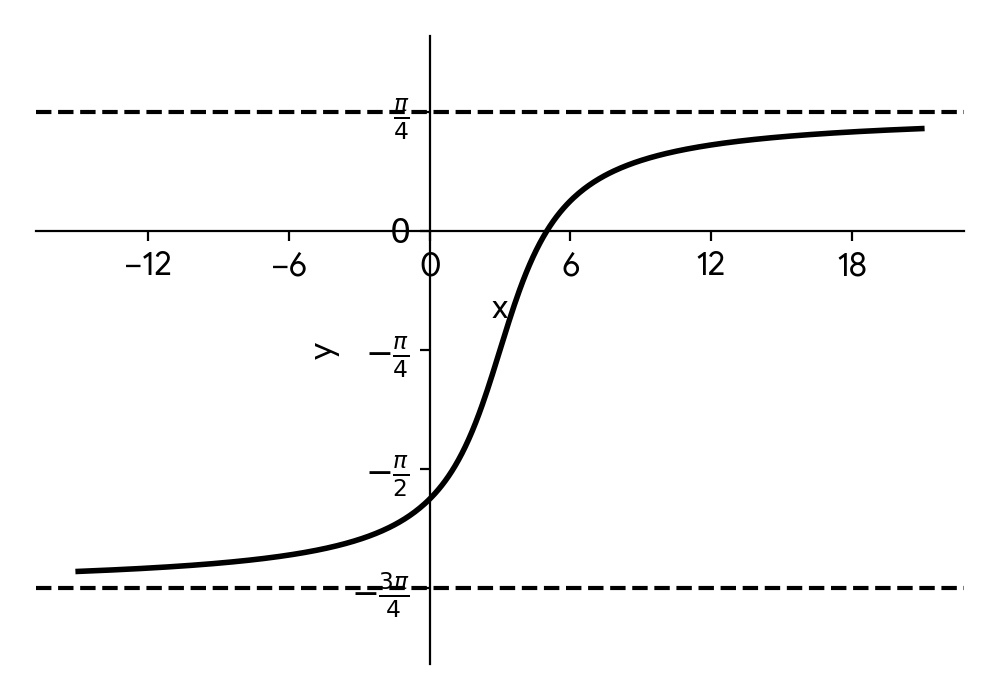
Describe a sequence of transformations that transforms the graph of to the graph of for .
Show that where and .
Using mathematical induction and the result from part (b), prove that
for .
Consider the transformations in the form . Think about the order of transformations, especially for the horizontal stretch and shift.
Let and . Express and in terms of and . Then use the compound angle formula for .
For the inductive step, assume the formula is true for . Then consider the sum for , which is the sum for plus the -th term. Use the identity from part (b) to combine the terms.
Question 15
MediumPaper 1 · no calculator7 marksA student claims that for all integers .
(a) Show that for all integers .
(b) Use mathematical induction and the result from part (a) to prove that the student's claim is valid for all integers .
Expand the right-hand side of the inequality. Then, rearrange the inequality to form a quadratic in terms of n. Consider the properties of this quadratic function for the given domain of n.
Follow the standard steps for proof by induction. First, show the base case is true (n=5). Then, assume the statement is true for n=k. For the inductive step, you need to show it's true for n=k+1. Start with and use your assumption and the result from part (a) to show it's greater than .
Question 16
HardPaper 1 · no calculator7 marksUse the principle of mathematical induction to prove that for all integers .
Start by showing the statement is true for the smallest possible value of n. Then, assume it's true for n=k and use this assumption to prove it's true for n=k+1. Remember Pascal's identity, , might be useful.
Question 17
MediumPaper 1 · no calculator7 marksUse the principle of mathematical induction to prove that
for all .
Start by showing the statement is true for n=1 (the base case). Then, assume the statement is true for n=k and use this assumption to prove it is also true for n=k+1. Remember the key algebraic step: .
Question 18
HardPaper 1 · no calculator21 marksLet , where .
The derivative of is denoted by , for .
Prove by induction that , for .
Hence or otherwise, find the Maclaurin series for up to and including the term.
Hence, find the series expansion of up to and including the term.
State the restriction which must be placed on for the approximation in part (c) to be valid.
Use a suitable value of to determine an approximate value for .
Give your answer as a rational number.
Start by verifying the base case for n=1. Then, assume the formula holds for n=k and differentiate this expression with respect to x to show it holds for n=k+1. Remember the chain rule and properties of factorials.
Recall the general formula for a Maclaurin series. You will need to evaluate the function and its first few derivatives at x=0 using the formula from part (a).
Use the property of logarithms . Then apply the series expansion you found in part (b) to each logarithmic term with the appropriate value of 'a'.
The Maclaurin series for is valid when . Consider the conditions for both series used in part (c) to be valid simultaneously.
First, find the value of x for which the expression inside the logarithm in part (c) equals 2. Then, substitute this value of x into your series approximation.
Question 19
MediumPaper 1 · no calculator6 marksUse the principle of mathematical induction to prove that is divisible by 6 for all .
Start by showing the statement is true for n=1 (the base case). Then, assume the statement is true for n=k and use this assumption to prove it is also true for n=k+1. Remember that the product of two consecutive integers is always even.
Question 20
HardPaper 1 · no calculator8 marksProve, by mathematical induction, that is divisible by 7 for all .
Start by showing the statement is true for n=1 (the base case). Then, assume the statement is true for n=k and use this assumption to prove it is true for n=k+1. Remember to manipulate the expression for n=k+1 to isolate the expression for n=k.
No question on this page matches those filters. Try another difficulty or paper.
5 more Proof by mathematical induction questions in the app
Every answer is marked mark by mark, IB-style, and the AI tutor helps when you are stuck.
Where marks are lost
- Using your own wrong value after failing a "show that".