Quadratic functions (general form, roots form, vertex form – intercepts, symmetry): notes and practice questions
- General form: .
- Vertex form: , where is the vertex.
- Roots form: , where and are the roots.
- Key features: vertex, axis of symmetry (), x-/y-intercepts.
- Use symmetry about the vertex and factorization/completing the square to analyze.
How it is examined
The three forms plus "change between them" is the whole subtopic, so questions give you one form and ask for a feature that another form makes obvious. Completing the square is the Paper 1 method. `Write down`, `Find`, `Show that`. 4 to 6 marks.
The axis of symmetry is given, together with the three forms.
- The quadratic function : its graph, -intercept . Axis of symmetry.
- The form , -intercepts and .
- The form , vertex .
Linking questions
- Links to other subjects: kinematics, projectile motion and simple harmonic motion (physics).
Practice questions
54 questions · 2 easy · 41 medium · 11 hardQuestion 1
EasyPaper 1 · no calculator5 marksConsider the function , where and is a real constant.
The axis of symmetry of the graph of has equation .
Show that .
Find the coordinates of the vertex of the graph of .
Hence, write down the range of .
The axis of symmetry lies exactly halfway between the two -intercepts of the quadratic function.
Substitute the -value of the axis of symmetry into the function to find the corresponding -coordinate.
Consider whether the parabola opens upwards or downwards to determine if the vertex is a maximum or a minimum.
Question 2
MediumPaper 2 · calculator4 marksA scientist is modeling the behavior of a particle in a fluctuating electromagnetic field. The particle's position over time can be described by a quadratic equation involving a field strength parameter . The equation is given by , where .
(a) Write down an expression for the product of the roots of this equation, in terms of .
(b) Hence or otherwise, determine the values of such that the equation has one positive and one negative real root.
Recall the relationship between the coefficients of a quadratic equation and its roots. The product of the roots is given by .
For a quadratic equation to have one positive and one negative real root, their product must be negative. Consider the critical values where the expression for the product of roots changes sign.
Question 3
HardPaper 1 · no calculator15 marksA drone takes off from a platform. Its height, metres, above the platform after seconds is given by , for . This is shown in the following diagram.
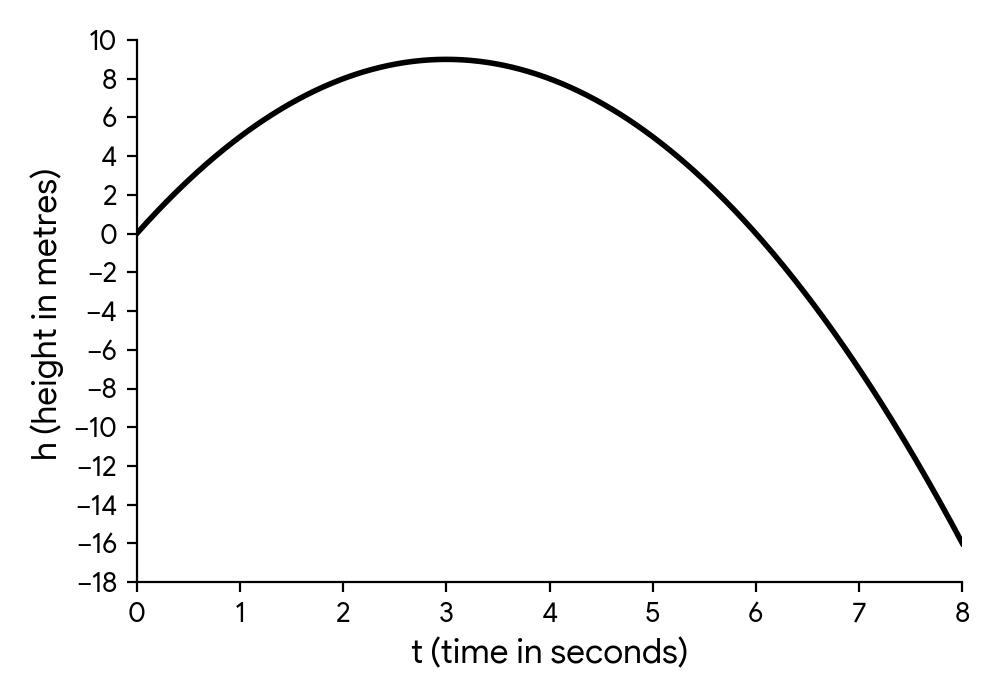
The drone lands back on the platform when .
Find the value of .
The drone reaches its maximum height when .
Find the value of .
Find the drone's maximum height above the platform.
Find the drone's vertical distance from the platform when .
The total vertical distance travelled by the drone in the first 8 seconds is given by .
Find the value of .
A second drone, Drone B, takes off from the same platform. Its velocity is given by , for .
When , the total vertical distance travelled by Drone B is equal to .
Find the value of .
The drone is on the platform when its height is zero. Set the height function equal to zero and solve for time .
The maximum height is reached when the drone's vertical velocity is zero. Find the derivative of the height function, which represents velocity, and set it to zero.
You found the time to reach maximum height in the previous part. Substitute this time back into the original height function.
Substitute into the height function. Remember that distance must be a positive value.
Total distance is not the same as displacement. The drone goes up and then comes down. You need to calculate the distance travelled on the way up and the distance travelled on the way down separately and add them together. The turning point you found in part (b) is crucial here.
First, find the total distance travelled by Drone B as a function of time . This will involve an integral of the absolute value of its velocity. You'll need to find when Drone B changes direction. Then, set this total distance equal to the value of you found in part (d) and solve for .
Question 4
EasyPaper 1 · no calculator4 marksLet . The function can be written in the form .
(i) Write down the value of .
(ii) Find the value of .
The value of corresponds to the x-coordinate of the vertex of the parabola. You can find this using the formula or by starting the process of completing the square.
You can find by substituting the value of you found into the function , as is the y-coordinate of the vertex. Alternatively, you can complete the process of completing the square.
Question 5
MediumPaper 1 · no calculator12 marksA function is defined by , where . The graph of is tangent to the line with equation .
(a) Show that .
(b) The function can be expressed in the form , where .
Find the value of and the value of .
(c) The function can also be expressed in the form , where .
Find the value of and the value of .
(d) Hence find the values of where the graph of is both positive and decreasing.
For a line to be tangent to a curve, they must intersect at exactly one point. Set the equations for the curve and the line equal to each other and use the discriminant of the resulting quadratic equation.
Substitute the value of you found in part (a) into the expression for and then factorize the quadratic to find its roots.
You can find the vertex of the parabola by completing the square, using the formula , or by finding the midpoint of the roots found in part (b).
Consider the information you found in the previous parts. Where are the roots (from part b)? This tells you where the function is positive or negative. Where is the vertex (from part c)? This tells you where the function is increasing or decreasing. Find the interval of x-values that satisfies both conditions.
Question 6
HardPaper 1 · no calculator14 marksA function is defined by . The following diagram shows part of the graph of .
The graph has a vertex at V and intersects the y-axis at point P.
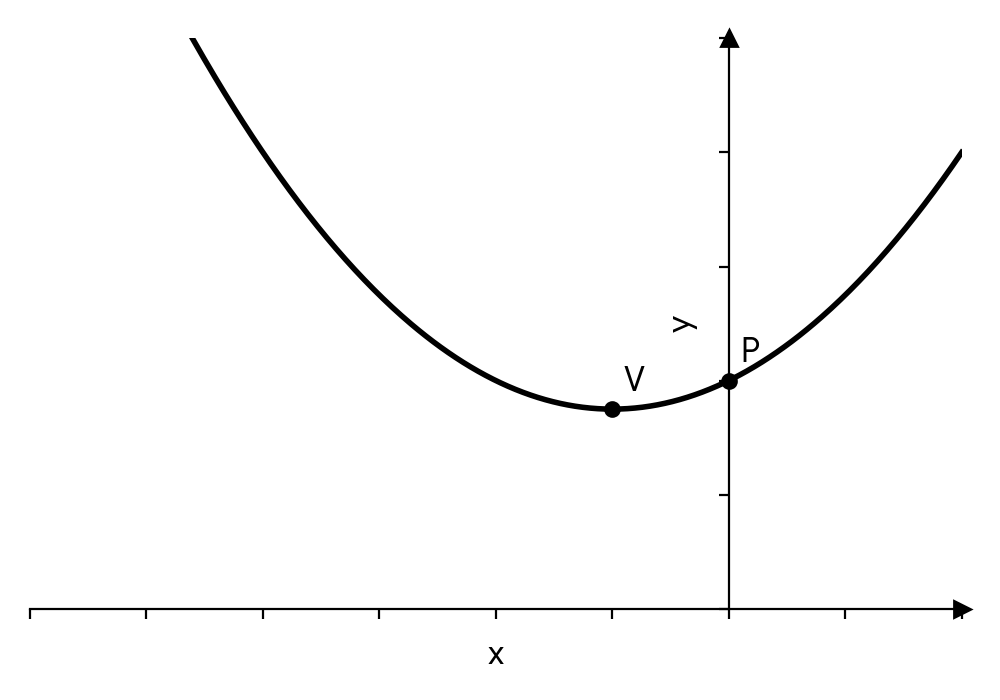
(a) Find the coordinates of the vertex V.
(b) Write down the coordinates of the y-intercept, P.
(c) The line L is the normal to the graph of at point P. Find the equation of L, giving your answer in the form .
(d) The line L intersects the graph of at a second point, Q. Calculate the distance between P and Q.
The x-coordinate of the vertex of a parabola can be found using the formula . Alternatively, you can find the derivative and solve for . Once you have the x-coordinate, substitute it back into the function to find the y-coordinate.
The y-intercept of a graph occurs when the x-coordinate is 0. Substitute into the function .
First, find the derivative of . Then, evaluate the derivative at the x-coordinate of P to find the gradient of the tangent. The gradient of the normal is the negative reciprocal of the tangent's gradient. Finally, use the point-slope form to find the equation of the line.
To find the coordinates of Q, set the equation for the function equal to the equation for the line L and solve the resulting quadratic equation for x. One solution will be the x-coordinate of P. The other will be for Q. Substitute this new x-value back into either equation to find the y-coordinate of Q. Finally, use the distance formula.
Question 7
MediumPaper 1 · no calculator13 marksA function, , has its derivative given by , where . The following diagram shows part of the graph of .
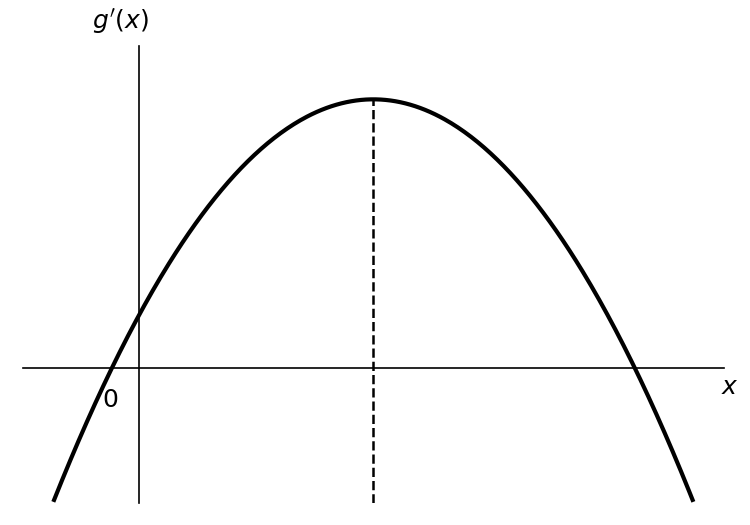
The graph of has an axis of symmetry .
(a) Find the value of .
(b) The vertex of the graph of has a y-coordinate of 10. Find the value of .
(c) Find the equation of the tangent to the graph of at .
The graph of has a point of inflexion at .
(d) (i) Find the value of .
(ii) Find the values of for which the graph of is concave-up. Justify your answer.
The axis of symmetry of a parabola is given by the formula . Alternatively, the vertex (and thus the axis of symmetry) occurs where the derivative of the function is zero.
The vertex lies on the axis of symmetry. Use the value of you found in part (a) as the x-coordinate of the vertex, and the given y-coordinate, to form an equation and solve for .
To find the equation of a tangent line, you need a point on the line and the gradient of the line. The point is found by evaluating . The gradient is found by evaluating the derivative of at .
A point of inflexion on the graph of occurs where the second derivative, , is equal to zero.
The graph of is concave-up when its second derivative, , is positive. Set up and solve the inequality .
Question 8
HardPaper 2 · calculator24 marksA team of engineers is designing a new roller coaster ride. The path of a certain section of the ride can be modelled by the function , where is the horizontal distance in metres from the starting point and is the vertical height in metres. The domain of the function is .
Find the coordinates where the path of the roller coaster crosses the horizontal ground (x-axis).
Find the coordinates where the path of the roller coaster crosses the vertical axis (y-axis).
Write down the equation of the vertical asymptote of the graph of .
The oblique asymptote of the graph of can be written as where .
Find the value of and the value of .
Sketch the graph of for , clearly indicating the points of intersection with each axis and any asymptotes.
Engineers want to analyse the inverse of the roller coaster's height function, .
Express in partial fractions.
Hence find the exact value of , expressing your answer as a single logarithm.
To find where the graph crosses the x-axis, set the numerator of the function equal to zero and solve for x. Remember to express your answer as coordinates.
To find where the graph crosses the y-axis, substitute into the function.
The vertical asymptote occurs where the denominator of a rational function is zero.
To find the oblique asymptote, perform polynomial long division of the numerator by the denominator. The quotient will be the equation of the oblique asymptote.
Plot the intercepts and draw the asymptotes first. Then sketch the two branches of the hyperbola, ensuring they approach the asymptotes and pass through the intercepts.
First, write out by taking the reciprocal of . Then, factorize the quadratic denominator and set up the partial fraction decomposition. Solve for the unknown constants.
Integrate the partial fractions found in part (e.i). Remember that . Apply the limits of integration and use logarithm properties to simplify to a single logarithm.
Question 9
MediumPaper 1 · no calculator7 marksThe functions and are defined for by
, where
.
Find the two possible functions such that .
Start by writing an expression for the composite function in terms of and . Then, expand this expression and compare the coefficients of the powers of with the given quadratic expression.
Question 10
HardPaper 1 · no calculator12 marksConsider the functions , , and .
(a) Find the range of .
(b) Find the range of .
(c) Find the range of .
(d) Find an expression for .
(e) Solve the equation .
(f) Solve the inequality .
The function is a quadratic. What is the vertex of the parabola and which way does it open? This will tell you the maximum or minimum value.
The function is a reciprocal function. Consider the horizontal asymptote of the graph of . The function can take any value except the value of the horizontal asymptote.
The function is an exponential function. What is the range of the basic exponential function ? How does the '+1' transform this range?
To find the composite function , you need to substitute the expression for into the variable in the function .
Use your expression from part (d) and set it equal to -1. Then, solve the resulting equation for .
First, find the composite function . Then set up the inequality and solve for . Remember the properties of exponential functions and how to solve quadratic inequalities.
Question 11
MediumPaper 1 · no calculator7 marksA student claims that for all integers .
(a) Show that for all integers .
(b) Use mathematical induction and the result from part (a) to prove that the student's claim is valid for all integers .
Expand the right-hand side of the inequality. Then, rearrange the inequality to form a quadratic in terms of n. Consider the properties of this quadratic function for the given domain of n.
Follow the standard steps for proof by induction. First, show the base case is true (n=5). Then, assume the statement is true for n=k. For the inductive step, you need to show it's true for n=k+1. Start with and use your assumption and the result from part (a) to show it's greater than .
Question 12
HardPaper 1 · no calculator8 marksConsider the function , for and .
(a) Find the range of values for for which the equation has two distinct real roots.
(b) Find the possible values of for which the vertex of the graph of lies on the line .
For a quadratic equation to have two distinct real roots, what condition must its discriminant satisfy? Remember to identify the coefficients and in terms of first.
The vertex of a parabola has coordinates . First, find the expression for the x-coordinate of the vertex, , in terms of . Then, since the vertex lies on the line , we must have . You can find by substituting back into the function, i.e., . Set up the equation and solve for .
Question 13
MediumPaper 1 · no calculator8 marksThe functions and are defined for by
where and are constants.
The vertex of the graph of and the vertex of the graph of both lie on the line with equation .
(a) Show that .
(b) Given that , find the value of .
First, find the coordinates of the vertex of the parabola . The x-coordinate can be found using the formula . Then, use the fact that this vertex must satisfy the equation of the given line.
Follow a similar process as in part (a), but for the function . The coordinates of the vertex will be in terms of . Substitute these into the line equation to form an equation in terms of . You should get a quadratic equation to solve.
Question 14
HardPaper 3 · calculator31 marksThis question explores the characteristics of a company's profit function, , where represents the number of units produced (in thousands), is the maximum production capacity (in thousands of units), with and .
For parts (a) and (b), consider the case where .
Consider .
Sketch the graph of , clearly indicating the values of any axes intercepts and the coordinates of any local maximum or minimum points.
Consider , where , .
Use your graphic display calculator to explore the graph of for:
- the odd values and ;
- the even values and .
Hence, copy and complete the following table:
Number of local maximum points | Number of local minimum points | Number of points of inflexion with zero gradient
---|---|---
and | |
and | |
Now consider where and , .
Show that .
State the three solutions to the equation .
Show that the point on the graph of is always above the horizontal axis.
Hence, or otherwise, show that , for .
By using the result from part (f) and considering the sign of , show that the point on the graph of is
(i) a local minimum point for even values of , where and ;
(ii) a point of inflexion with zero gradient for odd values of , where and .
Consider the graph of , where , and .
State the conditions on and such that the equation has four distinct solutions for .
For a quadratic function in the form , the x-intercepts are found by setting . The x-coordinate of the vertex is given by .
Pay close attention to the behaviour of the graph near the x-intercepts ( and ) and at the midpoint () for both odd and even values of . Use the 'Analyze Graph' features on your GDC.
Use the product rule for differentiation, , where and . Alternatively, consider rewriting as and using the chain rule.
Set each factor in the expression for to zero and solve for . Remember that .
Substitute into the original function and simplify the expression. Consider the properties of and .
Substitute into the expression for found in part (c) and analyze the sign of each factor. Remember and .
Calculate and determine its sign based on whether is even or odd. Then combine this with and to deduce the nature of the stationary point at .
Similar to part (g.i), evaluate for odd and compare its sign with .
Think about the shape of the graph and how a horizontal line would intersect it. The number of intersections depends on the parity of and the value of relative to the local extrema.
Question 15
MediumPaper 2 · calculator6 marksA tech company's daily profit, , in thousands of dollars, from producing units of a new gadget is modelled by the function , for .
(a) Find the range of the company's daily profit.
Due to new environmental regulations, the company faces a levy that adjusts its profit. The adjusted profit, , is given by the function , where is a constant representing the levy's impact.
Given that the adjusted profit must be non-positive for all , determine the set of possible values for .
To find the range of a quadratic function, identify whether it opens upwards or downwards and then find the coordinates of its vertex.
Consider the maximum value of the composite function . For it to be non-positive for all , its maximum value must be less than or equal to zero. Alternatively, you can use the discriminant of the resulting quadratic function.
Question 16
HardPaper 3 · calculator17 marksA civil engineer is designing a section of a curved bridge support. The vertical profile of the support can be modelled by the function , where is the height above the ground in meters and is the horizontal distance in meters from a reference point. The ground level is represented by .
(a) Consider the case where .
(i) Determine the two values of such that the bridge support profile touches the ground at exactly two points (i.e., has exactly two -axis intercepts).
(ii) State the set of values of for which the profile has exactly one -axis intercept.
(iii) State the set of values of for which the profile has exactly three -axis intercepts.
(b) Show that the critical points (points of zero gradient) of the function are located at and .
(c) For , determine whether is a local maximum or minimum, and whether is a local maximum or minimum.
(d) Prove that the bridge support profile has exactly three points where it meets the ground (three -axis intercepts) if and only if .
For a cubic function to have exactly two -axis intercepts, one of its local extrema must lie on the -axis. Find the critical points by setting the first derivative to zero, then evaluate the function at these points.
Consider the positions of the local maximum and local minimum relative to the -axis. If both are above or both are below, how many intercepts are there?
For three -intercepts, the local maximum must be above the -axis and the local minimum must be below the -axis (or vice-versa, depending on the leading coefficient and 'a').
To find critical points, differentiate the function with respect to and set the derivative equal to zero. Then substitute the -values back into the original function to find the corresponding -values.
Use the second derivative test. Calculate and evaluate it at the -coordinates of points and . Remember that indicates a local minimum and indicates a local maximum.
For a cubic function to have three distinct real roots, its local maximum and local minimum must have opposite signs. Consider the product of the -values at points and .
Question 17
MediumPaper 2 · calculator6 marksThe population, , in hundreds of plants, years after the study began, is modeled by the function , for .
(a) Find the range of .
Due to environmental changes, a new invasive plant species is introduced. The impact of this invasive species on the orchid's population is modeled by a function , where is the current orchid population (in hundreds of plants) and is a constant representing the environmental resilience. For the orchid species to survive and thrive, the combined effect must always be non-negative (i.e., ) for all . Determine the set of possible values for .
Recall that the range of a quadratic function depends on its vertex. If , the parabola opens downwards, and the range is .
Consider the composite function . For it to be always non-negative, analyze its properties as a quadratic function. What condition must its vertex or discriminant satisfy?
Question 18
HardPaper 3 · calculator30 marksA pharmaceutical company is formulating a new drug. They are testing two active ingredients, and , such that their total concentration is mg/mL. The drug's efficacy is modelled by the product of the concentrations of the two ingredients.
Find the efficacy, , as a function of only.
Determine the concentration of that maximizes the drug's efficacy.
Hence, show that the maximum efficacy for two ingredients with a total concentration of mg/mL is .
Let represent the maximum efficacy for a drug with active ingredients and a total concentration of mg/mL. For , the maximum efficacy can be expressed as .
Verify that is true for .
The relationship between the geometric mean and arithmetic mean states that for positive real numbers , their geometric mean is always less than or equal to their arithmetic mean .
Show that the geometric mean and arithmetic mean are equal when .
Use this result to prove that .
Using the formula for , determine the value of:
;
;
.
For a fixed total concentration of mg/mL, the company wants to find the optimal number of active ingredients, , to maximize the drug's efficacy. Let denote this maximum efficacy.
Write down the value of and the value of at which it occurs.
Determine the value of and the value of at which it occurs.
Consider the continuous function , defined by , where . A sketch of the graph of is shown in the following diagram. Point A is the maximum point on this graph.
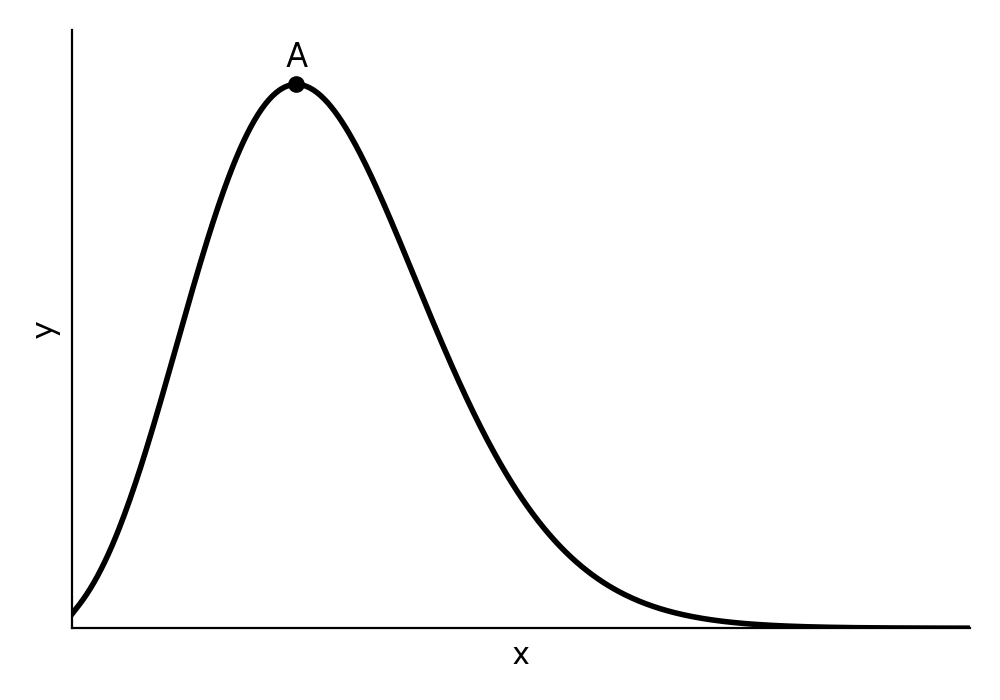
Find, in terms of , the -coordinate of point A.
Verify that , when .
The company has a total concentration of mg/mL available. Use your answer to part (h) to find the largest possible efficacy. Give your answer in the form , where and .
Express in terms of using the given total concentration. Then substitute this into the product expression.
The function is a quadratic. You can find its maximum by finding the vertex or by using calculus (setting the first derivative to zero).
Substitute the value of found in part (b.i) into the efficacy function .
Substitute into the given formula for and compare the result with your answer from part (b.ii).
Assume all are equal to a single variable, say . Substitute this into both sides of the inequality and simplify.
Start with the AM-GM inequality. Use the fact that the sum of the is . The maximum product occurs when the equality holds.
Substitute and into the formula .
Substitute and into the formula .
Substitute and into the formula .
Calculate for integer values of around the expected maximum (which can be estimated using ). Compare these values to find the largest.
Similar to part (f), calculate for integer values of around .
To find the maximum point, differentiate with respect to and set the derivative to zero. Remember to use the product rule and chain rule.
Use the properties of logarithms to rewrite the expression for and then convert it back to .
The optimal number of ingredients must be an integer. Use the result from part (h) to find the continuous maximum, then test the integer values of immediately surrounding this continuous maximum.
Question 19
MediumPaper 2 · calculator7 marksThe total number of units produced, , by a factory depends on the number of hours, , the factory operates. A production manager uses the model to predict the total units produced on any given day, where .
An energy auditor investigates the relationship between the total units produced and the energy consumption, , in kilowatt-hours (kWh). The following table shows the data collected on five different days.
Use the production model to estimate the number of units produced when the factory operates for 15 hours.
Find an appropriate regression equation that will allow the auditor to predict the energy consumption on a day when units are produced.
Hence, use your regression equation to predict the energy consumption when the factory operates for 15 hours.
Substitute the given number of hours into the quadratic model for production.
Determine which variable is the independent variable () and which is the dependent variable () for the regression. Use your GDC to find the linear regression equation.
Take the number of units produced from part (a) and substitute it into the regression equation found in part (b).
Question 20
HardPaper 1 · no calculator15 marksA quadratic function has its axis of symmetry at . One of its x-intercepts is at .
(a) Find the other x-intercept.
The graph of passes through the point .
(b) Find the equation of , giving your answer in the form .
A line with equation is a tangent to the graph of .
(c) Find the possible values of .
The axis of symmetry of a quadratic function is always located halfway between its x-intercepts (roots). Use this property to find the second root.
First, write the function in factored form using the roots you know. Then, use the given point to find the value of the constant . Finally, expand the expression to get the required form.
A tangent line intersects a curve at exactly one point. Set the equation of the line equal to the equation of the quadratic. Rearrange the resulting equation into the standard form . What does the discriminant () tell you about the number of solutions?
No question on this page matches those filters. Try another difficulty or paper.
34 more Quadratic functions (general form, roots form, vertex form – intercepts, symmetry) questions in the app
Every answer is marked mark by mark, IB-style, and the AI tutor helps when you are stuck.
Where marks are lost
- Using your own wrong value after failing a "show that".