Composite functions, inverse functions: notes and practice questions
- A composite function combines two functions and :
- The inverse function of , denoted , satisfies:
Found by solving for , then swapping and .
- Graphs of and are symmetric about .
How it is examined
Order matters and students get backwards. The other reliable loss is solving for and then forgetting to swap the variables back. Domain of the composite is fair game. 4 to 6 marks, both papers.
- Composite functions.
- Identity function. Finding the inverse function .
Extended at AHL 2.14.
Linking questions
- TOK: do you think mathematics or logic should be classified as a language?
Practice questions
45 questions · 2 easy · 35 medium · 8 hardQuestion 1
EasyPaper 1 · no calculator7 marksConsider the function , for .
Find the and intercepts.
Find the equations of the vertical and horizontal asymptotes.
Find the inverse function .
To find the intercept solve and to find the intercept calculate .
In a rational function , the vertical asymptote is while the horizontal asymptote is .
To solve for the inverse function interchange x and y then solve for the new y.
Question 2
MediumPaper 1 · no calculator7 marksThe function is defined for all . The line with equation is the tangent to the graph of at .
(a) Write down the value of .
(b) Find .
The function is defined for all where and .
(c) Find .
(d) Hence, find the equation of the tangent to the graph of at .
The derivative of a function at a point gives the gradient of the tangent line at that same point. What is the gradient of the given tangent line?
The point of tangency lies on both the function's graph and the tangent line. Substitute the x-coordinate of the point of tangency into the equation of the tangent line.
To find , you first need to calculate the value of the inner function, . Then, use this result as the input for the outer function, .
To find the equation of a tangent line, you need a point and a gradient. You found the point in part (c). To find the gradient, you need to calculate . Remember to use the chain rule to differentiate .
Question 3
HardPaper 1 · no calculator14 marksConsider the function where and . The graph of contains the point .
(a) Show that .
(b) Write down an expression for .
(c) Find the value of .
Consider the arithmetic sequence , where and .
(i) Show that and are four consecutive terms in a geometric sequence.
Consider the arithmetic sequence , where and .
(ii) Find the value of and the value of .
Substitute the given coordinates into the function's equation and solve for the base 'a'. You will need to use the rules of exponents.
The inverse of an exponential function is a logarithmic function. Recall the relationship between the base of the exponential and the base of the logarithm.
Substitute into the expression for the inverse function you found in part (b). Then, use the properties of logarithms to evaluate the result. Ask yourself: '9 to what power equals 1/81?'
An arithmetic sequence has a common difference. Set up equations by equating the differences between consecutive terms. Then, use the laws of logarithms to simplify these equations and show that the arguments of the logarithms have a common ratio.
You can use the properties of the geometric sequence from part (d)(i) or the properties of the original arithmetic sequence. Using the geometric sequence, find the common ratio 'r' first. Using the arithmetic sequence, find the common difference 'd' first.
Question 4
EasyPaper 1 · no calculator5 marksConsider the functions and , where is a non-zero real constant.
(a) Write down an expression for .
(b) Given that , find the possible values of .
To find the composite function , you need to substitute the expression for into the function wherever you see .
Substitute into your expression for from part (a). Set this equal to 5 and solve the resulting equation for .
Question 5
MediumPaper 1 · no calculator7 marksConsider the functions and for .
(a) Find an expression for .
(b) Hence, solve the equation for .
Recall that means . You need to substitute the expression for into the function wherever you see .
Start by using your result from part (a). You will get an equation involving and . Try using the compound angle identities to expand these terms.
Question 6
HardPaper 2 · calculator16 marksConsider the function f defined by for .
The graph of f and the line intersect at point P.
Find the x-coordinate of P.
The line L has a gradient of -2 and is a tangent to the graph of f at the point Q.
Find the exact coordinates of Q.
Show that the equation of L is .
The shaded region A is enclosed by the graph of f and the lines and L.
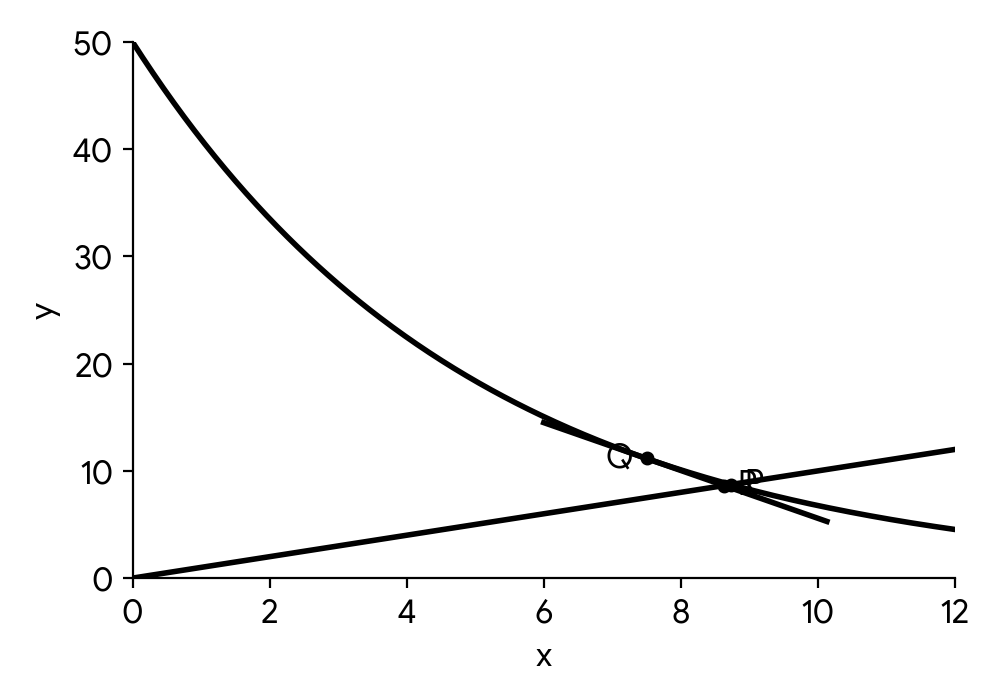
Find the x-coordinate of the point where L intersects the line .
Hence, find the area of A.
The line L is tangent to the graphs of both f and the inverse function .
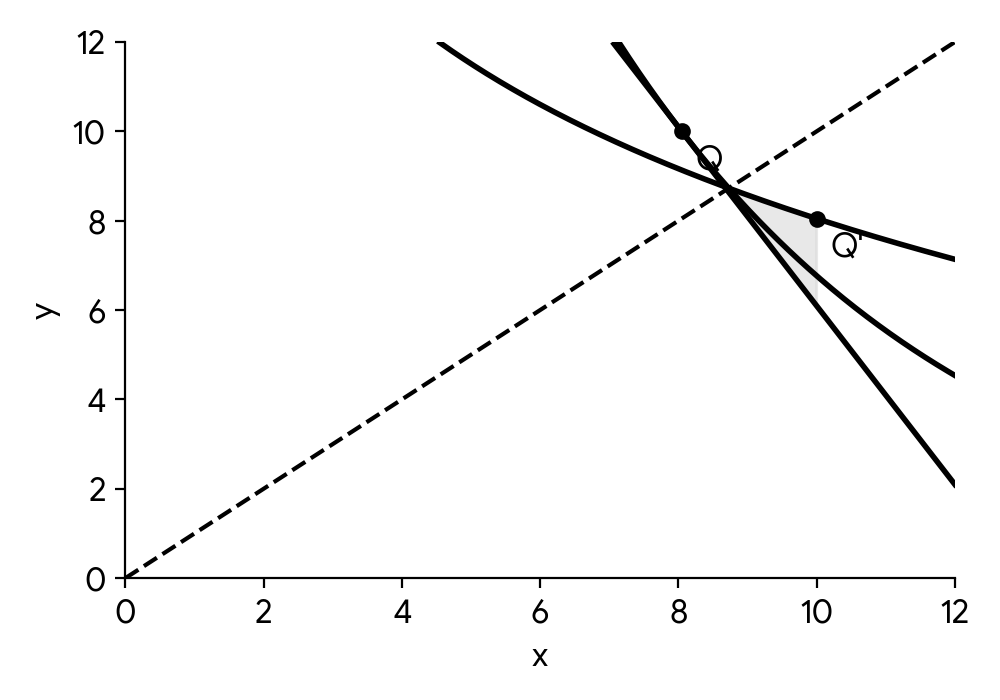
Find the shaded area enclosed by the graphs of f and and the line L.
To find the x-coordinate of P, you need to solve the equation . This is a transcendental equation, so a GDC will be useful to find the numerical solution.
First, find the derivative of . Then, set the derivative equal to the given gradient to find the x-coordinate of Q. Substitute this x-value back into to find the y-coordinate. Remember to provide exact values.
Use the point-gradient form of a line: , with the coordinates of Q and the gradient of L.
Set the equation of line L equal to and solve for x.
The area can be found by splitting it into two integrals. Identify the upper and lower bounding functions and the correct limits of integration based on the intersection points found in previous parts.
The graphs of a function and its inverse are symmetric about the line . How does this relate to the area calculated in part (d.ii)?
Question 7
MediumPaper 1 · no calculator7 marksThe function is defined by for , .
(a) Find the zero of .
(b) For the graph of , write down the equation of
(i) the vertical asymptote;
(ii) the horizontal asymptote.
(c) Find , the inverse function of .
To find the zero of a function, you need to find the value of for which the function's output is zero. For a rational function, when is the fraction equal to zero?
A vertical asymptote occurs where the function is undefined. For a rational function, where does this happen?
Consider the behavior of the function as approaches positive or negative infinity. What value does the function approach?
To find the inverse function, start by writing . Then, interchange the roles of and and solve the resulting equation for .
Question 8
HardPaper 2 · calculator16 marksA company models the efficiency of a new production line by the function , where represents the output rate (in units per hour) after hours of operation. For mathematical analysis, we consider the function over its natural domain , .
For the graph of f,
write down the equation of the vertical asymptote;
find the equation of the horizontal asymptote.
Find .
Using an algebraic approach, show that the graph of is obtained by a reflection of the graph of f in the y-axis followed by a reflection in the x-axis.
The graphs of f and intersect at and , where .
Find the value of p and the value of q.
Hence, find the area enclosed by the graph of f and the graph of .
The vertical asymptote of a rational function occurs where the denominator is zero, provided the numerator is not also zero at that point.
To find the horizontal asymptote of a rational function where the degree of the numerator and denominator are the same, consider the ratio of the leading coefficients as .
To find the inverse function, replace with , then swap and , and finally rearrange the equation to make the subject again.
A reflection in the y-axis transforms to . A subsequent reflection in the x-axis transforms to . You need to show that this sequence of transformations results in .
The intersection points of a function and its inverse often lie on the line . You can solve to find these points.
The area enclosed by two curves and between and is given by . Use your GDC to evaluate the definite integral.
Question 9
MediumPaper 1 · no calculator5 marksConsider the functions and , where is a real constant.
(a) Write down an expression for .
(b) Given that , find the value of .
To find , you need to substitute the entire function into the variable of the function .
Substitute into your expression from part (a) and set it equal to 36. Then, use the properties of exponents and logarithms to solve for .
Question 10
HardPaper 2 · calculator15 marksA landscape architect is designing a section of a garden path. The shape of one edge of the path can be modelled by the function for , where and are measured in metres.
(a) (i) Find , the inverse of , and state its domain.
(ii) Write down the range of .
(b) The graph of intersects the graph of at two points. Find the -coordinates of these two points.
(c) Find the area enclosed by the graph of and the graph of .
(d) Find .
(e) Find the value of for which the graph of and the graph of have the same gradient.
To find the inverse function, swap and in the equation and then solve for . Remember that the domain of is the range of .
The range of the inverse function is the domain of the original function.
The intersection points of a function and its inverse lie on the line . Therefore, you can solve or .
The area enclosed by and can be found by integrating the absolute difference between the two functions, with the limits of integration being the -coordinates found in part (b). You will need a GDC for this integral.
Use the power rule for differentiation: .
First, find the derivative of using the chain rule. Then, equate and and solve the resulting equation for . This may require a GDC to solve the cubic equation.
Question 11
MediumPaper 1 · no calculator7 marksThe functions and are defined for by
, where
.
Find the two possible functions such that .
Start by finding an expression for the composite function in terms of and . Then, expand this expression and compare the coefficients of the powers of with the given expression .
Question 12
HardPaper 2 · calculator20 marksA designer is creating a decorative glass container shaped like a dome. The outer profile of the container can be modelled by the function , where and and are measured in metres.
Sketch the curve , clearly indicating the coordinates of the endpoints.
Show that the inverse function of is given by .
State the domain and range of .
The container is formed by rotating the curve by about the y-axis. Show that the volume, , of liquid in the container when it is filled to a height of metres is given by .
Hence, determine the maximum volume of the container.
At , the container is empty. Liquid is then added to the container at a constant rate of .
Find the time it takes to fill the container to its maximum volume.
Find the rate of change of the height of the liquid when the container is filled to half its maximum volume.
Remember that the domain restricts the part of the curve you need to sketch. Identify the y-values at the given x-endpoints.
To find the inverse function, interchange and and then solve for . Remember the range of the original function.
The domain of an inverse function is the range of the original function, and vice versa.
The formula for volume of revolution about the y-axis is . Express in terms of from the original function.
The maximum height the liquid can reach is determined by the range of the original function.
Time equals total volume divided by the filling rate.
First, find the height when the volume is half the maximum. Then, use the chain rule . You'll need to differentiate the volume formula with respect to .
Question 13
MediumPaper 1 · no calculator7 marksConsider the functions and .
(a) Find .
(b) Solve the equation for .
To find the composite function , you need to substitute the function into every instance of in the function .
Start by substituting your answer from part (a) into the equation. Then, try to rearrange the equation so that you have a single trigonometric function (like tan, sin, or cos) on one side.
Question 14
HardPaper 1 · no calculator12 marksConsider the functions , , and .
(a) Find the range of .
(b) Find the range of .
(c) Find the range of .
(d) Find an expression for .
(e) Solve the equation .
(f) Solve the inequality .
The function is a quadratic. What is the vertex of the parabola and which way does it open? This will tell you the maximum or minimum value.
The function is a reciprocal function. Consider the horizontal asymptote of the graph of . The function can take any value except the value of the horizontal asymptote.
The function is an exponential function. What is the range of the basic exponential function ? How does the '+1' transform this range?
To find the composite function , you need to substitute the expression for into the variable in the function .
Use your expression from part (d) and set it equal to -1. Then, solve the resulting equation for .
First, find the composite function . Then set up the inequality and solve for . Remember the properties of exponential functions and how to solve quadratic inequalities.
Question 15
MediumPaper 1 · no calculator7 marksThe function is defined by for .
(a) Find the zero of .
(b) For the graph of , write down the equation of
(i) the vertical asymptote;
(ii) the horizontal asymptote.
(c) Find , the inverse function of .
To find the zero of a function, you need to find the value of for which the function's output is zero. For a rational function, this occurs when the numerator is equal to zero.
The vertical asymptote of a rational function occurs at the x-value(s) for which the denominator is zero, provided the numerator is not also zero at that x-value.
For a rational function where the degree of the numerator and the denominator are the same, the horizontal asymptote is the line .
To find the inverse function, start by writing the function as . Then, swap the variables and . Finally, rearrange the equation to make the subject. This new expression for is the inverse function.
Question 16
HardPaper 1 · no calculator16 marksConsider the functions , and defined by , and .
(a) Write down the value of .
(b) Write down the value of .
(c) Write down the value of .
(d) Find the value of .
(e) Find the value of .
(f) Find the value of .
(g) Find the value of .
(h) Find an expression for the composite function , giving your answer in the form .
(i) Find an expression for the composite function .
Substitute into the expression for .
Be careful when squaring the negative number. Substitute into the expression for .
Substitute into the expression for .
Evaluate each function separately first, then add the results.
Evaluate and first. Then perform the multiplication and subtraction.
Evaluate each function separately, then multiply the results.
To find , you can either first find the inverse function and then substitute , or you can solve the equation for .
To find , substitute the entire expression for into the function wherever you see an .
First find the inverse function . Then substitute this expression into to find .
Question 17
MediumPaper 1 · no calculator7 marksThe functions and are defined for by
, where
.
Find the two possible functions such that .
Start by writing an expression for the composite function in terms of and . Then, expand this expression and compare the coefficients of the powers of with the given quadratic expression.
Question 18
HardPaper 1 · no calculator13 marksThe function is defined by for .
(a) Find the range of .
(b) Find an expression for the inverse function, .
(c) Find an expression for .
(d) Solve the equation .
(e) Hence, or otherwise, state the number of solutions to the equation and justify your answer.
To find the range of a rational function of the form , consider the horizontal asymptote of its graph. You can find this by looking at the limit of the function as approaches infinity, or by algebraic long division.
To find the inverse function, first write the function as . Then, swap the variables and . Finally, rearrange the equation to make the subject.
To find the composite function , you need to substitute the entire expression for into every instance of in the definition of and simplify.
Set the expression for equal to and rearrange the resulting equation into a standard quadratic form . Then, you can use the quadratic formula or the discriminant to find the solutions.
Consider the relationship between the graphs of a function and its inverse. The points of intersection often lie on a specific line. How does this relate to your answer in part (d)?
Question 19
MediumPaper 1 · no calculator5 marksSolve the inequality .
The function is defined by , where .
Find the least value of for which exists, justifying your answer.
First, find the roots of the corresponding quadratic equation . Then, consider the shape of the parabola (does it open upwards or downwards?) to determine the intervals where the function's value is positive.
For an inverse function to exist, the original function must be one-to-one. Also, remember the condition for the expression inside a square root. How does this relate to your answer in part (a)?
Question 20
MediumPaper 2 · calculator6 marksA tech company's daily profit, , in thousands of dollars, from producing units of a new gadget is modelled by the function , for .
(a) Find the range of the company's daily profit.
Due to new environmental regulations, the company faces a levy that adjusts its profit. The adjusted profit, , is given by the function , where is a constant representing the levy's impact.
Given that the adjusted profit must be non-positive for all , determine the set of possible values for .
To find the range of a quadratic function, identify whether it opens upwards or downwards and then find the coordinates of its vertex.
Consider the maximum value of the composite function . For it to be non-positive for all , its maximum value must be less than or equal to zero. Alternatively, you can use the discriminant of the resulting quadratic function.
No question on this page matches those filters. Try another difficulty or paper.
25 more Composite functions, inverse functions questions in the app
Every answer is marked mark by mark, IB-style, and the AI tutor helps when you are stuck.
Where marks are lost
- Using your own wrong value after failing a "show that".