Exponents: notes and practice questions
- Standard Form (Scientific Notation): Expresses numbers in the form , where and is an integer ().
- Laws of Indices (Exponents): Rules used to simplify and manipulate expressions involving exponents. They require terms to have the same base and are not in the formula booklet. Key laws include:
How it is examined
Paper 1 asks for exponent manipulation with no calculator, usually as a step inside a longer question rather than on its own. Base 10 and e only at this subtopic; general bases arrive at SL 1.7. 2 to 4 marks.
The exponent laws are not given. is listed under the laws of logarithms.
- Laws of exponents with integer exponents.
- Introduction to logarithms with base 10 and e.
- Numerical evaluation of logarithms using technology.
Linking questions
- Other contexts: the Richter scale and the decibel scale.
- Links to other subjects: calculation of pH and buffer solutions (chemistry).
Practice questions
35 questions · 1 easy · 25 medium · 9 hardQuestion 1
EasyPaper 1 · no calculator6 marks(a) Find the value of .
(b) Find the value of .
(c) Find the value of .
Let the expression be equal to . Rewrite the logarithmic equation in exponential form. Then, try to express the number on the right-hand side as a power of the base.
Let the expression be equal to . Rewrite the logarithmic equation in exponential form. Remember the rule of negative exponents: .
Let the expression be equal to . Rewrite the logarithmic equation in exponential form. Remember the rule of fractional exponents: .
Question 2
MediumPaper 1 · no calculator5 marksA researcher is studying the propagation of a signal through a medium. The signal strength at a certain point is related to a characteristic parameter of the medium by the equation:
where .
(a) Determine the value of .
Focus on simplifying the logarithmic terms using properties of logarithms, especially the change of base formula, to bring all terms to a common base. Remember that and .
Question 3
HardPaper 1 · no calculator5 marksSolve the equation , where .
Start by simplifying the term with the different base. Remember the change of base formula for logarithms, specifically the reciprocal identity. Then, aim to combine all logarithmic terms into a single logarithm on each side of the equation.
Question 4
MediumPaper 1 · no calculator5 marks(a) A scientist is studying the rate at which a certain chemical compound dissolves in a solution. The rate of dissolution, , in grams per minute, at time minutes, is modeled by the expression .
This expression can be written in the form , where , , and are constants. Write down the value of .
(b) Hence, calculate the total amount of compound dissolved between minutes and minutes.
Recall the properties of exponents, specifically how to express square roots and fractions as powers of . Consider splitting the fraction into two terms.
The total amount of compound dissolved is found by integrating the rate of dissolution, , over the given time interval. Remember to use the limits of integration correctly.
Question 5
HardPaper 3 · calculator16 marksIn a study of wave propagation, a mathematical model uses the function , where , to describe a certain physical quantity. This function is also known as the hyperbolic sine function, .
Verify that satisfies the differential equation .
Another related function, the hyperbolic cosine, is defined as , also known as . Show that .
The functions and can be extended to complex numbers. Using Euler's formula , where , express in terms of and .
Similarly, express in terms of and .
Hence, show that .
In a design project, a component's profile is described by a hyperbola with parametric equations and , where are positive constants and .
Given that the component's profile passes through the point and has asymptotes , find the values of and .
Recall the derivatives of and . Differentiate the function twice.
Substitute the definitions of and into the expression and simplify.
Substitute into the definition of and use Euler's formula.
Substitute into the definition of and use Euler's formula.
Use your results from part (c) and trigonometric identities.
Substitute the parametric equations into the standard hyperbola form . Use the given point to find one constant and the asymptote equation to find the other.
Question 6
MediumPaper 1 · no calculator5 marks(a) Solve the equation , where .
Consider using the change of base formula for logarithms to simplify the term involving different bases. Recall that . Then, apply the properties of logarithms (product or quotient rule) to combine terms on one side of the equation before equating the arguments.
Question 7
HardPaper 3 · calculator24 marksA biologist is modelling the growth of two different bacterial colonies. The first colony, A, grows such that its population at time is given by , where is a growth factor and . The second colony, B, grows linearly such that its population at time is .
Consider the cases where the growth factor and . On the same set of axes, sketch the following three graphs for :
Clearly label each graph with its equation and state the coordinates of any non-zero -axis intercepts.
In parts (b) and (c), consider the case where the growth factor .
Use calculus to find the minimum value of the expression , justifying that this value is a minimum.
Hence deduce that for all .
There exist values of for which the graph of and the line have different numbers of intersection points. The following table gives three intervals for the value of .
| Interval | Number of intersection points |
|---|---|
By investigating the graph of for different values of , write down the values of and .
In parts (e) and (f), consider .
For , a value of exists such that the line is a tangent to the graph of at a point P.
Find the exact coordinates of P and the exact value of .
Write down the exact set of values for such that the graphs of and have
(i) two intersection points;
(ii) no intersection points.
Ensure your sketch accurately reflects the general shape and relative positions of exponential functions with different bases and the line . Pay attention to intercepts and asymptotic behaviour.
Recall how to find local extrema using calculus by analyzing the first and second derivatives.
Consider the implications of the minimum value found in part (b) for the expression .
Visualize how the graph of changes as the value of changes, especially relative to the line . Consider the general shapes for and .
For tangency, both the function values and their derivatives must be equal at the point of contact. Let the point of tangency be .
Relate the critical value of found in part (e) to the number of intersection points. Consider the graphical behavior.
Relate the critical value of found in part (e) to the number of intersection points. Consider the graphical behavior.
Question 8
MediumPaper 1 · no calculator6 marksShow that can be written as .
Hence, find the exact value of .
Expand the squared binomial expression. Remember that . Also, recall the rules for exponents, such as and .
Use the result from part (a) to rewrite the integrand. Then, integrate term by term. Remember the integral of is . Finally, evaluate the definite integral using the Fundamental Theorem of Calculus.
Question 9
HardPaper 1 · no calculator14 marksConsider the function where and . The graph of contains the point .
(a) Show that .
(b) Write down an expression for .
(c) Find the value of .
Consider the arithmetic sequence , where and .
(i) Show that and are four consecutive terms in a geometric sequence.
Consider the arithmetic sequence , where and .
(ii) Find the value of and the value of .
Substitute the given coordinates into the function's equation and solve for the base 'a'. You will need to use the rules of exponents.
The inverse of an exponential function is a logarithmic function. Recall the relationship between the base of the exponential and the base of the logarithm.
Substitute into the expression for the inverse function you found in part (b). Then, use the properties of logarithms to evaluate the result. Ask yourself: '9 to what power equals 1/81?'
An arithmetic sequence has a common difference. Set up equations by equating the differences between consecutive terms. Then, use the laws of logarithms to simplify these equations and show that the arguments of the logarithms have a common ratio.
You can use the properties of the geometric sequence from part (d)(i) or the properties of the original arithmetic sequence. Using the geometric sequence, find the common ratio 'r' first. Using the arithmetic sequence, find the common difference 'd' first.
Question 10
MediumPaper 1 · no calculator5 marksThe expression can be written as . Write down the value of .
Hence, find the value of .
Remember the exponent rule . How can you write in exponent form?
Use your result from part (a) to rewrite the integrand. Then, integrate term by term using the power rule for integration: . Finally, evaluate the definite integral using the fundamental theorem of calculus.
Question 11
HardPaper 2 · calculator20 marksThe rate of change of a certain quantity with respect to a variable is given by , , , where is a positive constant.
The expression for can be written in the form , where .
Find and in terms of .
Hence, find an expression for .
The concentration of a certain chemical product, (in mol/L), in a reaction vessel at time (in minutes) can be modelled by the differential equation , where is the maximum possible concentration and mol/L is the initial concentration.
By solving the differential equation, show that .
At minutes, the concentration of the product has reached mol/L.
Find the value of , giving your answer correct to four significant figures.
Find the value of when the rate of change of the concentration is at its maximum.
To find and , combine the partial fractions on the right side by finding a common denominator. Then, equate the numerator of this combined expression to the numerator of the original expression for . You can then either compare coefficients of and the constant terms, or substitute specific convenient values for (like and ) to solve for and .
Integrate the partial fraction form of that you found in part (a). Remember that the integral of is and that you might need to use a substitution for terms like . Don't forget the constant of integration.
This is a separable differential equation. Separate the variables and , then integrate both sides. You can use the partial fraction decomposition from part (a) to integrate the terms. After integrating, apply the initial condition to solve for the constant of integration and then rearrange the equation to match the required form.
Substitute the given values for and into the formula derived in part (c). You will then have an equation with only as an unknown. Use your GDC to solve for .
For a logistic growth model, the rate of change is maximized when the quantity (concentration in this case) reaches half of its carrying capacity (maximum value ). Use the value of found in part (d) to determine this critical concentration, then substitute it back into the formula from part (c) to solve for .
Question 12
MediumPaper 1 · no calculator6 marksSolve the equation for .
Start by applying the logarithm rules to expand or combine the terms. Remember the change of base formula, particularly the reciprocal identity:
Question 13
HardPaper 2 · calculator23 marksThe following table shows the annual revenue of a tech startup, Quantum Innovations, years after its launch in 2015.
| (years after 2015) | 0 | 2 | 4 | 6 | 8 |
|---|---|---|---|---|---|
| (revenue in millions of USD) | 1.5 | 2.8 | 4.2 | 5.5 | 7.1 |
A data analyst uses linear regression to model the revenue of Quantum Innovations using these data.
The analyst's model is .
(a)(i) Write down the value of and the value of .
(a)(ii) Interpret, in context, the value of .
(b) The analyst uses this model to predict the revenue of Quantum Innovations in the year 2030, where , and calculates a revenue of approximately million USD.
Comment on the reliability of the analyst's prediction.
(c)(i) A financial expert, Elena, develops an exponential model for Quantum Innovations' future revenue.
In this model, represents the revenue in millions of USD years after 2015, where .
Use Elena's model to predict the revenue of Quantum Innovations in the year 2035.
(c)(ii) Interpret, in context, the value in Elena's model.
(d) Another financial expert, Carlos, develops a third model for Quantum Innovations' revenue.
In this model, represents the revenue in millions of USD years after 2015, where .
Use Carlos's model to predict the revenue of Quantum Innovations in the year 2035.
(e) Determine the year in which the difference between the predictions from Elena's model and Carlos's model is greatest.
(f)(i) Find the value of
;
(f)(ii) Find the value of
.
(g) Compare and interpret, in context, the values of and .
Use your GDC's linear regression (LinReg(ax+b) ) function to find the values of and . Ensure you input the values as your independent variable and values as your dependent variable.
The value of represents the slope of the linear model. Think about what the slope means in terms of the variables (revenue) and (years).
Consider the range of the original data used to create the model. What happens when you make a prediction outside this range?
First, determine the value of that corresponds to the year 2035. Then substitute this value into Elena's exponential model.
In an exponential growth model , the base represents the growth factor. How is this related to a percentage growth rate?
As in part (c.i), first find the correct value of for the year 2035. Then substitute it into Carlos's model.
Define a difference function, for example, . Use your GDC to graph this function over the domain and find its maximum value. Remember to convert back to a year.
Use your GDC's numerical derivative function (e.g., nDeriv or dy/dx) to evaluate the derivative of Elena's model at . Alternatively, find the analytical derivative of and substitute .
Similar to part (f.i), use your GDC's numerical derivative function or find the analytical derivative of Carlos's model and substitute .
The derivative represents the instantaneous rate of change. Compare which model predicts a faster rate of revenue increase at and explain what that means for Quantum Innovations.
Question 14
MediumPaper 1 · no calculator4 marksA scientist is studying a spherical microbe. The radius of the microbe is measured to be cm.
(a) Write down the diameter of the microbe.
(b) The volume of the microbe can be expressed in the form where and .
Find the value of and the value of .
The diameter of a sphere is twice its radius. How can you apply this to the given radius in scientific notation?
The formula for the volume of a sphere is . Substitute the radius and use the laws of exponents to simplify. Remember to adjust the final answer to match the required scientific notation format.
Question 15
HardPaper 3 · calculator27 marksA company is designing a new power generator. The power output, , in megawatts (MW), of a prototype generator at time hours after startup is modelled by the function , where , is a control parameter, and is a constant representing the initial power. For parts (a) to (e), assume .
On separate axes, sketch the graph of showing the value of the -intercept and the coordinates of any points with zero gradient, for
(i) ;
(ii) .
Write down an expression for .
Hence, or otherwise, find the set of values of such that the graph of has
(i) a point of inflexion with zero gradient;
(ii) one local maximum point and one local minimum point;
(iii) no points where the gradient is equal to zero.
Given that the graph of has one local maximum point and one local minimum point, show that
(i) the -coordinate of the local maximum point is ;
(ii) the -coordinate of the local minimum point is .
Hence, for , find the set of values of such that the graph of has
(i) exactly one -axis intercept;
(ii) exactly two -axis intercepts;
(iii) exactly three -axis intercepts.
Consider a modified power output function for and where . Find all conditions on and such that the graph of has exactly one -axis intercept, explaining your reasoning.
To sketch the graph, first find the derivative and set it to zero to find the critical points. Evaluate at these points to find the coordinates of local maxima and minima. Also, find the -intercept by setting .
Similar to part (a.i), find the critical points and their corresponding -values. Remember to use exact values where possible, and approximate for plotting if necessary.
Recall the power rule for differentiation.
A point of inflexion with zero gradient occurs when has a repeated root, which also implies at that point.
Local maximum and minimum points occur when has two distinct real roots.
No points with zero gradient means has no real solutions.
From part (c.ii), the critical points are . Determine which one corresponds to a local maximum by considering the shape of a positive cubic or using the second derivative test. Then substitute that -value into .
Similar to part (d.i), substitute the -value for the local minimum into .
For a cubic function with local maximum and minimum, it has exactly one -axis intercept if either the local minimum is above the -axis or the local maximum is below the -axis.
A cubic function with local maximum and minimum has exactly two -axis intercepts if either the local minimum is on the -axis or the local maximum is on the -axis.
A cubic function with local maximum and minimum has exactly three -axis intercepts if the local minimum is below the -axis AND the local maximum is above the -axis.
Consider two cases for : and . For , analyze the derivative . For , use the -coordinates of the local maximum and minimum points, similar to part (e).
Question 16
MediumPaper 1 · no calculator6 marksThe expression can be written in the form . Write down the value of and the value of .
Hence, find the value of .
Rewrite the cube root as a power of . Then, split the fraction into two separate terms and use the laws of exponents to simplify each term.
Use your answer from part (a) to set up the integral. Integrate each term using the power rule for integration. Then, evaluate the definite integral by substituting the upper and lower limits.
Question 17
HardPaper 3 · calculator30 marksA pharmaceutical company is formulating a new drug. They are testing two active ingredients, and , such that their total concentration is mg/mL. The drug's efficacy is modelled by the product of the concentrations of the two ingredients.
Find the efficacy, , as a function of only.
Determine the concentration of that maximizes the drug's efficacy.
Hence, show that the maximum efficacy for two ingredients with a total concentration of mg/mL is .
Let represent the maximum efficacy for a drug with active ingredients and a total concentration of mg/mL. For , the maximum efficacy can be expressed as .
Verify that is true for .
The relationship between the geometric mean and arithmetic mean states that for positive real numbers , their geometric mean is always less than or equal to their arithmetic mean .
Show that the geometric mean and arithmetic mean are equal when .
Use this result to prove that .
Using the formula for , determine the value of:
;
;
.
For a fixed total concentration of mg/mL, the company wants to find the optimal number of active ingredients, , to maximize the drug's efficacy. Let denote this maximum efficacy.
Write down the value of and the value of at which it occurs.
Determine the value of and the value of at which it occurs.
Consider the continuous function , defined by , where . A sketch of the graph of is shown in the following diagram. Point A is the maximum point on this graph.
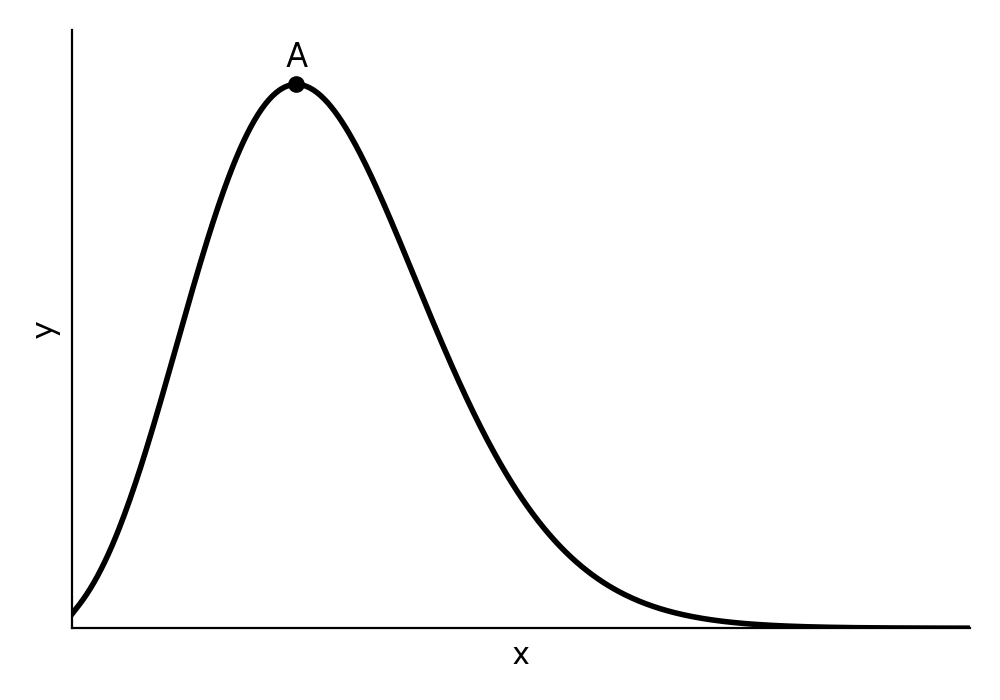
Find, in terms of , the -coordinate of point A.
Verify that , when .
The company has a total concentration of mg/mL available. Use your answer to part (h) to find the largest possible efficacy. Give your answer in the form , where and .
Express in terms of using the given total concentration. Then substitute this into the product expression.
The function is a quadratic. You can find its maximum by finding the vertex or by using calculus (setting the first derivative to zero).
Substitute the value of found in part (b.i) into the efficacy function .
Substitute into the given formula for and compare the result with your answer from part (b.ii).
Assume all are equal to a single variable, say . Substitute this into both sides of the inequality and simplify.
Start with the AM-GM inequality. Use the fact that the sum of the is . The maximum product occurs when the equality holds.
Substitute and into the formula .
Substitute and into the formula .
Substitute and into the formula .
Calculate for integer values of around the expected maximum (which can be estimated using ). Compare these values to find the largest.
Similar to part (f), calculate for integer values of around .
To find the maximum point, differentiate with respect to and set the derivative to zero. Remember to use the product rule and chain rule.
Use the properties of logarithms to rewrite the expression for and then convert it back to .
The optimal number of ingredients must be an integer. Use the result from part (h) to find the continuous maximum, then test the integer values of immediately surrounding this continuous maximum.
Question 18
MediumPaper 1 · no calculator15 marksConsider the series , where and .
(a) Consider the case where the series is geometric.
(i) Show that .
(ii) Given that and the sum to infinity is , find the value of .
(b) Now consider the case where the series is arithmetic.
(i) Show that .
(ii) Write down the common difference, , in the form where .
(iii) The sum of the first terms of the series is . Find the value of .
For a series to be geometric, the ratio of any two consecutive terms must be constant. Set up an equation using the first three terms to find this ratio, .
You'll need the formula for the sum to infinity of a geometric series, . Remember that determines the value of the common ratio .
For a series to be arithmetic, the difference between any two consecutive terms must be constant. Set up an equation using the first three terms, .
The common difference is given by . Use the value of you found in the previous part.
Use the formula for the sum of the first terms of an arithmetic series, . You will need to form and solve a quadratic equation in .
Question 19
HardPaper 1 · no calculator5 marksSolve the equation , where .
The equation involves natural logarithms (ln), which are logs to the base 'e'. Start by simplifying the term using the change of base formula. Then, use the properties of logarithms to combine the `ln` terms and solve for x.
Question 20
MediumPaper 1 · no calculator7 marksConsider the complex number .
(a) Write the integer 2 in the form where .
(b) Hence, find in the form , where and are expressed in terms of .
(c) Find , where is the multiplicative inverse of .
Recall the fundamental relationship between the exponential function and the natural logarithm. Any positive number can be written as to some power.
Use the result from part (a) and the laws of exponents to rewrite . Then apply Euler's formula, .
First, find an expression for using a similar method to part (b). Then add and and identify the imaginary part of the sum.
No question on this page matches those filters. Try another difficulty or paper.
15 more Exponents questions in the app
Every answer is marked mark by mark, IB-style, and the AI tutor helps when you are stuck.
Where marks are lost
- Using your own wrong value after failing a "show that".