Reciprocal & Rational functions (+ finding roots & asymptotes): notes and practice questions
- Reciprocal functions: or similar.
- Rational functions: , where and are polynomials.
- Roots: Found by solving .
- Vertical asymptotes: -values where .
- Horizontal asymptotes: Determined by the degrees of and .
How it is examined
Asymptotes are stated as equations (, not "2"), and that is a real mark. A sketch missing an asymptote loses the sketch mark even if the curve shape is right. 4 to 6 marks, both papers.
The two asymptote equations are given alongside the general form.
- The reciprocal function , : its graph and self-inverse nature.
- Rational functions of the form and their graphs.
- Equations of vertical and horizontal asymptotes.
Extended at AHL 2.13 to and .
Linking questions
- TOK: what are the implications of accepting that mathematical knowledge changes over time?
Practice questions
41 questions · 7 easy · 23 medium · 11 hardQuestion 1
EasyPaper 1 · no calculator2 marksConsider the function , .
State the range of .
The range of a rational function of the form is determined by its horizontal asymptote. Recall how to find the equation of the horizontal asymptote from the coefficients of the function.
Question 2
MediumPaper 1 · no calculator8 marksConsider the function .
The graph of passes through the point and has an oblique asymptote with equation .
(a) Write down the equation of the vertical asymptote.
(b) Find the value of:
(i)
(ii)
(c) Hence, find the exact coordinates of any points where the graph of intersects the x-axis.
A vertical asymptote occurs where the function is undefined. This happens when the denominator of the rational function is equal to zero.
The equation of the oblique asymptote is the quotient when the numerator is divided by the denominator. Perform polynomial long division or consider the limit of as approaches infinity.
You know that the point (1, -2) lies on the graph of the function. Substitute these x and y values, along with the value of 'a' you just found, into the equation for g(x).
The x-intercepts occur when y=0. Set the function g(x) equal to zero and solve for x. Remember that a fraction is zero only when its numerator is zero.
Question 3
HardPaper 3 · calculator16 marksIn a study of wave propagation, a mathematical model uses the function , where , to describe a certain physical quantity. This function is also known as the hyperbolic sine function, .
Verify that satisfies the differential equation .
Another related function, the hyperbolic cosine, is defined as , also known as . Show that .
The functions and can be extended to complex numbers. Using Euler's formula , where , express in terms of and .
Similarly, express in terms of and .
Hence, show that .
In a design project, a component's profile is described by a hyperbola with parametric equations and , where are positive constants and .
Given that the component's profile passes through the point and has asymptotes , find the values of and .
Recall the derivatives of and . Differentiate the function twice.
Substitute the definitions of and into the expression and simplify.
Substitute into the definition of and use Euler's formula.
Substitute into the definition of and use Euler's formula.
Use your results from part (c) and trigonometric identities.
Substitute the parametric equations into the standard hyperbola form . Use the given point to find one constant and the asymptote equation to find the other.
Question 4
EasyPaper 1 · no calculator4 marksConsider the function .
(a) State the largest possible domain for the function .
(b) State the largest possible range for the function .
(c) Find the coordinates of any points where the curve intersects the and -axes.
The domain of a rational function is all real numbers except for the values of x that make the denominator zero.
The range is restricted by the horizontal asymptote. Find the value that approaches as becomes very large by considering the ratio of the coefficients of in the numerator and denominator.
The y-intercept is found by calculating . The x-intercept is found by solving the equation .
Question 5
MediumPaper 1 · no calculator7 marks(a) Show that , for .
(b) Hence or otherwise, solve the equation for , .
To show that the two expressions are equal, you can either start with the left-hand side and combine the terms into a single fraction, or start with the right-hand side and perform algebraic long division.
Notice the structure of the equation in this part is the same as the expression in part (a). Let and use the result from part (a) to form a simpler equation. This will lead to a quadratic equation in terms of .
Question 6
HardPaper 1 · no calculator9 marksA function is defined by , where .
The graph of is shown below.
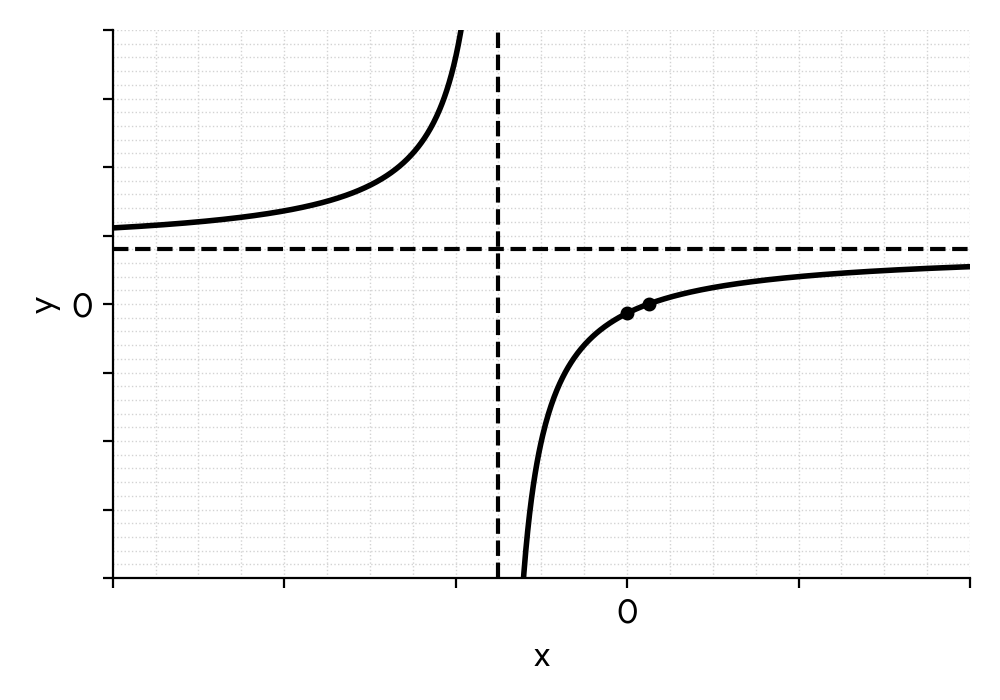
(a) Write down the equation of the horizontal asymptote.
Consider the function , where .
(i) Write down the number of solutions to for .
(ii) Determine the value of such that has only one solution for .
(iii) Determine the range of values for for which has two distinct solutions for .
The horizontal asymptote is determined by the behavior of the function as approaches . For a rational function where the degree of the numerator and denominator are the same, the asymptote is the ratio of the leading coefficients.
The line passes through the y-intercept of . Sketch a line with a negative slope passing through this point on the given graph. How many times does it intersect the curve ?
A single solution occurs when the line is tangent to the curve . Since the line always passes through the y-intercept of the curve, the point of tangency must be the y-intercept. Therefore, the slope of the line, , must be equal to the gradient of the curve at that point. Alternatively, you can set up the equation , rearrange it into a quadratic, and use the discriminant or analyze the roots.
From the previous part, you found the two solutions for in terms of . One solution is always . For there to be two distinct solutions for , what condition must the other solution satisfy?
Question 7
EasyPaper 1 · no calculator8 marksFor each of the following functions, write down its greatest possible domain and range.
(a)
(b)
(c)
(d)
The domain is restricted when the denominator of a fraction is zero. The range is restricted by the horizontal asymptote of the function.
For a rational function of the form , the horizontal asymptote is given by the line .
The vertical asymptote has changed from the previous part. Re-evaluate the value of x for which the denominator is zero.
This function is a transformation of the basic reciprocal function . Consider its asymptotes.
Question 8
MediumPaper 1 · no calculator7 marksThe function is defined by for , .
(a) Find the zero of .
(b) For the graph of , write down the equation of
(i) the vertical asymptote;
(ii) the horizontal asymptote.
(c) Find , the inverse function of .
To find the zero of a function, you need to find the value of for which the function's output is zero. For a rational function, when is the fraction equal to zero?
A vertical asymptote occurs where the function is undefined. For a rational function, where does this happen?
Consider the behavior of the function as approaches positive or negative infinity. What value does the function approach?
To find the inverse function, start by writing . Then, interchange the roles of and and solve the resulting equation for .
Question 9
HardPaper 1 · no calculator15 marksThe functions and are defined by
, where
, where .
(a) State the equation of the vertical asymptote to the graph of .
The graphs of and intersect at two distinct points.
(i) Show that, at the points of intersection, .
(ii) Hence show that .
(iii) Hence, or otherwise, find the range of possible values of .
The following diagram shows part of the graphs of and .
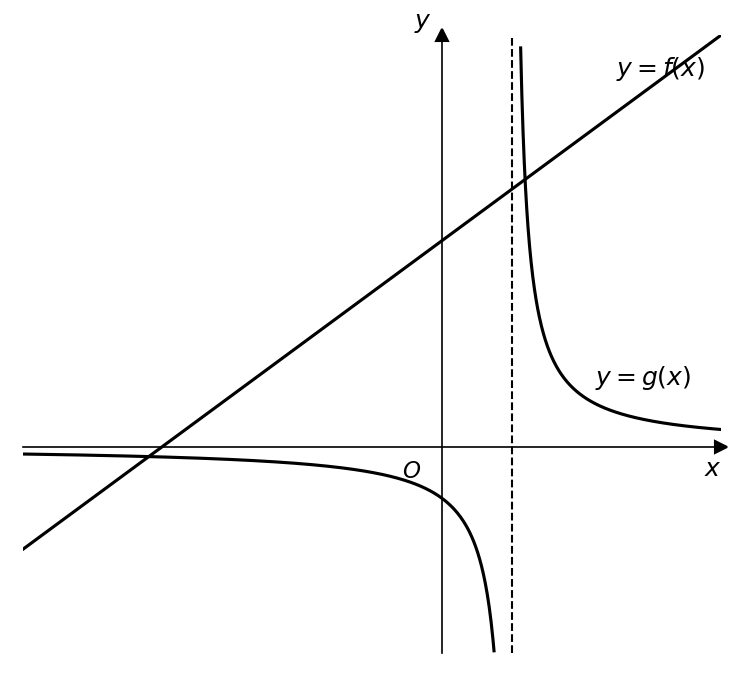
The graphs intersect at and , where .
In the case where , find the value of . Express your answer in the form , where .
A vertical asymptote occurs where the function is undefined. For a rational function of the form , this happens when the denominator is equal to zero.
The points of intersection are where the two functions are equal. Set and rearrange the equation into the required quadratic form.
The phrase 'two distinct points' tells you something about the discriminant of the quadratic equation you found in part (b.i). What is the condition for a quadratic to have two distinct real roots?
You need to solve the inequality . Consider the properties of this quadratic in . Does it ever equal zero? What is its minimum value? You could try finding the discriminant of this new quadratic or completing the square.
First, substitute the given value of into the quadratic equation from part (b.i). Then, solve this new quadratic equation to find the x-coordinates of the intersection points, and . Finally, calculate the difference .
Question 10
EasyPaper 1 · no calculator5 marksLet .
(a) Find the coordinates of the -intercept.
(b) Write down the equation of the vertical asymptote.
(c) Find the equation of the horizontal asymptote.
The x-intercept occurs when the function's value is zero, i.e., . For a rational function, when is the fraction equal to zero?
A vertical asymptote occurs where the function is undefined. For a rational function, this happens when the denominator is equal to zero.
To find the horizontal asymptote, consider the behavior of the function as approaches positive or negative infinity. What is the ratio of the leading terms of the numerator and the denominator?
Question 11
MediumPaper 1 · no calculator7 marksShow that , for .
Hence or otherwise, solve the equation for .
To show that the two expressions are equal, you can either start with the left-hand side and combine the terms into a single fraction, or you can start with the right-hand side and perform polynomial division.
Notice the similarity between the equation in this part and the expression from part (a). Let and use the result you proved to simplify the equation into a quadratic form.
Question 12
HardPaper 2 · calculator20 marksA civil engineer is analyzing the structural integrity of a new bridge design. The deflection of a certain point on the bridge, , in millimeters, is modeled by the function , where represents the horizontal distance in meters from a central support. The model is valid for , , .
Find the value of and the value of .
Find an expression for .
The graph of has exactly one point of inflexion.
Find the x-coordinate of the point of inflexion.
Sketch the graph of for , showing the values of any axes intercepts, the coordinates of any local maxima and local minima (if they exist), and giving the equations of any asymptotes.
Consider a related model for stress distribution, for , .
Find the equations of all the asymptotes on the graph of .
The engineer needs to identify the regions where the bridge deflection is less than mm. Solve for .
The function is undefined when the denominator is zero. Set the denominator equal to zero and solve for x.
Use the quotient rule for differentiation: If , then .
A point of inflexion occurs where the second derivative, , is zero or undefined, and the concavity changes. You may need to use a GDC to find the root of .
Identify vertical and horizontal asymptotes, x and y-intercepts. Determine if there are any local maxima or minima by analyzing the first derivative. Plot key points and sketch the curve's behavior around asymptotes.
For vertical asymptotes, set the denominator to zero. For oblique asymptotes, perform polynomial long division to express in the form .
Rearrange the inequality to have zero on one side. Find the critical values by setting the numerator and denominator to zero. Use a sign table or graph to determine the intervals where the inequality holds.
Question 13
EasyPaper 1 · no calculator5 marksA function is defined by .
(a) The asymptotes of the graph of are a vertical line and a horizontal line which intersect at the point . Find the value of and the value of .
(b) The graph of passes through the point . Find the value of .
Recall how the vertical and horizontal asymptotes of a rational function are determined by the denominator and the degrees of the polynomials and respectively.
If a graph passes through a certain point, the coordinates of that point must satisfy the function's equation. Substitute the known values of , , , and into the equation for .
Question 14
MediumPaper 1 · no calculator7 marksThe function is defined by for .
(a) Find the zero of .
(b) For the graph of , write down the equation of
(i) the vertical asymptote;
(ii) the horizontal asymptote.
(c) Find , the inverse function of .
To find the zero of a function, you need to find the value of for which the function's output is zero. For a rational function, this occurs when the numerator is equal to zero.
The vertical asymptote of a rational function occurs at the x-value(s) for which the denominator is zero, provided the numerator is not also zero at that x-value.
For a rational function where the degree of the numerator and the denominator are the same, the horizontal asymptote is the line .
To find the inverse function, start by writing the function as . Then, swap the variables and . Finally, rearrange the equation to make the subject. This new expression for is the inverse function.
Question 15
HardPaper 2 · calculator16 marksA company models the efficiency of a new production line by the function , where represents the output rate (in units per hour) after hours of operation. For mathematical analysis, we consider the function over its natural domain , .
For the graph of f,
write down the equation of the vertical asymptote;
find the equation of the horizontal asymptote.
Find .
Using an algebraic approach, show that the graph of is obtained by a reflection of the graph of f in the y-axis followed by a reflection in the x-axis.
The graphs of f and intersect at and , where .
Find the value of p and the value of q.
Hence, find the area enclosed by the graph of f and the graph of .
The vertical asymptote of a rational function occurs where the denominator is zero, provided the numerator is not also zero at that point.
To find the horizontal asymptote of a rational function where the degree of the numerator and denominator are the same, consider the ratio of the leading coefficients as .
To find the inverse function, replace with , then swap and , and finally rearrange the equation to make the subject again.
A reflection in the y-axis transforms to . A subsequent reflection in the x-axis transforms to . You need to show that this sequence of transformations results in .
The intersection points of a function and its inverse often lie on the line . You can solve to find these points.
The area enclosed by two curves and between and is given by . Use your GDC to evaluate the definite integral.
Question 16
EasyPaper 1 · no calculator5 marksA function is defined by , for .
(a) The graph of has a horizontal asymptote with equation . Write down the value of .
(b) The graph of has an -intercept at . Find the value of .
(c) Find the coordinates of the -intercept of the graph of .
The horizontal asymptote of a function of the form is given by the line . Compare this general form to the given function .
An -intercept at means the graph passes through the point . Substitute these coordinates into the function's equation, along with the value of you found in part (a). Then, solve for .
The -intercept occurs where the graph crosses the -axis. What is the value of at this point? Substitute this value of into the function's equation using the values of and you have found.
Question 17
MediumPaper 1 · no calculator6 marksGiven that , show that .
Hence, or otherwise, solve .
Factorize the quadratic expressions in the numerators and denominators first. Then look for common factors to cancel.
Rearrange the equation to have the logarithm terms on one side. Use the laws of logarithms to combine them into a single logarithm. Then, use the result from part (a).
Question 18
HardPaper 2 · calculator24 marksA team of engineers is designing a new roller coaster ride. The path of a certain section of the ride can be modelled by the function , where is the horizontal distance in metres from the starting point and is the vertical height in metres. The domain of the function is .
Find the coordinates where the path of the roller coaster crosses the horizontal ground (x-axis).
Find the coordinates where the path of the roller coaster crosses the vertical axis (y-axis).
Write down the equation of the vertical asymptote of the graph of .
The oblique asymptote of the graph of can be written as where .
Find the value of and the value of .
Sketch the graph of for , clearly indicating the points of intersection with each axis and any asymptotes.
Engineers want to analyse the inverse of the roller coaster's height function, .
Express in partial fractions.
Hence find the exact value of , expressing your answer as a single logarithm.
To find where the graph crosses the x-axis, set the numerator of the function equal to zero and solve for x. Remember to express your answer as coordinates.
To find where the graph crosses the y-axis, substitute into the function.
The vertical asymptote occurs where the denominator of a rational function is zero.
To find the oblique asymptote, perform polynomial long division of the numerator by the denominator. The quotient will be the equation of the oblique asymptote.
Plot the intercepts and draw the asymptotes first. Then sketch the two branches of the hyperbola, ensuring they approach the asymptotes and pass through the intercepts.
First, write out by taking the reciprocal of . Then, factorize the quadratic denominator and set up the partial fraction decomposition. Solve for the unknown constants.
Integrate the partial fractions found in part (e.i). Remember that . Apply the limits of integration and use logarithm properties to simplify to a single logarithm.
Question 19
EasyPaper 1 · no calculator3 marksConsider the function , where is a constant and .
(a) Write down the equation of the horizontal asymptote of the graph of .
(b) The vertical and horizontal asymptotes of the graph of intersect at the point . Find the value of .
Consider the behavior of the function as approaches positive or negative infinity. What value does the term approach?
First, determine the equation of the vertical asymptote from the function's definition. The x-coordinate of the intersection point of the asymptotes must be the value where the vertical asymptote is located.
Question 20
MediumPaper 1 · no calculator8 marksThe following diagram shows the graph of , where , for , and .
The graph has a y-intercept at and an x-intercept at .
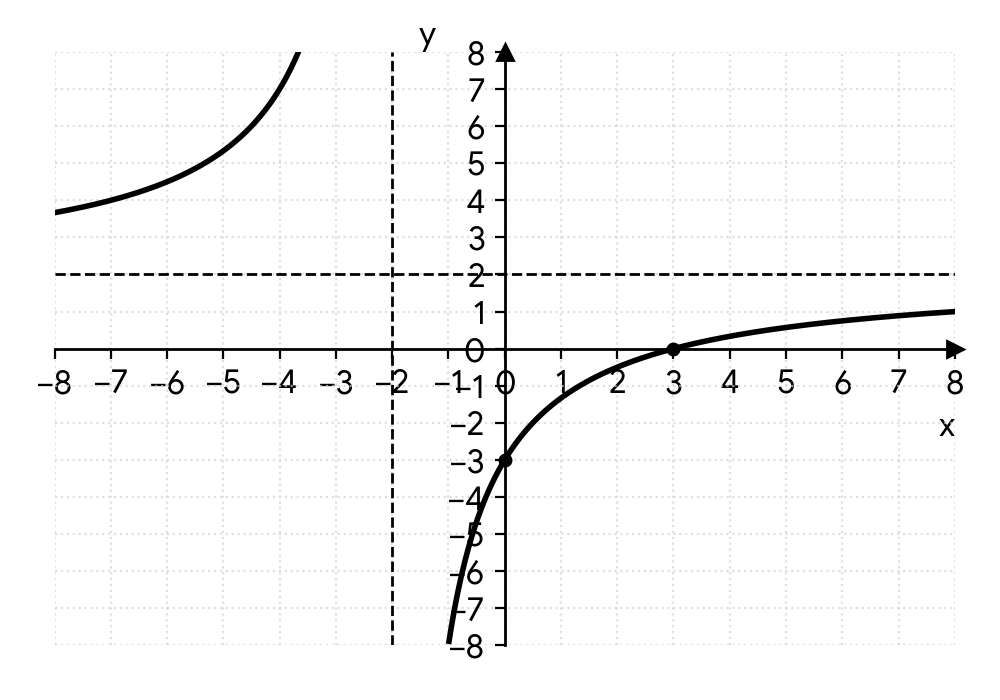
(a) Find the value of and the value of .
(b) Describe a sequence of transformations that maps the graph of onto the graph of .
Substitute the coordinates of the x-intercept and y-intercept into the function's equation to create a system of two linear equations with two variables, C and D.
First, rewrite the function in the form using algebraic long division or by manipulating the numerator. Then, identify the transformations (translation, stretch, reflection) and their parameters based on the values of P, Q, and R.
No question on this page matches those filters. Try another difficulty or paper.
21 more Reciprocal & Rational functions (+ finding roots & asymptotes) questions in the app
Every answer is marked mark by mark, IB-style, and the AI tutor helps when you are stuck.
Where marks are lost
- Using your own wrong value after failing a "show that".