Graph features (max / min, axis intercepts, symmetry, vertex, asymptotes & intercepts (GDC)): notes and practice questions
- Key properties: max/min points, x-/y-axis intercepts, symmetry, vertex (quadratics), and asymptotes (rational/exponential functions).
- Found using derivatives, algebra, or GDC tools.
- Asymptotes:
- Vertical at where the denominator is 0.
- Horizontal from end behavior of as .
How it is examined
A Paper 2 subtopic by construction, since the guidance says "using graphing technology". The mark is for the value, but a bare value with no evidence of a method can still be capped, so a sketch of the GDC screen or a stated equation helps. `Find`, `Write down`. 2 to 4 marks.
- Determine key features of graphs.
- Finding the points of intersection of two curves or lines using technology.
Linking questions
- Links to other subjects: production possibilities curve model, market equilibrium (economics).
Practice questions
67 questions · 7 easy · 38 medium · 22 hardQuestion 1
EasyPaper 1 · no calculator7 marksConsider the function , for .
Find the and intercepts.
Find the equations of the vertical and horizontal asymptotes.
Find the inverse function .
To find the intercept solve and to find the intercept calculate .
In a rational function , the vertical asymptote is while the horizontal asymptote is .
To solve for the inverse function interchange x and y then solve for the new y.
Question 2
MediumPaper 1 · no calculator7 marksConsider the functions and , where and .
The graph of is obtained by two transformations of the graph of .
Describe these two transformations.
The -intercept of the graph of is at .
Given that the maximum value of is less than or equal to 1, find the largest possible value of .
Look at how the input to the cosine function has changed, and how the entire function has been shifted vertically.
First, determine the maximum value of in terms of . Use the given condition to find the minimum possible value for . Then, calculate the y-intercept, , and use your result for to find the largest possible value of .
Question 3
HardPaper 1 · no calculator9 marksA function is defined by , where .
The graph of is shown below.
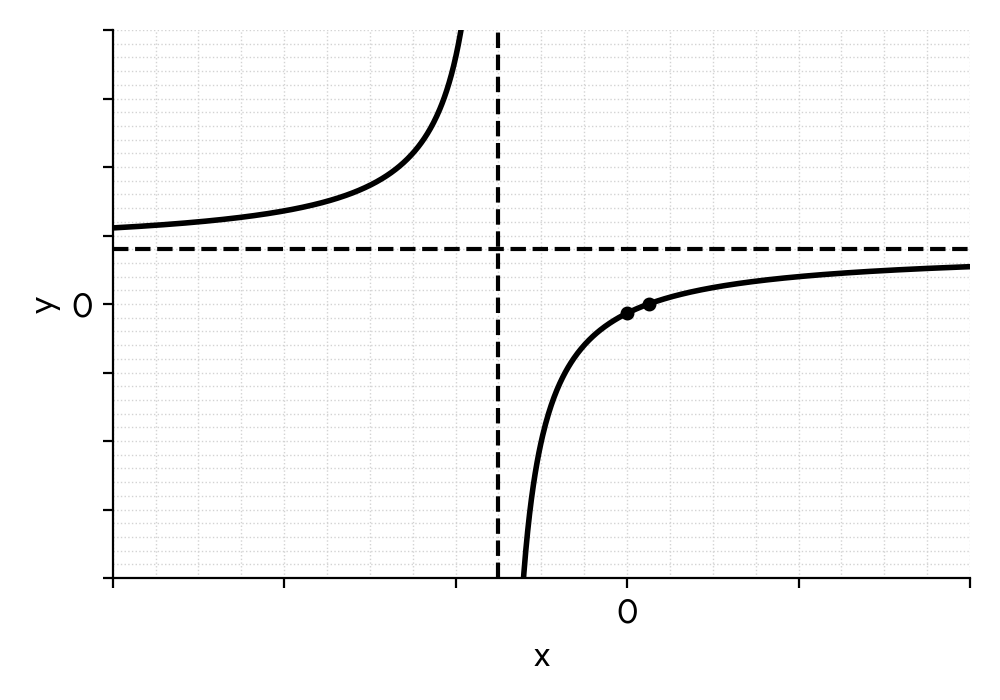
(a) Write down the equation of the horizontal asymptote.
Consider the function , where .
(i) Write down the number of solutions to for .
(ii) Determine the value of such that has only one solution for .
(iii) Determine the range of values for for which has two distinct solutions for .
The horizontal asymptote is determined by the behavior of the function as approaches . For a rational function where the degree of the numerator and denominator are the same, the asymptote is the ratio of the leading coefficients.
The line passes through the y-intercept of . Sketch a line with a negative slope passing through this point on the given graph. How many times does it intersect the curve ?
A single solution occurs when the line is tangent to the curve . Since the line always passes through the y-intercept of the curve, the point of tangency must be the y-intercept. Therefore, the slope of the line, , must be equal to the gradient of the curve at that point. Alternatively, you can set up the equation , rearrange it into a quadratic, and use the discriminant or analyze the roots.
From the previous part, you found the two solutions for in terms of . One solution is always . For there to be two distinct solutions for , what condition must the other solution satisfy?
Question 4
EasyPaper 1 · no calculator4 marksConsider the function .
(a) State the largest possible domain for the function .
(b) State the largest possible range for the function .
(c) Find the coordinates of any points where the curve intersects the and -axes.
The domain of a rational function is all real numbers except for the values of x that make the denominator zero.
The range is restricted by the horizontal asymptote. Find the value that approaches as becomes very large by considering the ratio of the coefficients of in the numerator and denominator.
The y-intercept is found by calculating . The x-intercept is found by solving the equation .
Question 5
MediumPaper 1 · no calculator7 marksThe function is defined by for , .
(a) Find the zero of .
(b) For the graph of , write down the equation of
(i) the vertical asymptote;
(ii) the horizontal asymptote.
(c) Find , the inverse function of .
To find the zero of a function, you need to find the value of for which the function's output is zero. For a rational function, when is the fraction equal to zero?
A vertical asymptote occurs where the function is undefined. For a rational function, where does this happen?
Consider the behavior of the function as approaches positive or negative infinity. What value does the function approach?
To find the inverse function, start by writing . Then, interchange the roles of and and solve the resulting equation for .
Question 6
HardPaper 1 · no calculator7 marksConsider the functions and , where and .
The graph of is obtained by two transformations of the graph of .
(a) Describe these two transformations.
The -intercept of the graph of is at .
(b) Given that the maximum value of is 1, find the value of .
Look at the changes inside the cosine function for the horizontal transformation and the changes outside the function for the vertical transformation. Remember the sign conventions for translations.
First, find the maximum value of the function in terms of . Use the given information that this maximum value is 1 to find the value of . Then, calculate the -intercept, , by evaluating .
Question 7
EasyPaper 1 · no calculator5 marksLet .
(a) Find the coordinates of the -intercept.
(b) Write down the equation of the vertical asymptote.
(c) Find the equation of the horizontal asymptote.
The x-intercept occurs when the function's value is zero, i.e., . For a rational function, when is the fraction equal to zero?
A vertical asymptote occurs where the function is undefined. For a rational function, this happens when the denominator is equal to zero.
To find the horizontal asymptote, consider the behavior of the function as approaches positive or negative infinity. What is the ratio of the leading terms of the numerator and the denominator?
Question 8
MediumPaper 1 · no calculator7 marksThe function is defined by for .
(a) Find the zero of .
(b) For the graph of , write down the equation of
(i) the vertical asymptote;
(ii) the horizontal asymptote.
(c) Find , the inverse function of .
To find the zero of a function, you need to find the value of for which the function's output is zero. For a rational function, this occurs when the numerator is equal to zero.
The vertical asymptote of a rational function occurs at the x-value(s) for which the denominator is zero, provided the numerator is not also zero at that x-value.
For a rational function where the degree of the numerator and the denominator are the same, the horizontal asymptote is the line .
To find the inverse function, start by writing the function as . Then, swap the variables and . Finally, rearrange the equation to make the subject. This new expression for is the inverse function.
Question 9
HardPaper 1 · no calculator14 marksA function is defined by . The following diagram shows part of the graph of .
The graph has a vertex at V and intersects the y-axis at point P.
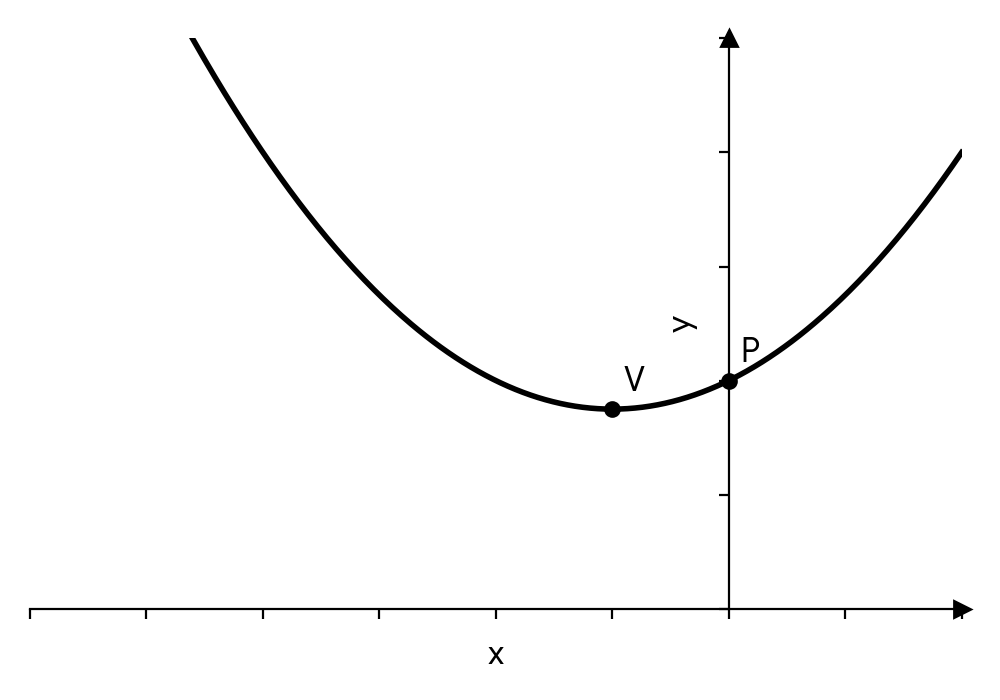
(a) Find the coordinates of the vertex V.
(b) Write down the coordinates of the y-intercept, P.
(c) The line L is the normal to the graph of at point P. Find the equation of L, giving your answer in the form .
(d) The line L intersects the graph of at a second point, Q. Calculate the distance between P and Q.
The x-coordinate of the vertex of a parabola can be found using the formula . Alternatively, you can find the derivative and solve for . Once you have the x-coordinate, substitute it back into the function to find the y-coordinate.
The y-intercept of a graph occurs when the x-coordinate is 0. Substitute into the function .
First, find the derivative of . Then, evaluate the derivative at the x-coordinate of P to find the gradient of the tangent. The gradient of the normal is the negative reciprocal of the tangent's gradient. Finally, use the point-slope form to find the equation of the line.
To find the coordinates of Q, set the equation for the function equal to the equation for the line L and solve the resulting quadratic equation for x. One solution will be the x-coordinate of P. The other will be for Q. Substitute this new x-value back into either equation to find the y-coordinate of Q. Finally, use the distance formula.
Question 10
EasyPaper 1 · no calculator5 marksA function is defined by .
(a) The asymptotes of the graph of are a vertical line and a horizontal line which intersect at the point . Find the value of and the value of .
(b) The graph of passes through the point . Find the value of .
Recall how the vertical and horizontal asymptotes of a rational function are determined by the denominator and the degrees of the polynomials and respectively.
If a graph passes through a certain point, the coordinates of that point must satisfy the function's equation. Substitute the known values of , , , and into the equation for .
Question 11
MediumPaper 1 · no calculator15 marksA function is defined by , for .
The following diagram shows part of the graph of .
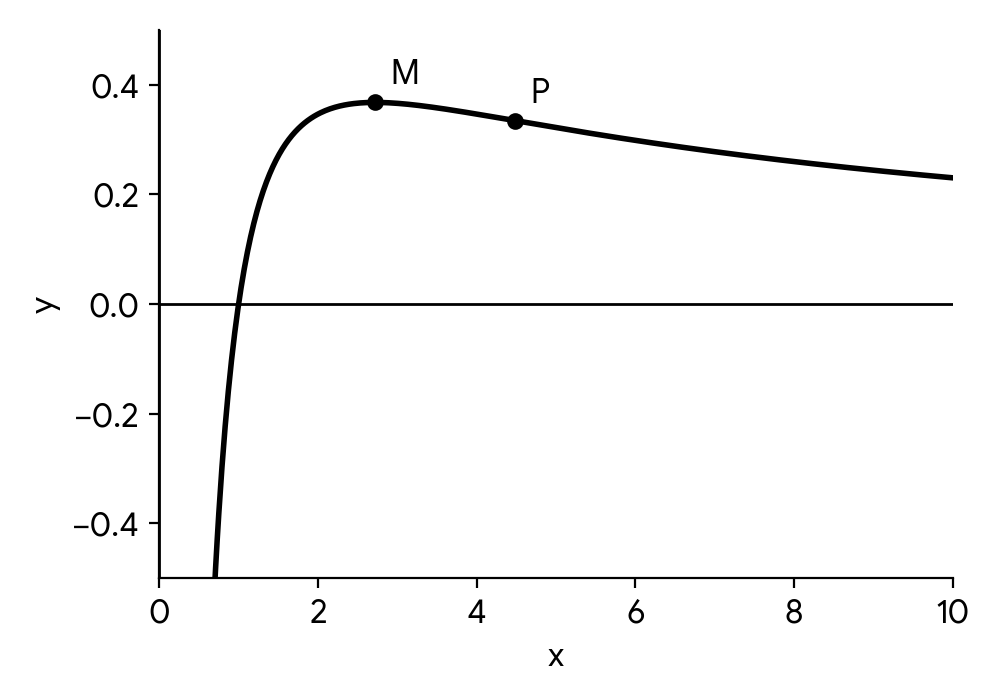
(a) Find the coordinates of the x-intercept of the graph of .
(b) Find .
The graph of has a local maximum at point M.
(c) Hence, find the exact coordinates of M.
(d) (i) Show that .
The graph of has a point of inflection at point P.
(d) (ii) Hence, find the exact coordinates of P.
The x-intercept is the point where the graph crosses the x-axis. At this point, the y-coordinate is zero. Set and solve for .
To differentiate a function that is a fraction of two other functions, you should use the quotient rule: .
A local maximum occurs at a stationary point, where the first derivative is equal to zero. Set your expression for from part (b) to zero and solve for . Then, substitute this -value back into the original function to find the corresponding -coordinate.
You need to find the second derivative, , by differentiating . You will need to use the quotient rule again.
A point of inflection occurs where the second derivative changes sign. This can happen where . Set the expression for to zero and solve for . Then find the corresponding -coordinate.
Question 12
HardPaper 2 · calculator20 marksA civil engineer is analyzing the structural integrity of a new bridge design. The deflection of a certain point on the bridge, , in millimeters, is modeled by the function , where represents the horizontal distance in meters from a central support. The model is valid for , , .
Find the value of and the value of .
Find an expression for .
The graph of has exactly one point of inflexion.
Find the x-coordinate of the point of inflexion.
Sketch the graph of for , showing the values of any axes intercepts, the coordinates of any local maxima and local minima (if they exist), and giving the equations of any asymptotes.
Consider a related model for stress distribution, for , .
Find the equations of all the asymptotes on the graph of .
The engineer needs to identify the regions where the bridge deflection is less than mm. Solve for .
The function is undefined when the denominator is zero. Set the denominator equal to zero and solve for x.
Use the quotient rule for differentiation: If , then .
A point of inflexion occurs where the second derivative, , is zero or undefined, and the concavity changes. You may need to use a GDC to find the root of .
Identify vertical and horizontal asymptotes, x and y-intercepts. Determine if there are any local maxima or minima by analyzing the first derivative. Plot key points and sketch the curve's behavior around asymptotes.
For vertical asymptotes, set the denominator to zero. For oblique asymptotes, perform polynomial long division to express in the form .
Rearrange the inequality to have zero on one side. Find the critical values by setting the numerator and denominator to zero. Use a sign table or graph to determine the intervals where the inequality holds.
Question 13
EasyPaper 1 · no calculator5 marksA function is defined by , for .
(a) The graph of has a horizontal asymptote with equation . Write down the value of .
(b) The graph of has an -intercept at . Find the value of .
(c) Find the coordinates of the -intercept of the graph of .
The horizontal asymptote of a function of the form is given by the line . Compare this general form to the given function .
An -intercept at means the graph passes through the point . Substitute these coordinates into the function's equation, along with the value of you found in part (a). Then, solve for .
The -intercept occurs where the graph crosses the -axis. What is the value of at this point? Substitute this value of into the function's equation using the values of and you have found.
Question 14
MediumPaper 2 · calculator6 marksThe amplitude of a sound wave, , is modeled by a composite function , where is time in seconds. The initial signal is given by , and the amplification stage is defined by .
(a) Find .
On the following grid, sketch the graph of for . Write down and clearly label the coordinates of any local maximum or minimum points.
Recall that . Substitute the expression for into .
Use your GDC to plot the function and find the local extrema within the given domain. Remember to label the axes and the coordinates of the points.
Question 15
HardPaper 2 · calculator16 marksA company models the efficiency of a new production line by the function , where represents the output rate (in units per hour) after hours of operation. For mathematical analysis, we consider the function over its natural domain , .
For the graph of f,
write down the equation of the vertical asymptote;
find the equation of the horizontal asymptote.
Find .
Using an algebraic approach, show that the graph of is obtained by a reflection of the graph of f in the y-axis followed by a reflection in the x-axis.
The graphs of f and intersect at and , where .
Find the value of p and the value of q.
Hence, find the area enclosed by the graph of f and the graph of .
The vertical asymptote of a rational function occurs where the denominator is zero, provided the numerator is not also zero at that point.
To find the horizontal asymptote of a rational function where the degree of the numerator and denominator are the same, consider the ratio of the leading coefficients as .
To find the inverse function, replace with , then swap and , and finally rearrange the equation to make the subject again.
A reflection in the y-axis transforms to . A subsequent reflection in the x-axis transforms to . You need to show that this sequence of transformations results in .
The intersection points of a function and its inverse often lie on the line . You can solve to find these points.
The area enclosed by two curves and between and is given by . Use your GDC to evaluate the definite integral.
Question 16
EasyPaper 1 · no calculator3 marksConsider the function , where is a constant and .
(a) Write down the equation of the horizontal asymptote of the graph of .
(b) The vertical and horizontal asymptotes of the graph of intersect at the point . Find the value of .
Consider the behavior of the function as approaches positive or negative infinity. What value does the term approach?
First, determine the equation of the vertical asymptote from the function's definition. The x-coordinate of the intersection point of the asymptotes must be the value where the vertical asymptote is located.
Question 17
MediumPaper 2 · calculator5 marksConsider the function .
On the following axes, sketch the graph of for .
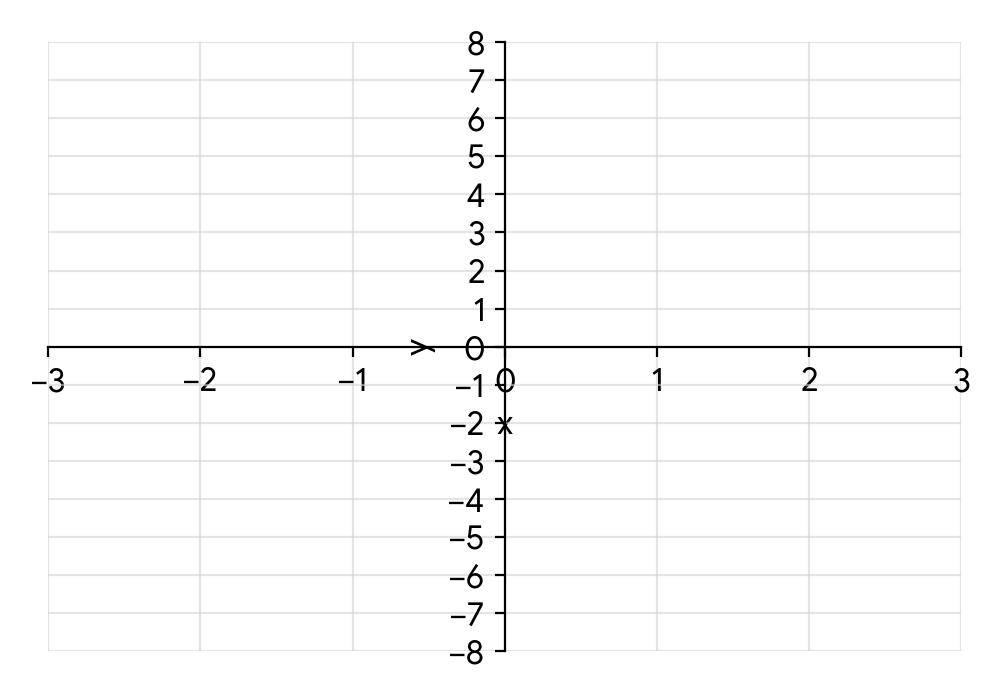
The function is defined by .
The graph of is obtained from the graph of (from part a) by a horizontal stretch with scale factor , followed by a vertical translation of units.
Find the value of and the value of .
To sketch the graph accurately, identify key features such as x-intercepts (roots), the y-intercept, local minimum or maximum points, and the function's values at the endpoints of the given domain. You may need to use a GDC to find the roots and the exact coordinates of the local minimum.
Consider how the input changes to for a horizontal stretch and how a constant is added or subtracted for a vertical translation. Compare the form of to .
Question 18
HardPaper 2 · calculator21 marksThe growth of a bacterial colony, , in a petri dish can be modelled by the logistic differential equation
where is the time measured in hours and are positive constants.
The constant represents the maximum number of bacteria the petri dish can sustain indefinitely due to limited nutrients.
In the context of this bacterial growth model, interpret the meaning of .
Show that .
Hence show that the bacterial colony will grow at its maximum rate when . Justify your answer.
Hence determine the maximum value of in terms of and .
Let be the initial number of bacteria.
By solving the logistic differential equation, show that its solution can be expressed in the form
.
After 5 hours, the number of bacteria is . It is known that .
Find the value of for this bacterial growth model.
Consider what a derivative represents in a physical context, especially when it's a quantity with respect to time.
You will need to differentiate with respect to . Remember that is a function of , so implicit differentiation or the chain rule will be necessary. Consider expanding the expression for first, or using the product rule.
To find the maximum rate of growth, you need to find the maximum of . This involves setting the second derivative, , to zero. Remember to justify that it is indeed a maximum.
Substitute the value of at which the growth rate is maximum into the original differential equation.
This is a separable differential equation. Separate the variables and use partial fractions to integrate the term involving . Remember to apply the initial condition ( when ) to find the constant of integration.
Substitute the given values for , , and into the solution obtained in part (e) and solve for . Remember will cancel out.
Question 19
EasyPaper 2 · calculator5 marksA freshly baked cake is taken out of an oven and placed on a wire rack to cool in a kitchen.
The temperature of the cake, , after minutes is modelled by the function , for .
(a) Find the initial temperature of the cake.
(b) Find the temperature of the cake after 20 minutes.
(c) Write down the temperature of the kitchen.
The initial temperature occurs at the exact moment the cake is taken out of the oven, which corresponds to .
Substitute into the given temperature function and evaluate it using your calculator.
Consider what happens to the value of as becomes very large. What temperature will the cake eventually cool down to?
Question 20
MediumPaper 2 · calculator5 marksA scientist is studying the growth of a certain bacterial culture. The population, in thousands, at time hours is modeled by the function .
On the following axes, sketch the graph of for .
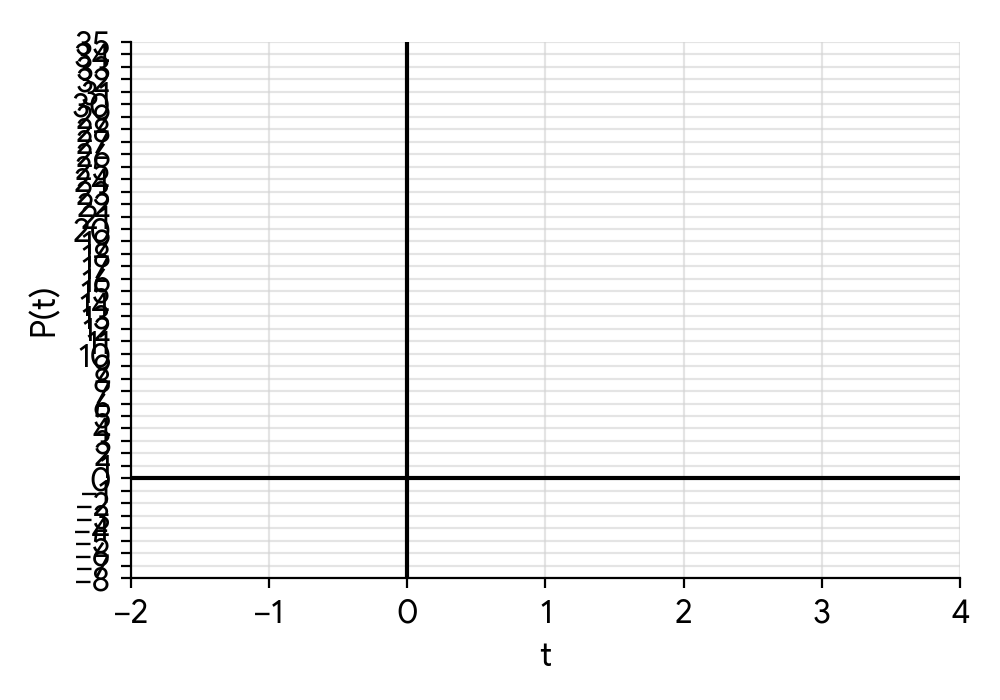
Another bacterial culture, observed under different conditions, has its population modeled by the function .
The graph of is obtained from the graph of by a horizontal stretch with scale factor , followed by a vertical translation of units.
Find the value of and the value of .
Use your GDC to find the key features of the function, such as the intercepts, local minimum, and the values at the endpoints of the given interval. Pay attention to the overall shape of the exponential function.
Recall how horizontal stretches and vertical translations affect the function notation. If is transformed to by a horizontal stretch with scale factor and a vertical translation of units, then . Substitute into the expression for and compare it to .
No question on this page matches those filters. Try another difficulty or paper.
47 more Graph features (max / min, axis intercepts, symmetry, vertex, asymptotes & intercepts (GDC)) questions in the app
Every answer is marked mark by mark, IB-style, and the AI tutor helps when you are stuck.
Where marks are lost
- Using your own wrong value after failing a "show that".